


Creative Testing for Facebook Ads: Why Most Tests Fail and How to Fix Yours
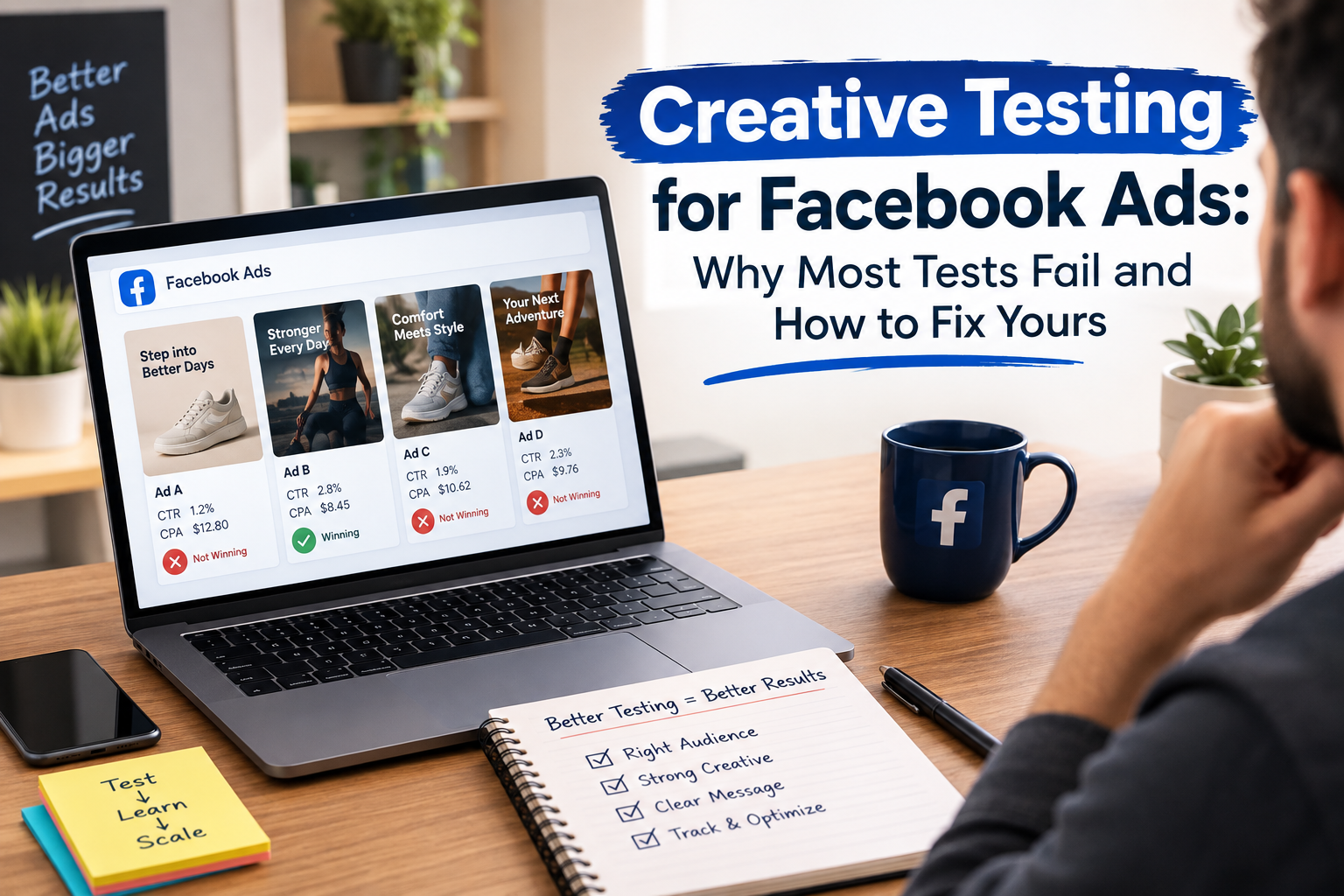
Every advertiser has run a test that ended with a shrug. Three ads, a week of spend, and a dashboard where nothing clearly won. So the budget moved on, a new batch of creatives went live, and the same thing happened again.
The problem is rarely the ads. It is the way the test was built. In this article, I'll break down why most creative tests on Facebook and Instagram fail and share a simple approach that gives you answers you can actually act on.
Why Most Creative Tests Fail
Too Many Variables at Once
The most common mistake is changing everything between ads: a new hook, a new image, a new offer and a new headline. When one ad wins, you have no idea why. Was it the opening line? The visual? The discount? Without that answer, you cannot repeat the win.
No Clear Question Behind the Test
Good tests start with a question, such as “Does a problem-first hook beat a result-first hook for this product?” Weak tests start with “let's see what happens.” If you do not know what you are trying to learn, any result will feel inconclusive.
Judging Too Early
Checking results after a few hours leads to emotional decisions. Early data is noisy, and an ad that looks like a loser on day one can recover once delivery settles. Setting rules in advance protects you from cutting ads too soon or keeping bad ones too long.
Testing Small Changes Before Big Ideas
Many teams spend weeks comparing two shades of button color while the core message has never been tested. A different angle usually moves results far more than a different font. Test the big levers first.
Build a Testing Structure That Gives Clear Answers
A simple creative testing structure removes most of the guesswork. It does not need to be complicated, but it does need to be consistent.
Separate Testing From Scaling
Keep your proven ads in one campaign and run new ideas in a separate testing campaign. This stops experimental ads from disrupting what already works, and it keeps your results clean. When a test ad proves itself, move it into the scaling campaign.
Test One Variable at a Time
Pick one element to change and keep everything else the same. The usual order of importance looks like this:
• Angle: the core reason someone should care (saving time, saving money, social proof, status).
• Hook: the first three seconds of a video or the headline of a static ad.
• Format: UGC, static image, carousel or a polished video.
• Offer and CTA: discount, bundle, free shipping or a guarantee.
Start at the top. A winning angle with an average hook will usually beat a weak angle with a perfect hook.
Write the Rules Before You Launch
Decide in advance what counts as a winner. For example, a target cost per purchase, a minimum spend per ad, and the number of days the test must run. When the numbers come in, you follow the rules instead of your gut.
A Simple 5-Step Testing Process
1. Research first. Read customer reviews, comments and support messages to find real pain points and the words buyers use.
2. Form a hypothesis. For example: “Ads that lead with the customer's frustration will earn a lower cost per click than ads that lead with the product.”
3. Build three to five variations that change only the variable you are testing.
4. Run the test long enough to gather meaningful data, then review hook rate, hold rate, click-through rate and cost per purchase together.
5. Document the result and turn the winner into new variations, so every test feeds the next one.
The documentation step is the one most teams skip, and it is the one that compounds. After a few months, you will have a clear picture of which angles, hooks and formats your market responds to.
Which Metrics Actually Matter
No single metric tells the full story. A high click-through rate means little if nobody buys, and a low cost per click means little if the traffic never converts. Read the numbers as a chain:
• Hook rate: are people stopping to watch?
• Hold rate: do they stay past the first few seconds?
• Click-through rate: does the message make them want to learn more?
• Cost per purchase or lead: does the whole journey pay for itself?
If the hook rate is low, fix the opening. If people watch but do not click, fix the message or the offer. If they click but do not buy, look at the landing page and the funnel after the ad.
When to Get Expert Support
Some brands can build this process internally. Others struggle because creative, campaign setup and tracking are all connected, and a problem in one area looks like a problem in another. Working with an experienced Meta ads specialist can shorten the learning curve, because the person planning the creative also understands how budgets, audiences and delivery will affect the test.
Final Thoughts
Creative testing is not about finding one lucky winner. It is about building a system that teaches you something new with every round of ads. Test one variable at a time, write your rules before you launch, and record what you learn so each test makes the next one smarter.
Do this consistently and your ad account stops being a guessing game. Instead of hoping the next batch of creatives works, you will know why they

 English
 Arabic
 French
 Spanish
 Portuguese
 Deutsch
 Dutch
 Italiano
 Russian
 Romaian
 Portuguese (Brazil)
 Greek