


Nitrogen Oxide Control Systems Market 2036 Outlook: USD 13.7 Billion; China Growth 6.9%, UK 6.4%, Germany 6.3%
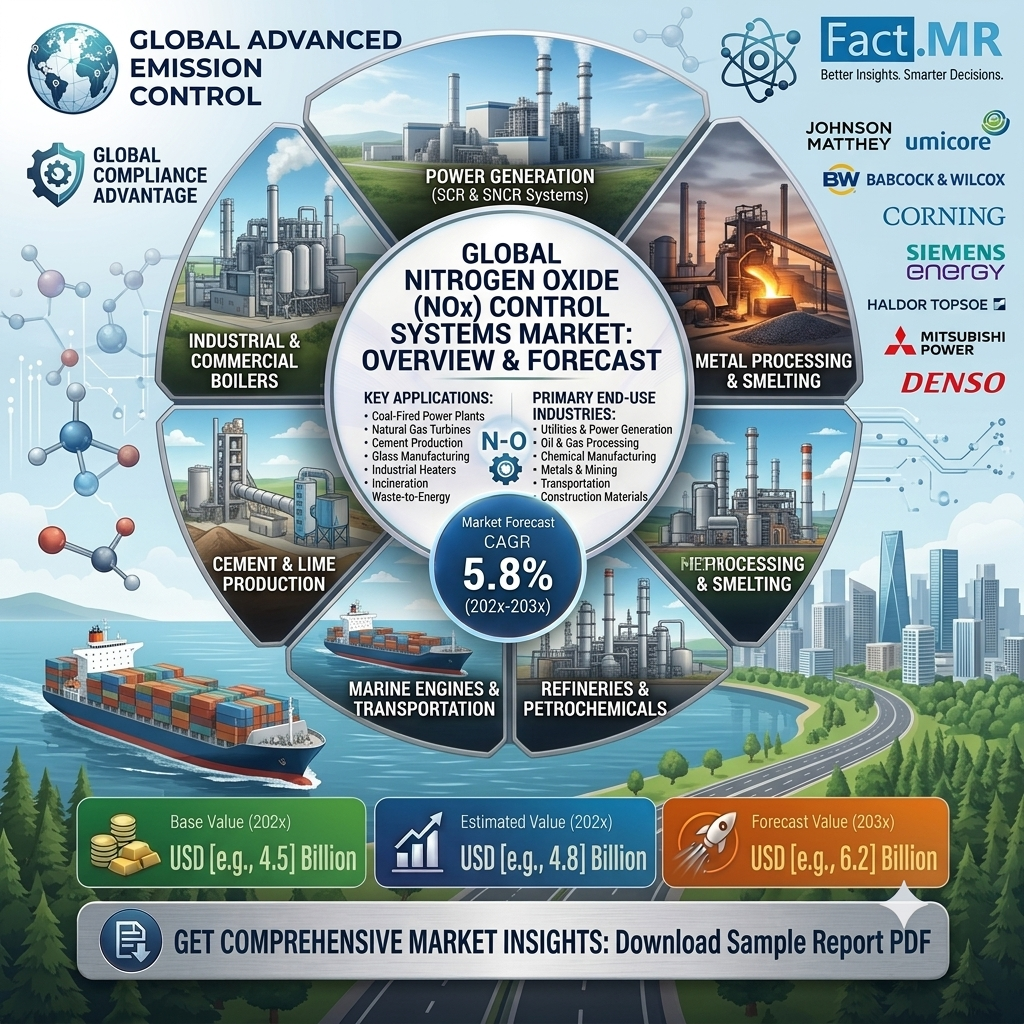
The nitrogen oxide control systems market is expected to increase from USD 7.7 billion in 2026 to USD 13.7 billion by 2036, registering a 6.0% CAGR over the forecast period. According to Fact.MR, the market was valued at USD 7.5 billion in 2025. Increasing enforcement of industrial emission standards and rising demand for effective nitrogen oxide reduction technologies are supporting market expansion. Power generation facilities, cement manufacturers, refineries, and chemical processing plants are investing in emission control equipment to meet environmental compliance requirements.
Industrial combustion processes remain a major source of nitrogen oxide emissions, creating sustained demand for selective catalytic reduction (SCR), selective non-catalytic reduction (SNCR), and advanced flue gas treatment systems. Aging thermal power plants are also upgrading existing emission control infrastructure to comply with changing regulatory limits. At the same time, improvements in catalyst materials and digital monitoring technologies are helping industrial operators maintain consistent emission reduction performance.
Get detailed market forecasts, competitive benchmarking, and pricing trends:
https://www.factmr.com/connectus/sample?flag=S&rep_id=14795
Selective Catalytic Reduction Systems Retain Leading Position
By technology, selective catalytic reduction systems are projected to account for 46% of the nitrogen oxide control systems market in 2026. Their leading position is supported by high nitrogen oxide removal efficiency and compatibility with industrial combustion equipment. SCR systems use catalytic reactions involving ammonia or urea-based reducing agents to convert nitrogen oxides into nitrogen and water.
These systems are widely integrated into power plants, industrial boilers, and other combustion facilities requiring continuous exhaust gas treatment. Their ability to maintain pollutant reduction performance across varying operating temperatures makes them suitable for regulated industrial environments.
Energy and utilities represent another major segment, accounting for 44% of market demand in 2026. Thermal power plants, gas turbines, and industrial boilers require emission control technologies to reduce nitrogen oxide concentrations within permitted limits. Continuous power generation operations also increase the importance of dependable flue gas treatment equipment.
China, United Kingdom, and Germany Show Strong Growth Potential
China is projected to register a 6.9% CAGR between 2026 and 2036, making it the fastest-growing country among those assessed in the report. Expanding industrial combustion infrastructure and increasing installation of flue gas treatment systems are supporting demand. The March 2024 ultra-low emission standards update for thermal power plants, referenced by Fact.MR, is contributing to the adoption of denitrification technologies. Growing requirements across power generation and heavy manufacturing are also encouraging investment in advanced emission reduction equipment.
The United Kingdom is expected to advance at a 6.4% CAGR through 2036. Industrial emission compliance requirements and continued installation of catalytic reduction technologies are supporting market development. Fact.MR references a February 2024 Environment Agency compliance update associated with industrial emissions regulation. Process industries are increasingly incorporating SCR and SNCR systems to manage nitrogen oxide concentrations and maintain environmental compliance.
Germany is forecast to expand at a 6.3% CAGR during the same period. Its established manufacturing sector and strict industrial environmental requirements are supporting demand for nitrogen oxide abatement systems. The October 2023 Federal Immission Control Act regulatory update cited in the report is associated with greater adoption of industrial flue gas purification technologies. Demand also reflects the need to modernize emission treatment equipment across regulated manufacturing facilities.
India is expected to grow at a 6.6% CAGR through 2036. Increasing deployment of emission control equipment across thermal power plants and heavy industrial operations is contributing to market expansion. Fact.MR also identifies the January 2024 National Clean Air Programme implementation update as a factor supporting industrial pollution control investment.
The United States is projected to record a 6.0% CAGR, supported by replacement demand and modernization of established industrial emission control infrastructure. Clean Air Act compliance requirements continue to influence SCR installation and industrial exhaust treatment investments.
Competitive Landscape
Competition in the nitrogen oxide control systems market includes established environmental engineering companies and industrial emission treatment technology providers. Key companies profiled by Fact.MR include Siemens AG, Mitsubishi Heavy Industries Ltd., Babcock and Wilcox Enterprises Inc., Honeywell International Inc., CECO Environmental Corp., FLSmidth and Co. AS, Hamon Group, John Wood Group plc, Thermax Ltd., and Ducon Technologies Inc.
Companies compete through catalyst technology, emission removal efficiency, system reliability, and engineering integration capabilities. Mitsubishi Heavy Industries and Babcock and Wilcox maintain established positions in catalytic and non-catalytic reduction technologies, while Siemens and Honeywell support industrial emission management through automation and monitoring capabilities.
Industrial buyers evaluate suppliers based on regulatory compliance, equipment performance, maintenance requirements, and lifecycle costs. Long-term engineering support and compatibility with existing combustion infrastructure remain important procurement considerations.
Technology and Regulatory Developments Shape the Market
The market is undergoing a gradual shift toward integrated catalytic emission control technologies. Fact.MR highlights increasing adoption of advanced SCR systems as industrial operators seek higher nitrogen oxide removal efficiency than basic combustion modification methods can provide. Improved catalyst materials and digital monitoring systems are also influencing equipment development.
Regulatory enforcement remains a central demand driver. The U.S. Clean Air Act and European industrial emissions requirements support continued investment in nitrogen oxide reduction equipment. Retrofit projects across aging power plants and industrial facilities are creating opportunities for technology providers capable of integrating new systems with existing exhaust treatment infrastructure.
However, high installation costs, catalyst maintenance requirements, and regulatory uncertainty can affect investment decisions. Manufacturers are therefore focusing on improving system efficiency and operational reliability while addressing the technical challenges associated with different combustion environments.
As industrial emission standards continue to influence infrastructure investment, nitrogen oxide control systems are expected to remain important across power generation and heavy manufacturing. Fact.MR's outlook indicates continued demand for catalytic reduction technologies, equipment modernization, and advanced emission monitoring solutions through 2036.
Top Reports:
https://adamaamresearch.blogspot.com/2026/10/sanitary-diaphragm-pump-market-to.html
https://net-pals.com/blogs/58746/Sanitary-Diaphragm-Pump-Market-2036-Forecast-USD-1-33-Billion
https://acmingle.com/blogs/32559/Sanitary-Diaphragm-Pump-Market-to-Reach-USD-1-33-Billion
About Fact.MR
Fact.MR is a market research and consulting company providing market intelligence, competitive analysis, and forecasting across global industries. Its research supports businesses with data-driven insights into emerging markets, technology trends, competitive dynamics, regional opportunities, and changing demand patterns.

 English
 Arabic
 French
 Spanish
 Portuguese
 Deutsch
 Turkish
 Dutch
 Russian
 Romaian
 Portuguese (Brazil)
 Greek