


How to Choose a Website Development Company: A Practical Guide for Growing Businesses
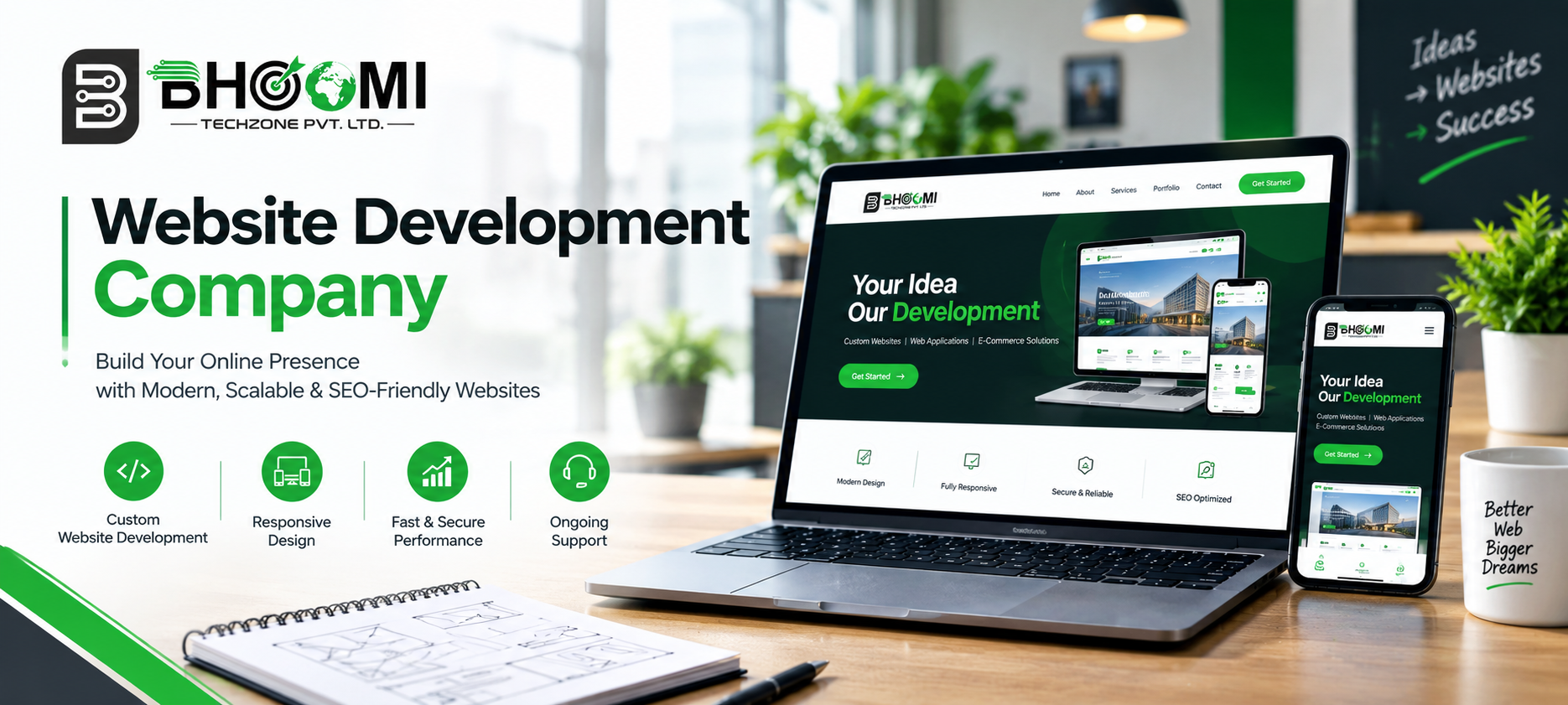
Quick Answer: A website development company plans, designs, builds, and maintains websites for businesses. To choose a good one, compare at least three providers on relevant portfolio work, technical skills, SEO readiness, post-launch support, and written ownership terms. Then pick the team with the clearest scope and communication, not simply the lowest price.
Choosing a website development company is one of the first major technology decisions a growing business makes. The right partner builds a site that loads quickly, works on every device, and supports your sales goals. The wrong one leaves you with a slow, hard-to-update website and a bill that keeps growing.
This guide explains what the work involves, how the process runs, what affects cost, and how to compare your options. You will also find a checklist of questions to ask before signing anything, plus a section for businesses in Delhi NCR that prefer a Noida-based team.
What Does a Website Development Company Do?
A website development company designs, builds, tests, launches, and maintains websites for businesses. Its work covers planning, interface design, front-end and back-end coding, content management setup, security, and ongoing support.
Most teams split that work into three layers.
Design, development, and maintenance
Design decides how the site looks and how visitors move through it. Development turns that design into working code, including forms, payment gateways, and databases. Maintenance covers updates, backups, security patches, and bug fixes after launch.
Services beyond a basic website
Many agencies also offer related services: ecommerce development, web application development, mobile app development, SEO, digital marketing, and custom software such as CRM or ERP systems. A website development company that offers these under one roof can reduce coordination between vendors, although a specialist is sometimes the better fit for a complex project.
When Does a Business Need Professional Website Development?
A business needs professional website development when a template or do-it-yourself builder can no longer meet its needs for speed, security, custom features, or search visibility.
Startups and new businesses
New businesses need a credible online presence quickly. A professionally built site gives you clean structure, mobile responsiveness, and a base for SEO from day one.
Businesses with outdated sites
Common signs that a site needs rebuilding include slow loading, poor display on phones, broken forms, repeated security warnings, and difficulty updating content.
Industry-specific needs
Ecommerce stores need secure checkout and inventory integration. Healthcare and fintech sites need strong data protection and, depending on the market, compliance with relevant regulations. Education businesses often need learning management features and student logins. A website development company with experience in your industry will already understand these requirements.
How Does the Website Development Process Work?
The process usually follows seven steps: discovery, planning, design, development, testing, launch, and maintenance. Each step produces something you can review before the project moves on.
-
Discovery: The team learns your business goals, audience, competitors, and must-have features.
-
Planning: It prepares a sitemap, feature list, technology choice, and timeline.
-
Design: Designers produce wireframes and visual mockups for your approval.
-
Development: Developers build the front end, back end, and integrations.
-
Testing: The team checks speed, browser and device compatibility, forms, security, and accessibility.
-
Launch: The site goes live on your domain and hosting, with analytics and Google Search Console connected.
-
Maintenance: Updates, backups, and monitoring continue after launch.
How long does it take? That depends on scope. A simple informational site can often be finished within a few weeks, while a custom platform or ecommerce store with integrations can take several months. Ask any website development company for a written timeline tied to milestones rather than a single launch date.
What Affects Website Development Cost?
Cost depends on the type of site, number of pages, custom features, integrations, design complexity, content volume, and deadline. There is no single standard price, so treat any quote given without a scoping discussion with caution.
|
Cost factor |
Why it matters |
|
Site type |
A brochure site costs less to build than an ecommerce store or web application |
|
Custom features |
Booking, dashboards, and user accounts add development hours |
|
Integrations |
Payment gateways, CRM, and ERP connections need extra work |
|
Design |
Custom UI/UX takes more time than a pre-built template |
|
Timeline |
Rush deadlines usually require more resources |
|
Maintenance |
Ongoing support is a recurring cost, not a one-time one |
Template versus custom development
Template-based sites launch faster and cost less, but they limit flexibility and can carry unused code that slows pages. Custom development takes longer and costs more, yet it fits your workflows and scales with your business. Choose the option that matches your growth plans, not only your current budget.
How to Choose the Right Development Partner
To choose a website development company, check five things: relevant portfolio work, technical skills, SEO readiness, post-launch support, and clear contract terms. Compare at least three providers against the same criteria.
-
Portfolio: Look for live projects similar to yours, and open them yourself.
-
Technology: Ask which frameworks and content management systems the team uses, and why.
-
SEO readiness: Confirm the build includes clean URLs, fast loading, mobile-first design, and structured data support.
-
Security: Ask about HTTPS, backups, and update practices.
-
Support: Find out who fixes bugs after launch and how quickly.
-
Ownership: Get written confirmation that you own the source code, design files, and domain.
A simple scoring method for comparing providers
Instead of relying on a general impression, score each provider from 1 to 5 on six criteria: portfolio relevance, technical approach, SEO readiness, security practices, support terms, and communication quality. Give extra weight to the two criteria that matter most for your project. A store owner might weight security and integrations, while a service business might weight SEO readiness and speed. Add up the scores and discuss any large gaps with each provider before deciding.
Agency, freelancer, or in-house team?
|
Option |
Best for |
Main limitation |
|
Freelancer |
Small, well-defined projects |
Single point of failure and a narrower skill range |
|
Agency |
Projects needing design, development, and marketing together |
Usually costs more than a freelancer |
|
In-house team |
Large, long-term products |
Hiring and management overhead |
For most small and mid-sized businesses, an established website development company offers a workable balance of skills, accountability, and cost.
Why Location Matters: Working with a Noida-Based Team
A Noida-based team suits businesses in Delhi NCR because of shared working hours, easy in-person meetings, and familiarity with the local market. Location also matters for local search, since your website should clearly state your service area and connect to your Google Business Profile.
Bhoomi Techzone Private Limited is an IT services company. According to its website, it offers website development, mobile app development, digital marketing, SEO, ecommerce development, ERP and CRM solutions, and custom software. It describes itself as an IT solutions and software development company in Noida, serving startups, enterprises, and sectors such as healthcare, fintech, retail, and logistics. Businesses that want to see its service range before shortlisting can visit Bhoomi Techzone, a website development company in Noida.
Whichever website development company you consider, apply the same checklist. A local address helps communication, but it does not replace proof of quality.
Common Mistakes to Avoid
The most common mistakes when hiring a website development company are choosing only on price, skipping a written scope, treating SEO as an afterthought, and leaving ownership and maintenance unclear.
-
Choosing the lowest quote: Low prices sometimes hide extra charges for revisions, hosting, or plugins.
-
No written scope: Without defined features and deliverables, disputes over what was included are common.
-
Treating SEO as an add-on: Fixing site structure after launch is harder than building it correctly.
-
Ignoring speed on mobile: Many visitors browse on phones, and slow pages give them a reason to leave.
-
Unclear ownership: Some providers keep control of code or hosting accounts, so settle this in writing.
-
No maintenance plan: Outdated software becomes a security risk.
Red flags during the sales conversation
Be careful if a website development company promises guaranteed search rankings, refuses to share live projects, gives a fixed price without asking about your goals, or avoids written terms on ownership. Search engines do not allow anyone to guarantee rankings, so such a promise is a warning sign about honesty.
Questions to Ask Before You Sign
Before signing with any website development company, ask these questions:
-
Can you show live projects in my industry?
-
Who will work on my project, and who is my main contact?
-
What does the quote include, and what costs extra?
-
How will you handle SEO basics, speed, and mobile design?
-
Who owns the code, design files, and content at the end?
-
What support and maintenance do you provide after launch?
-
How do you handle revisions and change requests?
Next Steps
Start with a one-page brief covering your goals, target audience, must-have features, example sites you like, and a rough budget range. Send it to two or three providers and compare the questions they ask as much as the prices they quote. A good website development company will want to understand your business before it gives a number.
If you prefer to work with a Noida-based team, you can contact Bhoomi Techzone through bhoomitechzone.in to discuss your project.
Frequently Asked Questions
How long does it take to build a business website?
A simple site can take a few weeks, while custom or ecommerce projects can take several months. Timelines depend on scope, content readiness, and how quickly you approve designs and give feedback.
What is the difference between a template and a custom website?
A template website uses a pre-built design with limited changes. A custom website is designed and coded around your requirements. Custom builds offer more flexibility and scalability but cost more and take longer.
Does website development include SEO?
Not always. Basic technical SEO, such as clean code, fast loading, and mobile responsiveness, should be part of a good build. Ongoing SEO, such as content and link building, is usually a separate service, so confirm this in your quote.
Why is website maintenance important after launch?
Maintenance keeps a site secure, fast, and functional. It includes software updates, backups, security monitoring, and bug fixes. Without it, outdated plugins and software can create security and performance problems.
Do I need a special setup for an ecommerce website?
Yes. Ecommerce sites need product management, secure checkout, payment gateway integration, and often inventory or shipping connections. A website development company with ecommerce experience can advise whether a platform such as Shopify or WooCommerce is enough or whether a custom build makes sense.
How can I verify the quality of a website development company?
Review its live projects, test their speed and mobile performance with free tools such as Google PageSpeed Insights, ask for client references, and read independent reviews on platforms such as Google Business Profile or Clutch. Do not rely on claims alone.
Name : Bhoomi techzone
Phone: +91 81307 87194
Address: A-43, A Block, Sector 63, Noida, Uttar Pradesh 201301
Website: https://bhoomitechzone.in/

 English
 Arabic
 Spanish
 Portuguese
 Deutsch
 Turkish
 Dutch
 Italiano
 Russian
 Romaian
 Portuguese (Brazil)
 Greek