


Biologics Manuuring Market Growth, Company Revenue Share, Key Drivers & Trend Analysis By Fact.MR
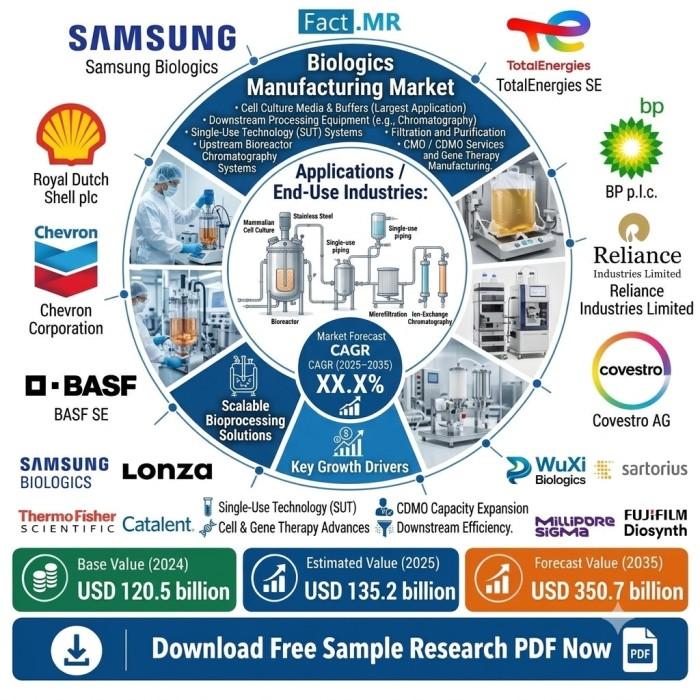
Rockville, Maryland — October 28, 2026 The global biologics manufacturing market is projected to reach USD 225.52 billion by 2036, increasing from USD 46.92 billion in 2026 at a compound annual growth rate (CAGR) of 17.0%, according to Fact.MR. The market is expected to create an incremental opportunity of USD 178.60 billion over the forecast period, highlighting the expanding commercial potential for biologics manufacturers, contract development and manufacturing organizations (CDMOs), and suppliers of specialized production technologies.
Fact.MR identifies Samsung Biologics Co., Ltd., Lonza Group AG, WuXi Biologics (Cayman) Inc., Pfizer Inc., and Novartis AG among the companies participating in the global market. Competitive positioning is influenced by manufacturing capacity, regulatory compliance, process development expertise, geographic reach, and the ability to support pharmaceutical companies from early development through commercial production.
Get detailed market forecasts, competitive benchmarking, and pricing trends:
Biologics Manufacturing Market Outlook: Key Figures
- Market size in 2026: USD 46.92 billion
- Forecast market size in 2036: USD 225.52 billion
- Market CAGR (2026–2036): 17.0%
- Incremental market opportunity: USD 178.60 billion
- Leading product segment: Monoclonal antibody manufacturing
- Leading expression system: Mammalian cell culture
- Key growth markets: USA and China
These figures reflect the market outlook presented in Fact.MR's Biologics Manufacturing Market report, covering 2026 to 2036.
What Is Driving Growth in the Biologics Manufacturing Market?
Increasing demand for biologic therapies is creating opportunities for manufacturers with specialized production capabilities. Rising disease prevalence, improvements in diagnosis, growing clinical evidence, and expanding access to advanced treatments are supporting demand across developed and emerging healthcare markets.
Biologics production also requires specialized infrastructure, technical expertise, and rigorous quality controls. As pharmaceutical and biotechnology companies manage increasingly complex development pipelines, outsourcing selected manufacturing activities can help them allocate capital, access established production platforms, and manage commercialization timelines.
Fact.MR highlights three important growth drivers:
Increasing outsourcing of biologics production: Pharmaceutical and biotechnology companies are seeking external partners for process development, manufacturing scale-up, and commercial production. This creates opportunities for CDMOs that can demonstrate reliable execution and regulatory readiness.
Growing complexity of manufacturing processes: Mammalian cell culture, Chinese hamster ovary (CHO) cell lines, and specialized biologic production workflows require technical expertise. Manufacturers with established process development and scale-up capabilities may be better positioned to serve complex projects.
Regulatory and quality requirements: Compliance requirements across major markets raise the importance of validated facilities, consistent production processes, documentation, and quality management. These requirements can favor experienced providers with established regulatory capabilities.
Which Segments Are Leading the Biologics Manufacturing Market?
Monoclonal antibody manufacturing is expected to lead the product segment in 2026. Its position reflects established clinical applications and demand across therapeutic areas. Chimeric, humanized, and fully human monoclonal antibodies are included within the broader product landscape, alongside recombinant proteins and other biologic manufacturing categories.
Mammalian cell culture is expected to account for 41.5% of the expression system segment in 2026, according to Fact.MR. CHO and HEK cell lines form part of this category, while microbial expression, insect cell expression, and plant-based systems provide additional production approaches.
Upstream processing is another important manufacturing area, encompassing cell line development, fermentation, and cell culture. Downstream processing, purification, bioreactor operations, and fill-and-finish services also contribute to the broader manufacturing value chain.
For investors and procurement leaders, these segments offer different strategic considerations. Facility investments depend on the biological product, production scale, process requirements, regulatory expectations, and the level of technical support required by customers.
Regional Opportunities: USA, China, and India
Country-level growth forecasts indicate substantial opportunities across North America, Europe, and Asia.
The USA is projected to record a CAGR of 17.9% between 2026 and 2036, the highest rate among the countries listed in Fact.MR's comparison. Established healthcare infrastructure, specialty treatment networks, and reimbursement systems influence demand for biologic therapies.
China is forecast to grow at a CAGR of 17.6%. Investments in healthcare infrastructure and domestic manufacturing capabilities are shaping the country's biologics landscape. Companies assessing this market must also consider pricing pressures, procurement conditions, and the requirements for local market access.
India is projected to expand at a CAGR of 16.8%. Growing healthcare investment, the expansion of urban tertiary-care networks, and increasing physician awareness are relevant demand factors. Cost-effectiveness remains an important consideration for procurement and commercialization strategies.
Germany is forecast to grow at a CAGR of 15.9%, followed by Japan at 15.3%, the UK at 14.7%, and South Korea at 14.1%.
For manufacturers planning capacity expansion, these forecasts support a country-by-country assessment of demand, regulatory requirements, production economics, and supply-chain resilience rather than a uniform global investment strategy.
Top Companies in the Biologics Manufacturing Market
Fact.MR identifies the following companies in its competitive landscape:
1. Samsung Biologics Co., Ltd.
2. Lonza Group AG
3. WuXi Biologics (Cayman) Inc.
4. Pfizer Inc.
5. Novartis AG
6. Amgen Inc.
7. Johnson & Johnson
8. Bristol Myers Squibb Company
9. AbbVie Inc.
10. F. Hoffmann-La Roche Ltd.
This list reflects companies identified in the report; it is not a ranking of market positions.
The competitive landscape encompasses organizations with different business models and capabilities. Specialized manufacturing providers compete on production infrastructure, process development, quality systems, and their ability to support customers across development stages. Pharmaceutical companies participate through biologic portfolios, therapeutic expertise, and established commercial networks.
Fact.MR reports that Samsung Biologics accounts for approximately 17% of the global market. This figure is the report's stated estimate and should be interpreted within its market definition and methodology.
For decision-makers, competitive analysis should extend beyond company size. Manufacturing capacity, technology transfer, regulatory track records, service integration, intellectual property protection, and geographic diversification can influence partner selection and long-term commercial performance.
Challenges and Strategic Opportunities for Manufacturers
Despite the favorable forecast, market expansion does not eliminate operational constraints. Fact.MR identifies manufacturing capacity limitations, lengthy lead times for production slots, demanding regulatory requirements, and technology transfer complexities as important challenges.
Building and maintaining compliant facilities can require substantial capital and specialized personnel. Smaller manufacturers may face barriers when establishing the certifications and quality systems needed to serve customers across multiple jurisdictions.
At the same time, expanding biologic development pipelines create opportunities for integrated service providers. Companies offering process development, analytical testing, manufacturing, and fill-and-finish services can address more stages of the production lifecycle.
Supply-chain diversification is another strategic consideration. Pharmaceutical companies seeking to reduce dependence on individual production locations may evaluate manufacturing partners across North America, Europe, and Asia-Pacific. Providers that combine technical expertise with dependable delivery and transparent quality systems may be better placed to compete for outsourcing contracts.
What the Forecast Means for Industry Decision-Makers
The projected increase to USD 225.52 billion by 2036 provides a basis for evaluating investment priorities across biologics manufacturing. However, market growth alone does not establish the commercial viability of an individual facility, technology platform, or outsourcing agreement.
Manufacturers should assess demand by product type, expression system, manufacturing stage, and target geography. Procurement teams can compare partners on available capacity, compliance history, technology transfer capabilities, and continuity planning. Investors should examine capital requirements, utilization prospects, customer concentration, and the time required to establish commercial production.
Fact.MR's forecast provides a market-level framework for these assessments. Company-specific investment decisions require additional evaluation of operating performance, contracts, capacity commitments, and competitive conditions.
About the Fact.MR Biologics Manufacturing Market Report
Fact.MR's Biologics Manufacturing Market report examines market size and forecasts for 2026–2036 across product categories, expression systems, manufacturing processes, product stages, service types, and regions. Its coverage includes country-level growth assessments and a competitive landscape analysis of companies participating in the market.
Explore More Related Studies Published by Fact.MR Research
Percutaneous Screw Placement Systems Market
About Fact.MR
Fact.MR is a market research and consulting firm providing syndicated research, customized research, investment research, and market intelligence across a broad range of industries. Its research coverage includes food and beverage, healthcare, pharmaceuticals, biotechnology, consumer products, chemicals and materials, technology, industrial goods, and packaging.
Fact.MR provides market intelligence designed to help organizations understand market dynamics, emerging opportunities, competitive developments, and changing industry requirements.
Media Contact
Fact.MR
Email: sales@factmr.com
Phone: +1 (628) 251-1583
Website: www.factmr.com

 English
 Arabic
 French
 Spanish
 Portuguese
 Deutsch
 Dutch
 Italiano
 Russian
 Romaian
 Portuguese (Brazil)
 Greek