


1. Disease-Modifying MS Therapies Market: Key Players, Regional Trends, and Growth Forecast
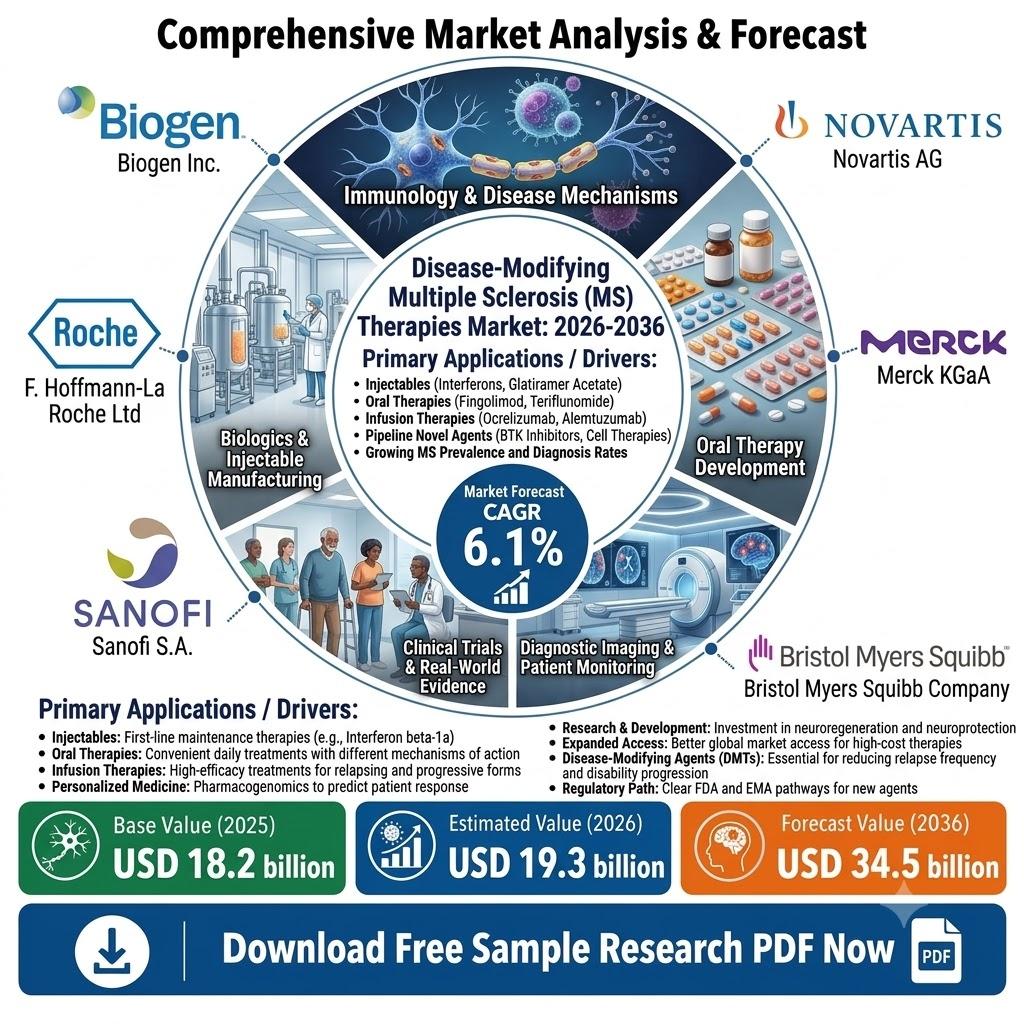
The disease-modifying multiple sclerosis therapies market is projected to grow at a 6.4% CAGR through 2036, supported by early high-efficacy treatment adoption, expanding therapeutic options for progressive MS, and advances in long-term disease management.
October 29, 2026 — The global disease-modifying multiple sclerosis therapies market is projected to increase from USD 30.32 billion in 2026 to USD 56.21 billion by 2036, according to Fact.MR, representing a compound annual growth rate (CAGR) of 6.4% over the forecast period. Market expansion reflects the growing emphasis on early intervention, improved treatment outcomes, and therapies designed to slow the progression of multiple sclerosis (MS).
The shift toward high-efficacy treatment is influencing prescribing decisions across major healthcare markets. Pharmaceutical companies are also expanding their research efforts to improve treatment safety and convenience while addressing unmet needs in progressive forms of MS. These developments are creating opportunities for established drug manufacturers and biotechnology companies focused on next-generation disease-modifying therapies.
Get detailed market forecasts, competitive benchmarking, and treatment trends https://www.factmr.com/connectus/sample?flag=S&rep_id=13506
Disease-Modifying Multiple Sclerosis Therapies Market Forecast Reflects Changing Treatment Priorities
Fact.MR's analysis identifies oral therapies as the leading product segment, with a projected 36.1% share in 2026. Relapsing-remitting multiple sclerosis (RRMS) accounts for an estimated 62.7% of the application segment, while hospital pharmacies are expected to represent 43.7% of end-user demand.
Disease-modifying therapies help reduce inflammatory disease activity and the frequency of relapses in multiple sclerosis. Depending on the medicine, they can also reduce new lesion formation and delay aspects of disease progression. Treatment selection depends on disease activity, individual patient circumstances, safety considerations, and clinical guidance.
The move toward earlier use of effective treatments is an important market driver. Neurologists increasingly assess the potential benefits of controlling disease activity before substantial neurological damage accumulates. However, treatment decisions require a careful balance between efficacy, adverse effects, monitoring requirements, and patient preferences.
The market's expansion also reflects continuing research into therapies for progressive MS. Although treatment options have advanced, primary progressive and secondary progressive forms of the disease continue to present challenges, particularly when disability progression occurs independently of relapses.
Oral Therapies Strengthen Their Position in Product Demand
Oral therapies are projected to hold a 36.1% share of the market in 2026. Their position reflects patient interest in convenient administration and the availability of medicines that can be taken outside infusion settings.
Oral disease-modifying therapies vary in their mechanisms of action, efficacy, monitoring requirements, and safety profiles. Their suitability depends on the patient's clinical condition and the medicine's prescribing requirements. For pharmaceutical manufacturers, developing oral treatments with favorable benefit-risk profiles remains an important area of competition.
Injectable therapies continue to serve patients who benefit from established treatment options, while monoclonal antibodies offer high-efficacy approaches for selected patients. The choice between these categories depends on disease severity, previous treatment response, tolerability, and the risks associated with individual medicines.
As treatment options expand, manufacturers must demonstrate meaningful clinical benefits and communicate the evidence supporting their products. Long-term safety data and real-world treatment outcomes can influence physician confidence and reimbursement decisions.
Relapsing-Remitting MS Remains the Largest Application Segment
Relapsing-remitting MS is expected to account for 62.7% of the application segment in 2026. This form of the disease is characterized by episodes of new or worsening neurological symptoms followed by periods of partial or complete recovery.
Its large share reflects the established use of disease-modifying therapies to reduce relapse frequency and inflammatory activity. A broad range of treatment options allows neurologists to select therapies according to disease activity, patient needs, and the potential benefits and risks of treatment.
Progressive forms of MS represent an important area of unmet medical need. Primary progressive MS involves gradual worsening from disease onset, while secondary progressive MS develops after an earlier relapsing-remitting course. Treatment strategies differ across these forms, and the potential to slow disability progression remains a major focus of research.
For drug developers, advances in neuroprotection and remyelination could create future opportunities beyond conventional approaches to controlling inflammation. However, these areas require further clinical evidence to establish whether investigational treatments can preserve or restore neurological function.
Hospital Pharmacies Lead Distribution
Hospital pharmacies are projected to account for 43.7% of end-user demand in 2026. Their position reflects the specialized requirements associated with many MS medicines, including procurement, storage, treatment coordination, and monitoring.
Some therapies require infusion facilities or closer clinical supervision, while others involve laboratory monitoring and ongoing assessment of adverse effects. Hospital-based healthcare teams can coordinate these requirements with neurologists and other specialists.
Specialty neurology clinics and retail pharmacies also contribute to treatment access. Their roles vary according to the medicine, local healthcare infrastructure, reimbursement arrangements, and whether prescriptions are managed through specialist or community settings.
High treatment costs remain a significant constraint. Affordability, insurance coverage, public reimbursement, and access to specialist care can influence whether patients initiate or continue therapy. These factors are particularly relevant in markets where advanced treatments are not consistently available across public and private healthcare systems.
Regional Growth: India Leads the Market Forecast
Fact.MR projects varying growth rates across the countries covered in its forecast. India leads with an 8.4% CAGR from 2026 to 2036, followed by China at 8.2% and Brazil at 7.9%. The United States is projected to grow at 7.3%, while the United Kingdom records a 6.3% CAGR. Germany and France are forecast to expand at 6.2% and 6.1%, respectively.
India's growth outlook reflects the potential for improved diagnosis, broader treatment availability, and the expansion of specialist neurological services. Greater access to generic medicines and biosimilars may also influence affordability, although access to advanced therapies remains uneven.
China's market is supported by improving diagnostic capabilities and changes in treatment access. Domestic pharmaceutical development and potential competition from biosimilars could influence pricing and adoption over the forecast period.
In Brazil, growth depends partly on the availability of disease-modifying therapies through public healthcare and private insurance. Reimbursement decisions and the capacity of healthcare systems to fund higher-cost treatments will remain important factors.
The United States benefits from a broad range of approved therapies and established specialist treatment networks. However, payer coverage, formularies, and out-of-pocket costs can affect access to individual medicines.
In the United Kingdom, cost-effectiveness assessments influence the availability of newer treatments through the National Health Service. Germany and France also evaluate clinical benefit, safety, and economic value when making reimbursement decisions. These differences are likely to shape the pace at which new therapies reach patients across mature European markets.
Competitive Landscape and Strategic Priorities
The competitive landscape includes Biogen Inc., F. Hoffmann-La Roche Ltd, Novartis AG, Sanofi S.A., and Merck KGaA. These companies compete through established MS medicine portfolios, ongoing clinical development, and efforts to improve treatment efficacy, safety, and administration.
Competition increasingly centers on demonstrating sustained clinical benefits and addressing the needs of patients whose disease remains active despite existing treatment. Research into progressive MS, neuroprotection, and remyelination could influence the next phase of therapeutic development, although the commercial potential of emerging approaches depends on clinical results and regulatory approval.
Pharmaceutical companies must also consider pricing and reimbursement requirements when planning launches across different countries. Strong clinical evidence can support treatment adoption, but access ultimately depends on affordability, healthcare infrastructure, and local prescribing practices.
For investors and industry stakeholders, the market offers opportunities across established disease-modifying medicines and emerging therapeutic approaches. Assessing individual companies requires attention to approved indications, clinical pipeline progress, patent positions, and exposure to competitive pricing pressures.
View Related Reports:
https://ayushjadhavblogs.blogspot.com/2026/10/pleated-filter-market-to-reach-usd-4.html
https://sohomoy.com/blogs/73256/Digital-Signage-System-Market-to-Reach-USD-93-2-Billion
About Fact.MR
Fact.MR is a market research and consulting firm that provides industry analysis, market sizing, forecasts, and strategic insights to support business planning and commercial decision-making.
The disease-modifying multiple sclerosis therapies market report examines market size and forecasts, product categories, applications, end-user segments, regional growth, competitive positioning, and factors influencing treatment adoption and investment decisions from 2026 to 2036.

 English
 Arabic
 French
 Spanish
 Portuguese
 Deutsch
 Turkish
 Dutch
 Italiano
 Russian
 Romaian
 Portuguese (Brazil)