


Aerospace Plastics Market 2036 Forecast: USD 11.2 Billion, United States Leads Germany and France in Growth Rate
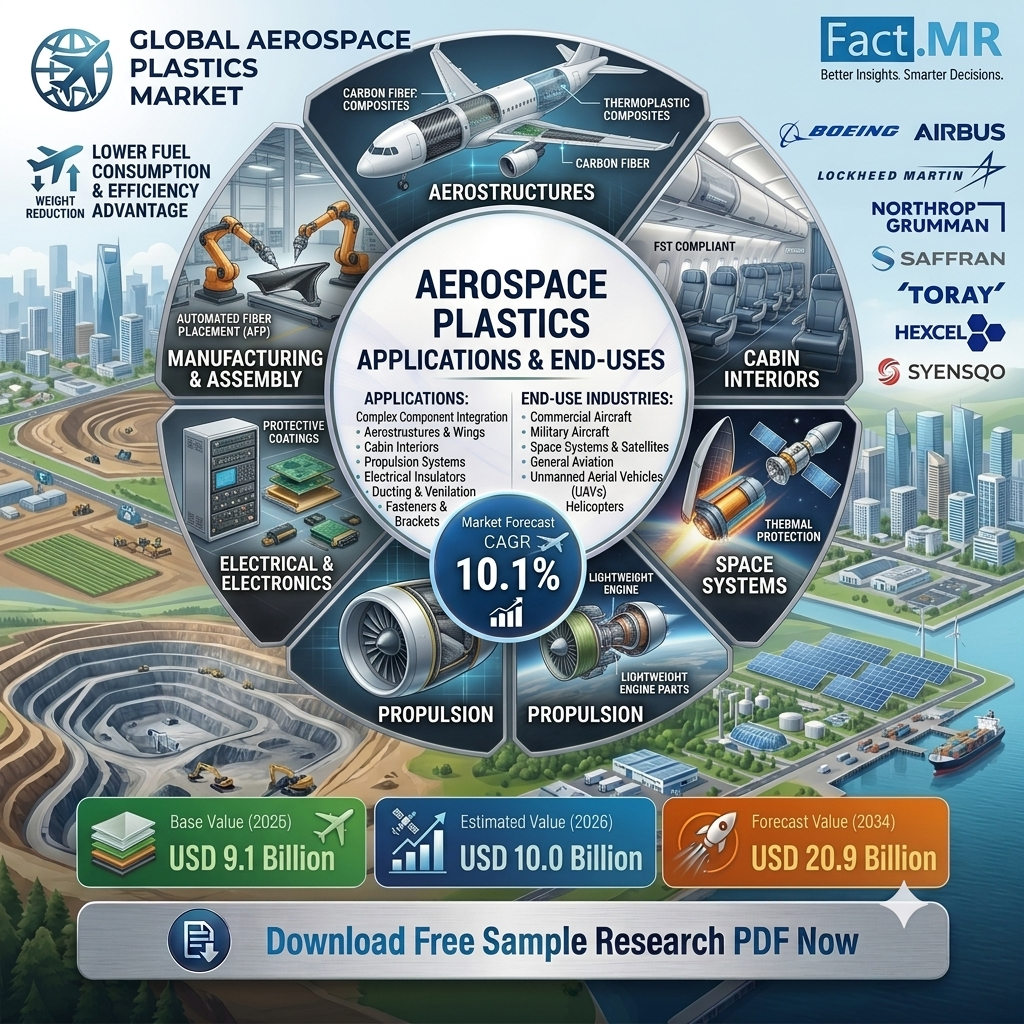
The aerospace plastics market is forecast to expand from USD 7.1 billion in 2026 to USD 11.2 billion by 2036, registering a 4.7% CAGR over the forecast period. Fact.MR attributes this expansion to increasing aircraft production, demand for lightweight materials, and the growing use of high-performance polymers in aircraft interiors and systems components. The market was valued at USD 6.8 billion in 2025, with aerospace manufacturers increasingly adopting engineered plastics to reduce aircraft weight while maintaining safety and operational performance.
Aircraft manufacturers are placing greater emphasis on materials that combine lower weight with mechanical strength, thermal stability, and flame resistance. Advanced polymers are being incorporated into cabin panels, seating components, electrical housings, and selected structural applications. Rising demand for commercial aircraft and continued investment in cabin modernization are also supporting the adoption of certified plastic components. Maintenance, repair, and overhaul providers contribute to demand through aircraft refurbishment and replacement programs.
Get detailed market forecasts, competitive benchmarking, and pricing trends:
https://www.factmr.com/connectus/sample?flag=S&rep_id=4736
PEEK, PEKK, and PAEK Polymers Retain Leading Position
By polymer type, PEEK, PEKK, and PAEK polymers are expected to account for 34.0% of the aerospace plastics market in 2026. Their ability to withstand elevated temperatures, resist chemicals, and maintain mechanical strength supports adoption in demanding aerospace applications. These high-performance materials are increasingly relevant for aircraft systems where conventional plastics may not meet operational requirements.
Cabin interiors represent another major area of demand, projected to capture 45.0% of the market in 2026. Lightweight plastic panels, seating components, and interior fittings help aircraft manufacturers reduce overall weight while maintaining passenger comfort and material performance. Aircraft cabin modernization programs are also creating opportunities for suppliers of certified engineering plastics.
Commercial aircraft are anticipated to account for 62.0% of market demand in 2026, supported by passenger aircraft production and the substantial volume of polymer components required in cabin and systems applications. Business aviation and defense aircraft also use specialized plastics for premium interiors and demanding operating environments.
Injection molding is expected to represent 38.0% of the market by processing method in 2026. Its ability to produce consistent components with controlled dimensions makes it suitable for aircraft cabin parts, brackets, and systems housings. By end use, original equipment manufacturers are projected to hold 54.0% of market demand as aircraft production programs continue specifying qualified polymer materials.
United States, Germany, and France Show Strong Growth Potential
The United States is expected to record the fastest growth among the countries assessed, with aerospace plastics demand increasing at a 5.2% CAGR from 2026 to 2036. Aircraft production, aftermarket cabin upgrades, and the country's established aerospace manufacturing base are supporting demand. According to the Aerospace Industries Association, the U.S. aerospace and defense industry generated USD 995 billion in total business activity in 2024. Continued demand for certified cabin materials and defense-related components is creating opportunities for aerospace polymer suppliers.
Germany is projected to advance at a 4.5% CAGR during the same period. Its established aerospace engineering capabilities, aircraft interior manufacturing, and precision component production are supporting the adoption of high-performance plastics. German suppliers increasingly use PPS and PAEK materials in applications requiring thermal stability, flame resistance, and consistent processing characteristics. Material certification and technical support remain important considerations for manufacturers supplying aircraft programs.
France is forecast to register a 4.3% CAGR through 2036, supported by aircraft assembly and aerospace systems manufacturing. Airbus reported consolidated revenue of EUR 73.4 billion in 2025 and a commercial aircraft backlog of 8,754 aircraft at year-end. Aircraft production programs are creating continued demand for qualified plastics used in cabin panels, electrical housings, and systems components. French aerospace suppliers also require materials that meet established performance and certification standards.
Mexico is expected to grow at a 4.9% CAGR through 2036 as aerospace manufacturing clusters support North American aircraft supply chains. Component manufacturing and demand for molded housings are encouraging the use of engineering plastics. The United Kingdom is projected to register a 4.0% CAGR, supported by aircraft wing manufacturing, defense aerospace programs, and the use of high-temperature polymers in specialized components.
Competitive Landscape
Competition in the aerospace plastics market includes established specialty polymer manufacturers with expertise in advanced materials, technical support, and aerospace qualification requirements. Key companies profiled by Fact.MR include Victrex plc, SABIC, Arkema S.A., Evonik Industries AG, and Syensqo SA/NV.
These manufacturers supply engineered polymer materials for aircraft interiors, electrical components, and other demanding aerospace applications. Competitive positioning increasingly depends on material performance, certification documentation, processing consistency, and the ability to support aircraft manufacturers throughout component development and qualification.
Aircraft manufacturers and tier suppliers evaluate polymer grades based on flame resistance, mechanical durability, traceability, and long-term performance. Suppliers offering technical assistance and qualified material portfolios are better positioned to participate in aerospace manufacturing programs.
Technology and Regulatory Developments Shape the Market
The aerospace plastics market is experiencing growing demand for high-temperature polymers and advanced manufacturing methods. Materials such as PEEK, PEKK, PAEK, PPS, and PEI are being evaluated for applications where weight reduction must be balanced with thermal performance and mechanical reliability.
Additive manufacturing is also creating opportunities for low-volume aircraft components and prototype development. Thermoforming continues to support lightweight cabin panels, while injection molding remains important for repeatable production of precision components.
Regulatory compliance remains a major consideration. The U.S. Federal Aviation Administration's 14 CFR 25.853 requirements establish flammability standards for aircraft compartment interior materials. Polymer suppliers must provide testing documentation and technical evidence before new materials can receive approval for specific aerospace applications.
Certification expenses and lengthy qualification processes can limit the pace of material adoption. Nevertheless, aircraft lightweighting remains a central demand driver. Boeing's June 2025 commercial market outlook forecast demand for 43,600 new commercial jets through 2044, indicating continued requirements for aircraft materials and components.
As aerospace manufacturers pursue lower aircraft weight and improved material performance, certified engineering plastics are expected to gain further importance in aircraft production and maintenance. Continued investment in specialty polymers, manufacturing technologies, and material qualification will influence market development through 2036.
To View Top Reports
https://adamaamresearch.blogspot.com/2026/10/gluten-free-sugar-syrup-market-to.html
https://net-pals.com/blogs/59843/Gluten-Free-Sugar-Syrup-Market-2036-Outlook-USD-2-7
https://acmingle.com/blogs/33070/Gluten-Free-Sugar-Syrup-Market-2036-Projection-Stands-at-USD
About Fact.MR
Fact.MR is a market research and consulting company providing market intelligence, competitive analysis, and forecasting across global industries. Its research supports businesses with data-driven insights into emerging markets, technology trends, competitive dynamics, regional opportunities, and changing demand patterns.

 English
 Arabic
 French
 Portuguese
 Deutsch
 Turkish
 Dutch
 Italiano
 Russian
 Romaian
 Portuguese (Brazil)
 Greek