


How Can Changheng Composite Material Cutting Blades Support Stable Production
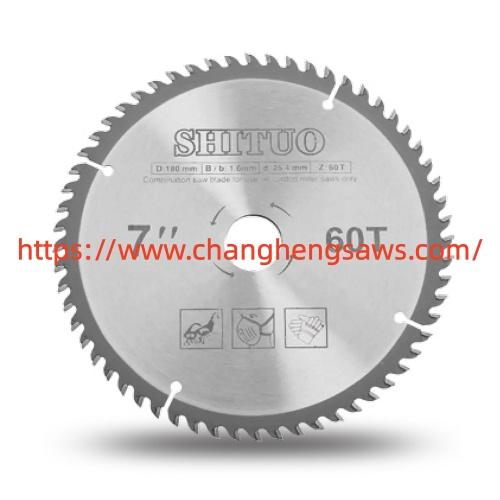
Composite Material Cutting Blades play an important role in helping manufacturers manage edge damage when processing fiber reinforced panels, laminated sheets, and other engineered workpieces. Frayed fibers, chipped edges, and surface separation can affect assembly accuracy and create additional finishing work. For production teams, reducing these problems starts with understanding how the cutting tool, machine settings, and material structure interact during each operation.
Fiber reinforced laminates behave differently from solid wood or ordinary metal sheets. Carbon fibers and glass fibers can cause abrasive wear, while the resin matrix may respond to heat and mechanical pressure in different ways. When a tool becomes dull, it may pull or tear fibers instead of cutting them cleanly. Excessive heat can also affect the resin and contribute to surface defects.
The structure of the workpiece matters as well. Fiber direction, layer arrangement, thickness, and resin type can change how the material responds to cutting forces. A process that produces a clean edge on one panel may create fraying or separation on another. Identifying these differences helps manufacturers select a suitable tool and establish workable production settings.
The cutting edge determines how force is applied to the workpiece. Tooth shape, edge geometry, abrasive construction, and tool dimensions can all influence the finished result. A conventional toothed saw may suit certain jobs, while an abrasive or carbide based design may be appropriate for materials containing hard reinforcing fibers. The right choice depends on the material composition, cutting method, machine compatibility, and required finish.
Manufacturers should consider the intended cutting method before choosing a specification. Straight cuts, curved profiles, narrow slots, and repeated panel trimming can require different tool designs. The required edge finish also matters. Parts that will be hidden inside an assembly may have different finishing requirements from components with exposed edges. Evaluating these needs before purchasing can help buyers avoid unnecessary adjustments during production.
Changheng focuses on industrial cutting solutions for manufacturing applications. When evaluating a suitable product, buyers can compare available specifications with their equipment, workpiece dimensions, and expected cutting conditions. This practical approach helps narrow the selection before production trials begin.
Even a suitable tool may produce unsatisfactory results when the machine is incorrectly adjusted. Feed rate, rotational speed, fixture stability, and workpiece support all influence cutting behavior. Excessive feed pressure can increase mechanical stress, while unsuitable speed settings may generate unnecessary heat or vibration. Operators should follow the equipment and tool manufacturer's recommendations rather than relying on a single setting for every material.
There is no single setting that works for every laminate. Operators can conduct controlled trials using representative offcuts and change one parameter at a time. This makes it easier to identify which adjustment improves the result. Recording the settings alongside the finished edge condition also helps production teams repeat successful processes across later batches.
Workholding deserves particular attention. If a panel moves or vibrates during cutting, the tool may leave an irregular edge. Supporting the workpiece close to the cutting area can help limit movement. For certain operations, leaving a small finishing allowance and removing the remaining material in a separate pass may also help manage edge quality. The appropriate method depends on the panel structure and the requirements of the finished component.
Regular inspection helps production teams identify wear before it causes repeated quality problems. Operators can check the cutting edge for visible damage, resin buildup, uneven wear, and changes in cutting behavior. A sudden increase in cutting resistance or a rise in defective parts may indicate that the tool requires cleaning, adjustment, or replacement.
Keeping records can make maintenance decisions more consistent. Useful information includes the material batch, tool specification, machine settings, operating time, and observed edge condition. Comparing these records across production runs can reveal patterns that are difficult to notice during routine operation. Dust extraction and appropriate protective equipment are also important when processing fiber reinforced materials, as cutting can release fine airborne particles.
Purchasing teams can prepare a more useful specification by sharing details about their actual production needs. Material type, reinforcement structure, panel thickness, machine model, cutting method, and required edge condition provide a practical starting point. Sample parts or photographs of existing defects can help clarify the application. Buyers should also ask about dimensional compatibility, recommended operating conditions, maintenance requirements, and application guidance.
Changheng serves buyers seeking industrial cutting solutions that match their processing requirements. Rather than selecting a product by appearance alone, manufacturers can evaluate suitable options against real workpieces and measurable quality criteria. To review available products and identify potential options for specific cutting applications, visit the Changheng product catalogue at https://www.changhengsaws.com/product/ and compare the available specifications with your production needs.

 Arabic
 French
 Spanish
 Portuguese
 Deutsch
 Turkish
 Dutch
 Italiano
 Russian
 Romaian
 Portuguese (Brazil)
 Greek