


Amusement Parks Market Size, Trends, Demand & Forecast 2026-2034
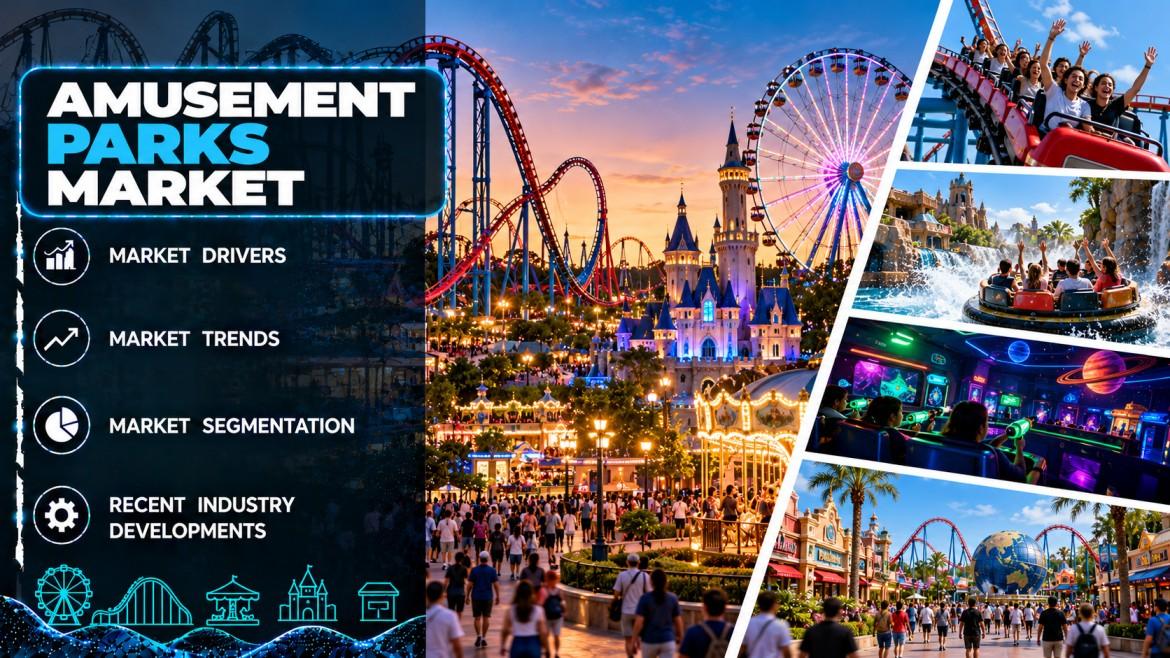
IMARC Group, a leading global market research and management consulting firm, has published its latest market intelligence report on the amusement parks market. The global amusement parks market size was valued at USD 58.73 Billion in 2025 and is projected to reach USD 84.42 Billion by 2034, exhibiting a CAGR of 3.96% during the forecast period 2026-2034, driven by recovering international tourism, rising middle-class incomes across Asia, rapid adoption of immersive attraction technologies, strong franchise-led visitor demand, and the expansion of integrated destination resorts that combine rides, hotels, dining, and retail worldwide.
The market is experiencing strong growth momentum driven by the increasing shift of parks from single-day ride venues to multi-day leisure destinations. Families, young adults, and tourist groups are seeking experiences that blend thrill rides, themed storytelling, and on-site stays, a need that operators are meeting through new lands, hotels, and entertainment districts. Global tourism has rebuilt to roughly 1.4 Billion international arrivals, which is widening the visitor pool for major operators. Simultaneously, advances in ride engineering, animatronics, and AR/VR are raising dwell time and per-guest spending, while demand-based ticketing and premium passes are helping operators capture more revenue from the same peak-season capacity.
How AI is Reshaping the Future of the Amusement Parks Market
- AI-Powered Dynamic Pricing and Demand Forecasting for Park Operators: Machine learning platforms are enabling park operators to analyze advance bookings, weather patterns, school holiday calendars, and local event data to adjust ticket prices, staffing levels, and ride capacity in real time. This is particularly valuable because most annual attendance is concentrated in roughly 90 to 120 peak days, and demand-based ticket models such as those used by Disney show how operators can lift yield per visitor without adding physical capacity.
- Intelligent Guest Experience and Personalization Through Mobile Platforms: AI-driven park apps are delivering virtual queues, personalized itineraries, and targeted food, merchandise, and hotel offers based on guest behavior and past visits. With food and beverage contributing 24.3%, hotels and resorts 16.8%, and merchandise 11.2% of total revenue, better targeting directly increases spending per guest and strengthens repeat visitation across mechanical ride, water park, and resort-led destinations.
- Predictive Maintenance and Automated Safety Monitoring for Rides: Sensor networks and AI diagnostics are being integrated into roller coasters, drop towers, and water rides to detect component wear, vibration anomalies, and structural stress before failures occur. This reduces unplanned downtime, supports compliance with strict safety and regulatory requirements across North America, Europe, and Asia Pacific, and protects operators from reputational and liability risks in a market where safety standards are non-negotiable.
Grab a sample PDF of this report: https://www.imarcgroup.com/amusement-parks-market/requestsample
Amusement Parks Market Trends and Drivers:
The global amusement parks market is witnessing steady expansion, fueled by the convergence of tourism recovery, rising discretionary incomes, and accelerating investment in immersive, franchise-driven attractions that are repositioning parks as full-scale destination resorts. Rising middle-class incomes are the foundational demand driver, particularly across Asia Pacific, which already accounts for 38.4% of global revenue, led by China, Japan, and India. Leading operators are responding with large-scale capacity additions. Disney’s parks and experiences business generates roughly USD 34 Billion in annual revenue, while the top five operators together hold an estimated 35% to 40% of global revenue, which means their expansion plans directly shape ride supplier volumes, hospitality demand, and innovation pipelines across the industry.
Immersive technology and intellectual property are emerging as both a visitor attraction and a commercial efficiency argument across the industry. Franchises from Disney, Universal, and Warner Bros. bring repeat visitation and support premium pricing, while AR/VR attractions, animatronics, and app-based personalization extend the time guests spend in the park. Mechanical rides such as roller coasters, dark rides, and drop towers hold 58.4% of the market, and ticket sales remain the largest revenue source at 42.6%, yet the faster-growing opportunity lies in resorts, food, and merchandise as operators push to convert day-trippers into multi-day guests. Sustainability-themed concepts are also gaining traction as operators respond to environmentally aware visitors in Europe and North America.
Government-backed tourism and entertainment programs are unlocking entirely new regional markets that were previously underserved. Saudi Arabia’s Vision 2030 is channeling large-scale investment into entertainment and leisure through mega-projects such as Qiddiya and NEOM, positioning the Middle East and Africa, which holds 6.5% of global revenue, as one of the highest-growth regions. Greenfield development in India and Southeast Asia, along with waterpark expansion in hot climates, is further broadening the opportunity set. At the same time, operators must manage capital intensity, as large parks can require USD 2 to 5 Billion in investment with payback periods of 10 to 20 years, along with operating margins of roughly 15% to 30%, labor cost inflation, weather dependence, and competition from streaming and at-home gaming.
Amusement Parks Industry Segmentation:
The report has segmented the market into the following categories:
Breakup By Ride Type:
- Mechanical Rides
- Water Rides
- Others
Mechanical rides account for the largest ride type segment with a 58.4% share, driven by the strong pull of roller coasters, dark rides, and drop towers that serve as the headline attractions for major parks, supported by continuous engineering innovation, themed integration, and immersive technology that keep visitors returning. Water rides follow with 32.3%, supported by waterpark expansion in hot climates.
Breakup By Revenue Source:
- Ticket Sales
- Food and Beverage
- Hotels and Resorts
- Merchandise
Ticket sales command the largest revenue source share at 42.6%, followed by food and beverage at 24.3%, hotels and resorts at 16.8%, and merchandise at 11.2%, reflecting the shift toward integrated destination resorts where on-site spending increasingly supplements gate revenue.
Breakup By Age Group:
- Up to 18 Years
- 19 to 35 Years
- 36 to 50 Years
- 51 to 65 Years
- Above 65 Years
The 19 to 35 age group represents the leading segment, driven by strong appetite for thrill rides, social-media-led experiences, themed events, and premium pass products.
Breakup By Region:
- Asia Pacific
- North America
- Europe
- Latin America
- Middle East and Africa
Asia Pacific dominates the global amusement parks market with the largest regional share of 38.4%, driven by large populations, rising disposable incomes, and heavy investment in China, Japan, and India. North America follows with 24.6%, Europe with 20.3%, Latin America with 10.2%, and the Middle East and Africa with 6.5%, where Vision 2030 projects are accelerating development.
Competitive Landscape:
The report provides a comprehensive analysis of the competitive landscape in the amusement parks market with detailed profiles of all major companies, including:
- Walt Disney Company
- Comcast (Universal Parks & Resorts)
- Merlin Entertainments
- Cedar Fair and Six Flags
- SeaWorld (United Parks & Resorts)
- Chimelong Group
- Ardent Leisure Group
- Fantawild Holdings
- IMG Worlds of Adventure
What Does The Full Report Cover?
If you are tracking the amusement parks market for investment decisions, market entry planning, competitive benchmarking, or strategic advisory, IMARC Group’s report gives you everything in one place:
- Complete market sizing with revenue projections covering the full outlook period
- Quantified growth driver analysis across ride type, revenue source, age group, and regional markets
- Sub-segment breakdowns for mechanical rides, water rides, ticket sales, food and beverage, hotels and resorts, and merchandise with individual share data
- Competitive profiles of leading operators with strategic landscape assessment
- Latest innovation trends covering AR/VR attractions, dynamic and tiered pricing, sustainability-themed concepts, and integrated destination resort development shaping competition across key regional markets
Recent News and Developments in Amusement Parks Market
- December 2025: Six Flags Qiddiya City opened in Saudi Arabia, becoming the first Six Flags park in the Kingdom. Located within the Qiddiya entertainment destination, the opening supports Vision 2030 tourism goals and signals the Middle East’s growing role in global theme park development.
- December 2025: Industry reports indicated that Universal Parks & Resorts is planning a new theme park in Saudi Arabia, reinforcing the region’s appeal for global operators seeking long-term growth beyond North America and Europe.
- July 2025: Cedar Fair and Six Flags completed their merger, creating one of the largest regional park operators in North America and giving the combined company greater scale in procurement, marketing, and season pass sales.
- May 2025: Universal Orlando Resort opened Epic Universe, its fourth theme park in Orlando, featuring multiple themed worlds and adding significant capacity and hotel demand to one of the world’s largest leisure destinations.
- November 2024: Cedar Fair and Six Flags announced their agreement to merge, a landmark consolidation aimed at improving cost efficiency and expanding the combined guest base across North America.
Key Questions This Report Answers
- What is the current global amusement parks market size and what is its projected value?
- Which ride type segment holds the largest share in the global amusement parks market?
- What are the key drivers of global amusement parks market growth?
- Which region dominates the global amusement parks market and why?
- How are immersive technology, dynamic pricing, and integrated resort development reshaping competitive strategies in the amusement parks industry?
- Who are the top companies in the global amusement parks market and what are their competitive strategies?
- What are the investment and market entry opportunities across integrated resorts, waterparks, and emerging markets in India, Southeast Asia, and the Middle East?
About Us:
IMARC Group is a global management consulting firm that helps the world’s most ambitious changemakers to create a lasting impact. The company provides a comprehensive suite of market entry and expansion services. IMARC offerings include thorough market assessment, feasibility studies, company incorporation assistance, factory setup support, regulatory approvals and licensing navigation, branding, marketing and sales strategies, competitive landscape and benchmarking analyses, pricing and cost research, and procurement research.
Media and Sales Contact
IMARC Group
Email: sales@imarcgroup.com
United States: +1-201-971-6302
India: +91-120-433-0800
United Kingdom: +44-753-714-6104

 English
 Arabic
 French
 Spanish
 Portuguese
 Deutsch
 Turkish
 Dutch
 Russian
 Romaian
 Portuguese (Brazil)
 Greek