


Global Automotive Seating Market Forecast to Hit USD 114.79 Billion by 2036, India Growing at 5.3% CAGR
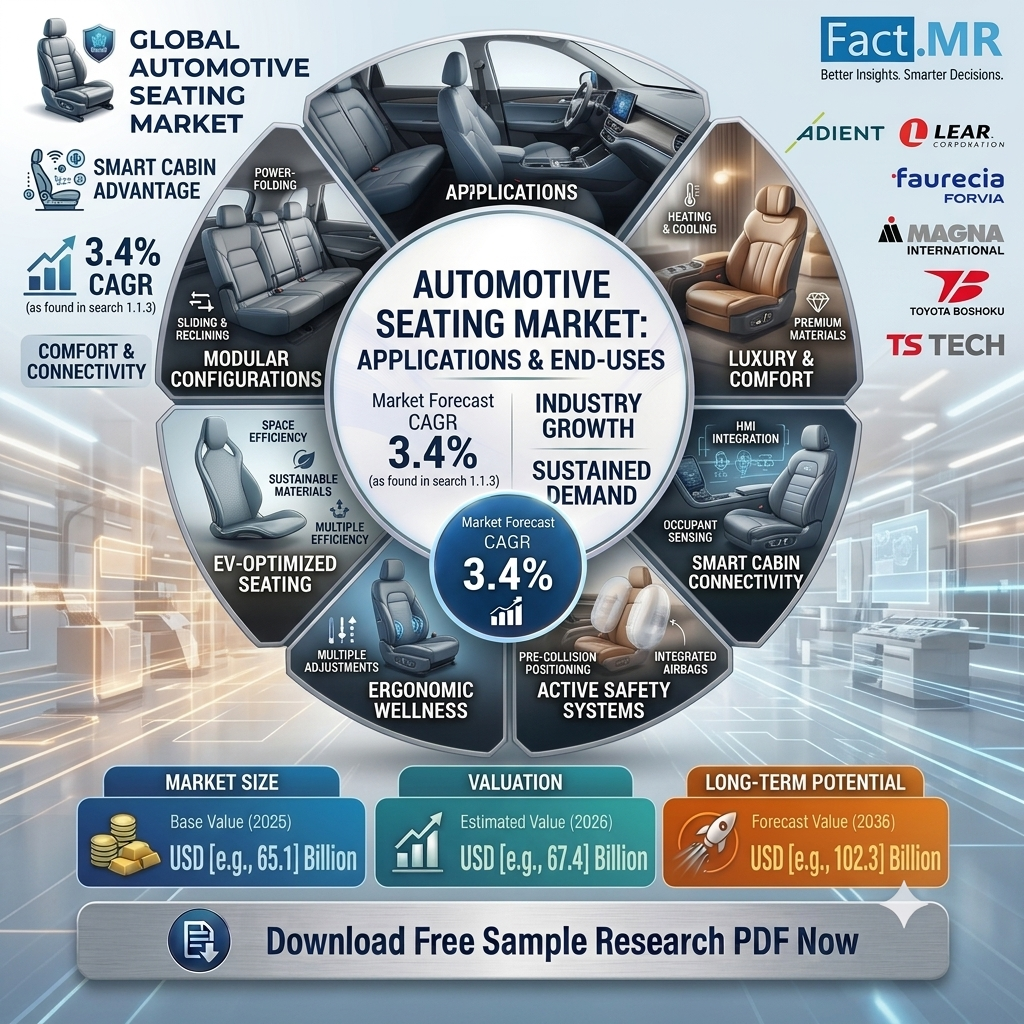
The global automotive seating market is forecast to expand from USD 74.63 billion in 2026 to USD 114.79 billion by 2036, registering a 4.4% CAGR over the forecast period. Fact.MR attributes this expansion to increasing vehicle production, rising demand for premium automotive interiors, and growing adoption of advanced seating technologies across passenger and commercial vehicles. The market was valued at USD 68.66 billion in 2025 and is expected to generate an absolute dollar opportunity of USD 40.16 billion between 2026 and 2036.
Automotive manufacturers are placing greater emphasis on passenger comfort, ergonomic design, and cabin functionality as consumer preferences shift toward vehicles with advanced interior features. Heated, ventilated, powered, and climate-controlled seats are gaining relevance across vehicle categories. The transition toward electric vehicles is also creating opportunities for modular seating arrangements and alternative cabin layouts. At the same time, automakers are increasingly considering recyclable materials and sustainability requirements when selecting seating components.
Get detailed market forecasts, competitive benchmarking, and pricing trends:
https://www.factmr.com/connectus/sample?flag=S&rep_id=42
Passenger Vehicles Retain Dominant Position
By vehicle type, passenger vehicles are expected to account for 75.0% of the automotive seating market in 2026. Their leading position is supported by sustained production of SUVs and crossover vehicles, particularly across China, India, and North America. Growing consumer preference for improved cabin comfort and premium interior features is encouraging automakers to incorporate advanced seating systems across different vehicle price categories.
Electric vehicle development is also influencing passenger vehicle seating design. Flat-floor architectures provide manufacturers with greater flexibility in seat positioning and interior configurations. Modular seat structures are becoming increasingly relevant as automakers seek to improve manufacturing efficiency while accommodating different vehicle platforms.
Leatherette and vinyl materials represent another leading segment, accounting for 24.1% of automotive seat material demand in 2026. Their durability, relatively lower cost compared with genuine leather, and compatibility with different vehicle interiors support widespread adoption. Synthetic upholstery is increasingly used across entry-level and mid-range vehicles, while premium manufacturers are also introducing alternatives to conventional leather.
The growing use of PVC-free polyurethane materials and other synthetic upholstery solutions is influencing seating material development. Manufacturers are working to balance appearance, durability, production costs, and environmental performance while maintaining compatibility with advanced seating features.
India, USA, and Germany Show Strong Growth Potential
India is projected to record the fastest growth among the countries assessed in the report, with automotive seating demand increasing at a 5.3% CAGR from 2026 to 2036. Expansion of domestic vehicle manufacturing, supported by the Production Linked Incentive scheme, is contributing to demand for automotive seating components. Growing electric vehicle production and seating upgrades are creating additional opportunities for suppliers serving domestic and international automotive manufacturers.
The USA is expected to advance at a 4.8% CAGR during the same period. Increasing demand for SUVs and light trucks, along with greater use of premium interior features, is supporting market expansion. Automotive manufacturers are placing greater emphasis on seating comfort and functionality, creating opportunities for advanced seat designs and higher-value interior components.
Germany is projected to register a 3.9% CAGR through 2036. Its established automotive manufacturing industry and increasing focus on sustainable vehicle interiors are supporting demand for innovative seating solutions. German automakers are incorporating bio-based and recycled materials into seating programs as environmental performance becomes an important consideration in component procurement and vehicle development.
China is also expected to record notable growth, with automotive seating demand advancing at a 4.6% CAGR. Expansion of new energy vehicle production and increasing integration of smart seating technologies are contributing to market development. The growing importance of advanced cabin features is encouraging manufacturers to introduce seating systems designed for evolving electric vehicle platforms.
Japan is forecast to expand at a 3.8% CAGR through 2036. Demand is supported by ergonomic seating improvements and the development of seating solutions suited to older drivers. Continued attention to vehicle comfort and functionality is influencing product development across the country's automotive industry.
Competitive Landscape
Competition in the automotive seating market includes established manufacturers with extensive product portfolios, technical capabilities, and relationships with global automotive original equipment manufacturers. Key companies profiled by Fact.MR include Lear Corporation, Recaro Automotive, Faurecia, Toyota Boshoku Corporation, Grammer Seating Systems, and Tata Autocomp Systems Limited. Other companies covered include Fisher and Company and TM Automotive Seating Systems Private Limited.
Automotive seating suppliers are increasingly competing on product quality, regulatory compliance, material innovation, and integration capabilities. Vehicle manufacturers are evaluating suppliers based on lifecycle costs, certification records, sustainability performance, and their ability to deliver seating systems across multiple vehicle platforms.
The increasing complexity of modern seating systems is also influencing supplier selection. Manufacturers capable of supporting advanced seat functionality and meeting regional technical requirements are better positioned to participate in long-term automotive procurement programs.
Technology and Sustainability Developments Shape the Market
The automotive seating industry is experiencing a technology transition as manufacturers incorporate advanced comfort features and flexible seating configurations into vehicle interiors. Heated, ventilated, powered, and massage-enabled seats are expanding beyond premium vehicle categories, creating opportunities for seating component manufacturers and technology suppliers.
Electric vehicle platforms are contributing to this transition. Changes in vehicle architecture allow automakers to explore alternative seat arrangements, while increasing attention to passenger comfort is supporting investment in ergonomic design and integrated seating technologies.
Sustainability requirements are another important influence. Automotive manufacturers are introducing recycled and bio-based materials while evaluating alternatives to conventional upholstery. European manufacturers are particularly focused on material selection and environmental performance as part of broader vehicle sustainability strategies.
High production costs remain a challenge. Fact.MR notes that automotive seats account for approximately 5% of total vehicle cost, making the integration of advanced features an important consideration for manufacturers seeking to balance comfort with affordability.
Continued investment in material development, seating technology, and manufacturing efficiency is expected to influence the automotive seating market through 2036. As vehicle manufacturers prioritize cabin comfort and sustainable interior solutions, suppliers offering adaptable seating systems are expected to find opportunities across established and emerging automotive markets.
Top Reports:
https://adamaamresearch.blogspot.com/2026/10/baby-bottle-market-to-reach-usd-642.html
https://net-pals.com/blogs/60912/Baby-Bottle-Market-2036-Forecast-USD-6-42-Billion-USA
https://acmingle.com/blogs/33540/Baby-Bottle-Market-2036-Outlook-USA-5-1-China-4
https://ikofficial.com/blogs/61616/Baby-Bottle-Market-2036-Projection-USD-6-42-Billion-USA
About Fact.MR
Fact.MR is a market research and consulting company providing market intelligence, competitive analysis, and forecasting across global industries. Its research supports businesses with data-driven insights into emerging markets, technology trends, competitive dynamics, regional opportunities, and changing demand patterns.

 English
 Arabic
 French
 Spanish
 Portuguese
 Deutsch
 Turkish
 Dutch
 Italiano
 Russian
 Romaian
 Portuguese (Brazil)