


How to Prepare for IGCSE Economics Past Papers
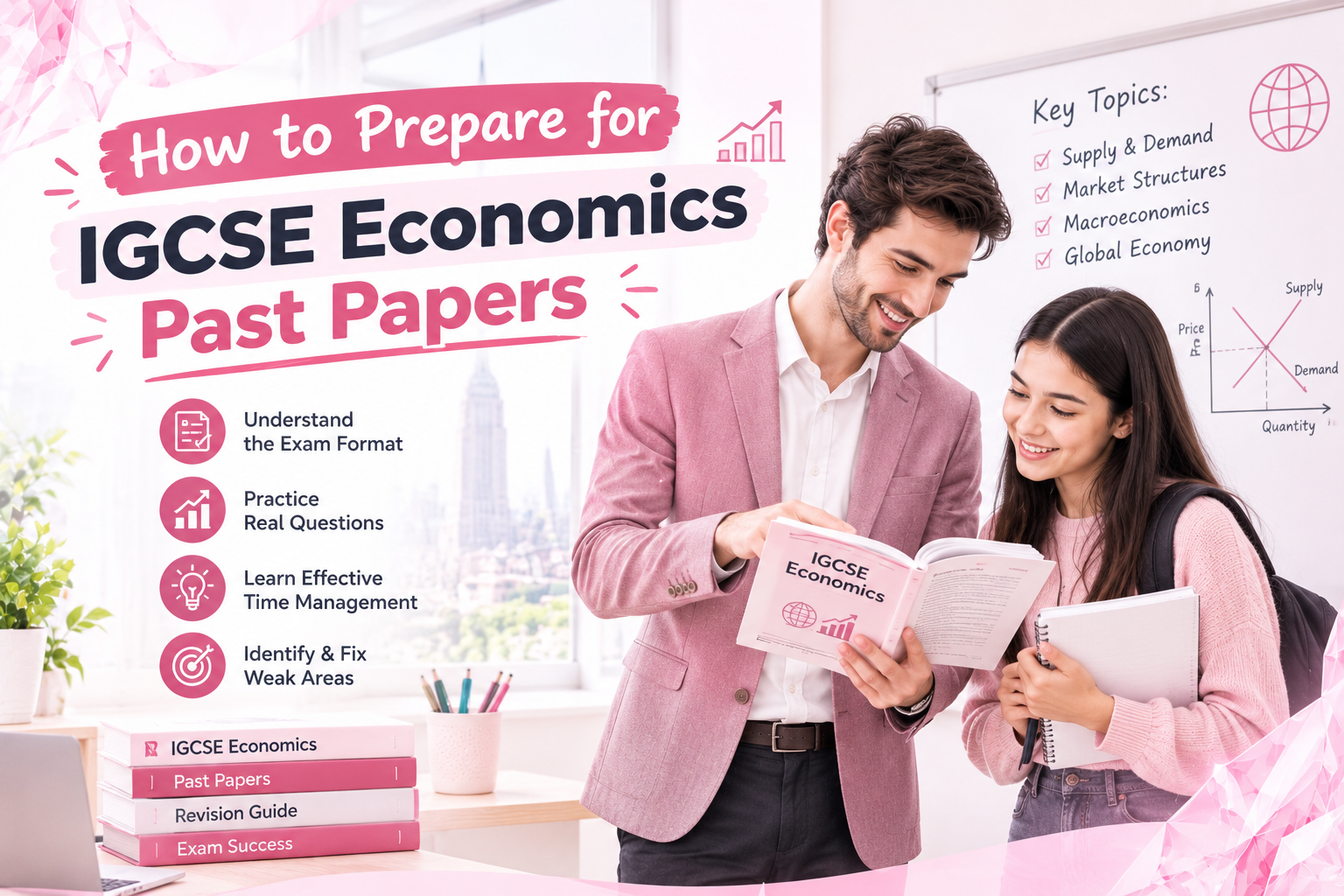
Preparing for IGCSE Economics can feel challenging when you need to remember definitions, understand economic theories and answer questions within a limited time. Many students understand the topics in class but struggle to apply their knowledge in examinations. Regular practice with past papers can help bridge this gap.
The key is to practise with a clear plan rather than complete papers without reviewing your answers. You need to understand what each question asks, use the correct economic terms and explain your points with suitable examples.
For students in Malaysia, a structured revision routine can make Economics more manageable. With support from online economics tutors, students can identify weak areas, improve their answer-writing skills and prepare more confidently for their IGCSE examinations.
1. Understand Your IGCSE Economics Syllabus First
Before starting past papers, make sure you know which topics are included in your examination syllabus. Attempting questions without revising the relevant concepts can lead to repeated mistakes.
Create a Topic-Based Revision Checklist
Divide your syllabus into manageable sections, such as:
-
The basic economic problem and opportunity cost
-
Demand, supply and price determination
-
Production, costs and revenue
-
Market structures and business decisions
-
Government economic policies
-
Inflation, unemployment and economic growth
-
International trade and globalisation
Tick off each topic once you can explain the main concepts without looking at your notes. Spend more time on topics that you find difficult instead of revising familiar chapters repeatedly.
Always check the syllabus for your examination year, as content and assessment arrangements may change.
2. Start with Topic-Based Past Paper Questions
You do not need to complete a full examination paper on your first day of revision. Start with questions from one topic and build your confidence gradually.
For example, if you are revising demand and supply, attempt questions about changes in demand, shifts in supply curves and equilibrium prices. Check your answers before moving to another topic.
Learn from Every Mistake
Suppose a question asks you to explain why the demand for a product might increase. Writing that demand rises because the product becomes popular may be a starting point, but you should develop your explanation further.
You could explain that an increase in consumer income may raise demand for a normal good, shifting the demand curve to the right, assuming other factors remain constant.
This approach helps you connect economic theory with practical situations. Keep a record of mistakes and revisit similar questions after a few days.
3. Practise Answering Different Question Types
IGCSE Economics requires more than memorising definitions. You must understand economic concepts, interpret information and explain how different factors affect individuals, businesses and the wider economy.
Understand Command Words
Pay attention to the instruction at the beginning of each question.
-
Define: Give a clear and accurate meaning.
-
Identify: State the required fact or feature.
-
Explain: Give a point and show why or how it happens.
-
Analyse: Develop a logical chain of economic reasoning.
-
Discuss: Consider relevant arguments and, where appropriate, reach a supported judgement.
For example, a question asking you to define inflation needs a precise definition. A question asking you to discuss the effects of inflation requires a more developed response that considers different groups, such as consumers, workers and businesses.
Practise these command words regularly so that you know how much detail each answer needs.
4. Use Mark Schemes to Improve Your Answers
Completing a past paper is only one part of revision. Reviewing the mark scheme is where you can discover what your answers are missing.
After attempting a question, compare your response with the relevant mark scheme. Check whether you included the correct terminology, explained your reasoning and addressed every part of the question.
Keep an Economics Mistake Journal
Create a simple table with three columns: the question, your mistake and how you will improve.
For instance, you might discover that your explanation of unemployment lacks a clear link between lower demand and reduced demand for labour. Write down the missing link and practise explaining it again.
Do not simply memorise model answers. Learn why an answer earns marks so that you can apply the same reasoning to a different question.
5. Practise Under Examination Conditions
Once you are comfortable with individual topics, attempt complete past papers under timed conditions. Choose a quiet place, put away your phone and avoid checking your notes during the session.
Use the timing and paper structure specified for your examination year. For Cambridge IGCSE Economics, the assessment arrangements differ between the 2026 and 2027–2029 syllabuses, so check the correct specification before planning your practice.
Review Your Time Management
After each paper, check whether you spent too long on certain questions. Practise allocating time according to the marks available, while leaving a few minutes to review your work.
If you regularly leave the final question unfinished, practise shorter timed sections before attempting another complete paper. Gradually, you will become more comfortable working at the required pace.
6. Connect Economics Concepts with Real-Life Examples
Economics becomes easier to understand when you relate theories to everyday situations. Students in Malaysia can consider changes in food prices, fuel costs, household spending, tourism and international trade.
For example, if the price of a commonly purchased food item increases, consumers may buy less of it or choose a substitute. This can help you understand price elasticity of demand and consumer behaviour.
Use relevant examples to support your explanations, but make sure they answer the question. An example should strengthen your economic reasoning rather than replace it.
7. Get Personalised Support When You Need It
Sometimes, repeated practice does not solve a problem because you may have misunderstood a concept or developed an ineffective answering technique.
Working with qualified online tutors can help you identify these gaps. A tutor can explain difficult topics, review past paper answers and guide you through the reasoning needed for structured questions.
At Mixt Academy, students can explore personalised online tuition to support their Economics revision. Focused lessons can help learners practise examination questions, strengthen their understanding and build a revision routine that suits their needs.
The most useful support is not simply being shown the correct answer. It is learning how to reach that answer independently.
Conclusion
Preparing for IGCSE Economics past papers becomes more effective when you combine syllabus revision, topic-based practice, mark scheme analysis and timed examinations. Focus on understanding why an answer is correct instead of memorising responses without context.
Set realistic weekly targets, review your mistakes and return to difficult topics regularly. With consistent effort and the right guidance, you can improve your economic reasoning and approach your examination with greater confidence.
Explore Mixt Academy Malaysia to learn more about personalised Economics tuition and academic support.
Frequently Asked Questions (FAQs)
1. How many IGCSE Economics past papers should I practise?
Start with topic-based questions and gradually move to complete papers. The number depends on your current understanding and available revision time. Reviewing mistakes is more valuable than completing many papers without learning from them.
2. Where can I find IGCSE Economics past papers?
You can access official syllabus information and available past paper resources through the Cambridge International Economics page. Use the materials that match your examination syllabus and year.
3. How can I improve my marks in IGCSE Economics?
Learn key definitions, understand command words, practise structured answers and review mark schemes. Focus on explaining cause-and-effect relationships clearly and using relevant economic terminology.
4. Can online economics tutors help with past paper practice?
Yes. Online economics tutors can help you understand difficult concepts, identify weaknesses in your answers and practise examination techniques. Regular feedback can help you become more independent when answering questions.
5. When should I start practising IGCSE Economics past papers?
Start practising topic-based questions as soon as you have covered the relevant material. Introduce full timed papers as your understanding improves, then increase their frequency as the examination approaches.

 English
 French
 Spanish
 Portuguese
 Deutsch
 Turkish
 Dutch
 Italiano
 Russian
 Romaian
 Portuguese (Brazil)
 Greek