


Mileage Recording During Dyno Testing: What Vehicle Owners and Technicians Should Know
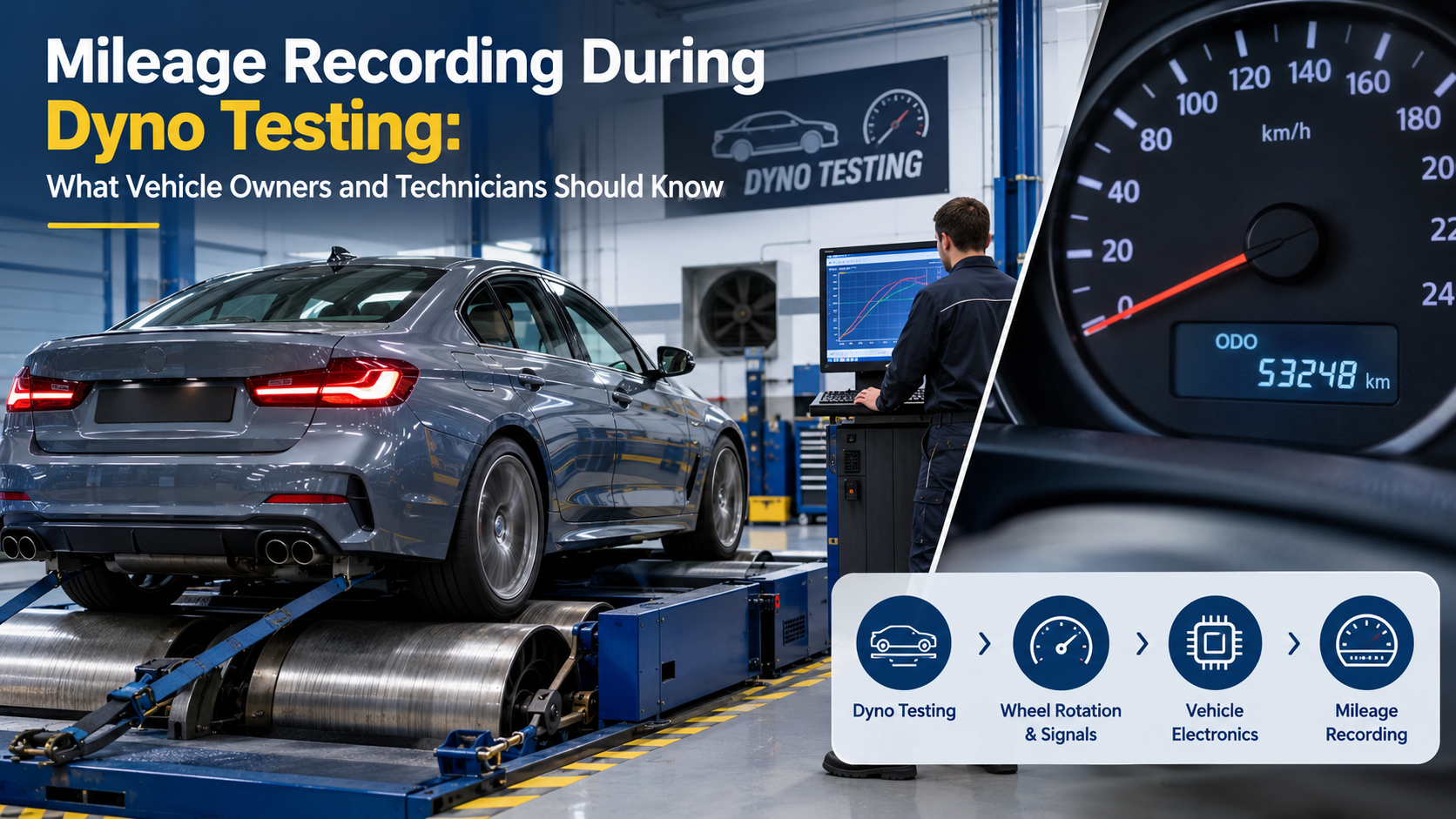
Mileage Recording During Dyno Testing: What Vehicle Owners and Technicians Should Know
Dynamometer testing plays an important role in modern automotive performance assessment. It allows technicians to evaluate engine output, torque delivery and vehicle behaviour under controlled conditions without requiring a conventional road test. However, because vehicle wheels can rotate while the vehicle remains stationary, dyno testing raises an interesting question: does the process affect the mileage displayed on the odometer?
The answer is not identical for every vehicle. Modern mileage-recording systems depend on electronic architecture, vehicle speed information and the way different control modules process distance-related data. The type of dynamometer and the testing configuration can also influence how the vehicle behaves during a session.
Understanding the relationship between wheel rotation, electronic signals and recorded mileage helps vehicle owners and technicians maintain accurate service histories and avoid unnecessary confusion after performance testing.
What Is Dyno Testing and How Does It Work?
A dynamometer, commonly called a dyno, is a testing device used to measure mechanical power and torque. In automotive workshops, it helps technicians assess how a vehicle performs under different engine speeds and loading conditions.
Two common arrangements are rolling-road and hub dynamometers.
Rolling-road dynamometers
A rolling-road dynamometer, also known as a chassis dynamometer, uses large rotating rollers positioned beneath the vehicle's driven wheels.
The vehicle is secured in place, and its tyres rotate against the rollers during testing. The equipment measures rotational speed and applied force to calculate power output.
For example, a performance technician might conduct a series of controlled acceleration tests to assess whether an engine modification has changed the vehicle's power delivery. Comparing results from different sessions can help identify performance improvements or potential mechanical problems.
Rolling-road systems are useful because they allow a complete vehicle to be tested while remaining inside a controlled workshop environment.
Hub dynamometers
Hub dynamometers use equipment connected directly to the vehicle's wheel hubs instead of relying on tyres running against rollers.
They measure rotational speed and torque at the hubs, providing information about the power delivered through the drivetrain.
The mechanical arrangement is therefore different from a traditional rolling road. However, both systems allow technicians to evaluate vehicle performance without requiring the vehicle to travel along an ordinary road.
The Dynojet automotive dynamometer range provides examples of chassis dynamometer equipment, while its hub dynamometer information illustrates the alternative hub-based arrangement.
These systems are useful for performance assessment, tuning, diagnostics and controlled engineering tests.
How Do Vehicles Record Mileage?
A vehicle's odometer displays the cumulative distance recorded during its service life. Older vehicles often relied on mechanical arrangements, while modern vehicles generally use electronic systems to calculate and store distance information.
Electronic mileage recording involves collecting vehicle movement information and processing it into a distance measurement.
Wheel-speed sensors are an important part of modern automotive electronics. They detect wheel rotation and provide signals used by systems such as anti-lock braking systems (ABS) and electronic stability control.
According to Bosch's technical explanation of wheel-speed sensors, these sensors detect rotational wheel speed through non-contact measurement principles.
However, it is important to distinguish wheel-speed measurement from odometer calculation. Although wheel-speed information can contribute to vehicle speed and distance calculations, not every manufacturer uses identical electronic arrangements.
The SAE International J2976 recommended practice describes electronic speedometer and odometer systems that use rotational information from at least one vehicle wheel to calculate longitudinal speed and distance travelled. It also recognises that other measurement methods may be used.
Depending on the vehicle, mileage-related information may be processed or communicated through different electronic control units before appearing on the instrument cluster.
Consequently, two vehicles from different manufacturers may respond differently to similar operating conditions.
Does Dyno Testing Increase the Vehicle's Mileage?
This is one of the most interesting questions surrounding dynamometer testing.
During a rolling-road session, the vehicle remains stationary relative to the workshop while its driven wheels rotate against the rollers. Since some electronic mileage systems use wheel-related information to calculate distance, it is reasonable to ask whether this rotation can affect the odometer reading.
However, wheel rotation does not automatically establish that additional mileage will be recorded.
The outcome depends on the vehicle's electronic architecture and how its systems interpret distance-related signals during testing.
Some vehicle configurations may process particular rotational signals as part of their distance calculations. Others may use additional information or different electronic arrangements that influence how mileage is recorded.
Hub dynamometers introduce another mechanical configuration because the equipment connects directly to the wheel hubs. Nevertheless, this does not establish a universal odometer response. The vehicle's electronic design remains an important consideration.
Consider two vehicles undergoing similar performance assessments. Both remain stationary in the workshop, and their drivetrains operate under comparable testing conditions. Their mileage-recording systems may nevertheless process the available signals differently.
This is why technicians should examine the actual vehicle records rather than assume that all dyno sessions either increase mileage or leave it unchanged.
The most reliable approach is to document the displayed odometer reading before and after testing and investigate any unexpected difference using appropriate manufacturer information.
Five Factors That Can Affect Mileage Recording During Dyno Testing
Several technical considerations help explain why mileage behaviour can vary between vehicles and testing sessions.
1. Vehicle Electronic Architecture
Vehicle manufacturers use different electronic architectures to manage speed, distance and instrument-cluster information.
The location of mileage-related processing, communication between modules and storage arrangements can differ according to the vehicle's model and production generation.
For this reason, technicians should avoid applying assumptions based on another vehicle's behaviour.
2. Wheel-Speed Signals
Wheel-speed sensors detect rotational movement and provide information to vehicle control systems.
These signals are important for braking and stability functions and may also contribute to vehicle speed and distance calculations.
However, their exact relationship with odometer recording depends on the manufacturer's system design.
3. Dynamometer Configuration
Rolling-road and hub dynamometers interact with vehicles through different mechanical arrangements.
A rolling road uses rotating rollers beneath the tyres, while a hub dynamometer connects measuring equipment directly to the wheel hubs.
These differences affect the physical testing arrangement, but neither configuration guarantees a particular odometer response.
4. Vehicle Control Modules
Modern vehicles contain multiple electronic control units responsible for different functions.
Depending on the architecture, distance-related information may be processed, communicated or stored through different modules.
The instrument cluster may receive mileage information from another control unit rather than calculate the cumulative distance independently.
Understanding these relationships can help technicians investigate unexpected mileage discrepancies more accurately.
5. Testing Conditions and Procedures
The circumstances of a dynamometer session also deserve consideration.
Relevant factors include:
- The duration of the testing session.
- Vehicle make, model and production year.
- The type of dynamometer being used.
- The vehicle's electronic configuration.
- Applicable operating conditions.
- Manufacturer-specific testing procedures.
These considerations should be evaluated together. No single factor determines odometer behaviour across every vehicle.
Why Accurate Mileage Records Matter After Dyno Testing
Accurate mileage documentation is important for vehicle maintenance, workshop accountability and resale transparency.
A vehicle's recorded distance helps owners understand its maintenance history and determine when certain servicing requirements may become due.
When a vehicle undergoes dynamometer testing, recording the session creates a useful reference for future maintenance and diagnostic work.
For example, a workshop can document the odometer reading when the vehicle arrives, the date of testing, the type of dynamometer used and the displayed reading after the session.
If a difference appears, technicians can investigate it using suitable diagnostic equipment and manufacturer documentation.
Maintaining clear records also benefits prospective buyers. Vehicle history information can help them understand the vehicle's previous use and assess whether the available maintenance documentation is consistent.
In the UK, the GOV.UK MOT history service allows users to examine historical test results, including mileage readings recorded during MOT tests.
Any discrepancy between vehicle records should be investigated and explained honestly. Accurate documentation is more valuable than making assumptions about why a reading has changed.
Understanding Mileage-Blocking Technology
Modern vehicles rely on interconnected electronic systems to process speed and distance information. Understanding these systems also provides useful context when examining technologies designed to interact with mileage-recording signals.
Mileage-blocking devices are electronic products associated with the processing of vehicle mileage-related information. They are distinct from ordinary odometer systems, which are designed to record cumulative distance travelled.
It is important to distinguish three concepts:
Ordinary odometer recording: The vehicle's mileage-recording system calculates and maintains cumulative distance information for display and vehicle-history purposes.
Mileage-blocking technology: This describes devices designed to interfere with or alter the normal recording of mileage-related information under particular operating circumstances. Their technical behaviour depends on the product and vehicle architecture.
Mileage correction: This generally refers to correcting an inaccurate displayed mileage record, for example following an instrument-cluster replacement or a documented repair. Any legitimate correction should follow applicable legal requirements and preserve evidence of the vehicle's actual history.
These concepts should not be confused. A device being commercially available does not establish that every use is lawful or appropriate.
Understanding the relationship between vehicle electronics and mileage recording is important when examining different automotive technologies. Readers seeking additional background can explore how a mileage blocker works and how these devices relate to vehicle mileage-recording systems.
Mileage information should always remain accurate and transparent. Using electronic equipment to misrepresent a vehicle's actual distance travelled can create serious financial, legal and ethical consequences, particularly when a vehicle is sold or its history is disclosed to another party.
Best Practices for Technicians Conducting Dyno Testing
A consistent workshop procedure can help technicians maintain reliable mileage documentation and reduce confusion following dynamometer sessions.
Identify the vehicle correctly. Record the exact manufacturer, model, production year and relevant electronic configuration before testing.
Consult manufacturer documentation. Review the applicable technical information rather than assuming that every vehicle uses the same mileage-recording architecture.
Follow dynamometer operating procedures. Use the equipment according to its manufacturer's safety and operating requirements.
Record the starting mileage. Document the displayed odometer reading before the vehicle enters the testing session. A dated photograph or workshop inspection report can provide a useful reference.
Document the testing configuration. Record whether a rolling-road or hub dynamometer was used, along with the date and purpose of the session.
Check the ending mileage. Compare the displayed reading after testing with the original record and document any difference.
Investigate unexpected discrepancies. Consult appropriate diagnostic equipment and manufacturer information rather than making assumptions about the cause.
Maintain transparent service records. Keep dynamometer reports alongside relevant maintenance and repair documents so that future owners and technicians can understand the vehicle's history.
These practices support accurate recordkeeping and responsible automotive testing.
Conclusion
Dynamometer testing provides valuable information about vehicle power, torque and engine performance under controlled conditions. However, the relationship between wheel rotation and electronic mileage recording is more complicated than it may initially appear.
Although vehicle wheels or hubs rotate during testing, this does not automatically mean that additional mileage will appear on the odometer. The outcome depends on vehicle-specific electronic architecture, distance-related signals, control modules and testing configuration.
For vehicle owners and automotive technicians, the most reliable approach is to understand the relevant vehicle systems, document mileage readings before and after testing and investigate unexpected discrepancies.
Ultimately, accurate records, technical understanding and transparent workshop procedures help ensure that dynamometer testing remains a valuable part of responsible vehicle performance assessment.

 English
 Arabic
 Spanish
 Portuguese
 Deutsch
 Turkish
 Dutch
 Italiano
 Russian
 Romaian
 Portuguese (Brazil)
 Greek