


Liquid Penetrant Testing Kit: A Guide for Canadian Industries
Industrial quality and workplace safety are essential priorities for businesses throughout Canada. From manufacturing facilities and automotive workshops to aerospace companies and oil and gas operations, organizations need reliable inspection methods to maintain product quality and identify potential defects. Even a small surface crack in a metal component can create expensive problems if it remains undetected during production or maintenance. This is why non-destructive testing has become an important part of modern industrial quality control.
A Liquid Penetrant Testing Kit provides a practical and cost-effective way to identify surface-breaking defects without damaging the inspected component. It helps technicians detect imperfections that may not be visible during a normal visual examination. For Canadian businesses looking to balance inspection quality with operating costs, understanding this testing method is a smart move. The right equipment can support better maintenance planning, reduce unnecessary rework, and help companies maintain confidence in their products.
What Is a Liquid Penetrant Testing Kit?
A Liquid Penetrant Testing Kit is a collection of specialized products used to identify surface-breaking imperfections in nonporous materials. A standard kit generally includes three main components: a penetrant liquid, a cleaner or remover, and a developer. These products work together to reveal surface discontinuities such as cracks, porosity, laps, seams, and other imperfections that extend to the material's surface.
The testing process is based on capillary action. The penetrant enters small openings on the component's surface and remains inside them during the inspection process. After excess penetrant is removed, a developer helps draw the trapped liquid back toward the surface, creating visible indications. Trained inspectors then examine these indications to determine whether they represent relevant defects.
A professional Liquid Penetrant Testing Kit can be used on various compatible nonporous materials, including stainless steel, carbon steel, aluminium, and certain other metals. This makes it useful for different manufacturing and maintenance applications. However, the material's surface condition and compatibility with the selected chemicals must always be considered before testing.
For Canadian businesses, purchasing a Liquid Penetrant Testing Kit involves more than comparing prices. Product quality, technical specifications, compatibility, ease of application, and supplier support all contribute to long-term value. Making an informed purchasing decision can help businesses avoid unnecessary expenses while maintaining dependable inspection practices.
How Does a Liquid Penetrant Testing Kit Work?
Understanding the inspection process is important for achieving consistent and reliable results. A Liquid Penetrant Testing Kit follows a systematic procedure in which every step contributes to the final inspection outcome. Proper surface preparation, correct chemical application, and accurate evaluation are essential.
Surface Preparation and Cleaning
The first stage involves preparing the component's surface. Dirt, oil, grease, paint, rust, and other contaminants can prevent penetrant from entering small surface openings. Therefore, technicians must thoroughly clean the inspection area before applying the testing liquid.
A Liquid Penetrant Testing Kit typically includes a compatible cleaner that helps remove surface contamination. The component must also be properly dried before penetrant application. Proper cleaning is important because contamination can produce unreliable indications or prevent defects from being detected.
Applying the Penetrant
After cleaning and drying the component, technicians apply the penetrant evenly across the inspection area. Depending on the product, the liquid can be applied through spraying, brushing, or immersion.
The penetrant included in a Liquid Penetrant Testing Kit is designed to enter surface-breaking imperfections through capillary action. It must remain on the surface for the recommended dwell time to allow sufficient penetration into potential defects.
Dwell time depends on the manufacturer's instructions, material, temperature, and applicable inspection procedure. Technicians should always follow the approved requirements instead of using an estimated application time.
Removing Excess Penetrant
Once the required dwell time has passed, excess penetrant must be removed from the component's surface. This step requires care because leaving too much liquid behind can create background staining and make defect indications difficult to interpret.
A compatible remover included in a Liquid Penetrant Testing Kit helps eliminate excess surface penetrant while preserving liquid trapped inside defects. The exact removal process depends on whether the system is water-washable, solvent-removable, or uses another approved removal method.
Applying the Developer
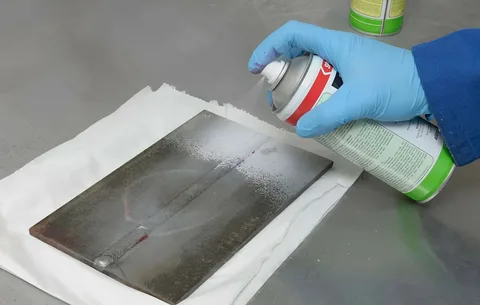
The developer is applied after excess penetrant has been removed. It creates a contrasting background and helps draw the penetrant from surface imperfections back toward the surface.
A properly selected Liquid Penetrant Testing Kit includes a developer compatible with its penetrant system. The developer must be applied evenly and allowed to work for the recommended development time.
Final Inspection and Evaluation
The final stage involves examining the component under appropriate lighting conditions. Visible penetrant systems generally produce coloured indications against a contrasting background, while fluorescent systems require suitable ultraviolet-A lighting.
A Liquid Penetrant Testing Kit reveals potential surface defects, but the final evaluation must be completed by qualified personnel. Inspectors should use the applicable acceptance criteria, technical specifications, and approved inspection procedures when determining whether an indication requires further action.
Essential Components of a Liquid Penetrant Testing Kit
A complete Liquid Penetrant Testing Kit includes several important products that work together during the inspection process. Understanding these components helps buyers compare available systems and choose equipment that meets their requirements.
Penetrant Liquid
The penetrant is the main inspection product. It is formulated to enter small surface-breaking openings and remain inside them during the required dwell period.
Visible penetrants commonly use a strong colour, often red, to produce noticeable indications. Fluorescent products use special formulations that become visible under suitable ultraviolet-A lighting.
When purchasing a Liquid Penetrant Testing Kit, businesses should consider sensitivity, material compatibility, application requirements, and manufacturer specifications.
Cleaner and Remover
The cleaner is used to prepare the component before testing, while the remover eliminates excess penetrant after the dwell period.
A quality Liquid Penetrant Testing Kit should contain compatible cleaning products with clear instructions. Using unsuitable chemicals can affect inspection performance and may damage certain materials or coatings.
Developer
The developer helps reveal penetrant trapped inside surface defects. It creates a contrasting background and improves the visibility of indications.
A professional Liquid Penetrant Testing Kit should include a developer designed to work with the selected penetrant. Using compatible products is important for achieving consistent inspection results.
Supporting Inspection Accessories
Depending on the application, additional accessories may be required. These can include suitable lighting equipment, cleaning materials, protective gloves, application supplies, and inspection documentation.
Businesses using a Liquid Penetrant Testing Kit should ensure that technicians have access to everything necessary to perform the inspection safely and according to the applicable procedure.
Different Types of Liquid Penetrant Testing
Not every inspection project has the same requirements. A Liquid Penetrant Testing Kit can be selected according to the inspection method, required sensitivity, component material, and working environment.
Visible Dye Penetrant Testing
Visible dye penetrant testing is one of the most common approaches because of its straightforward application process. It typically uses a coloured penetrant that produces contrasting indications against a light developer background.
A visible Liquid Penetrant Testing Kit can be suitable for workshops, manufacturing facilities, and industrial maintenance operations. One of its main advantages is that it generally does not require specialized ultraviolet inspection equipment.
For businesses that want to control inspection expenses, visible testing can be a practical choice when its sensitivity meets the requirements of the application.
Fluorescent Penetrant Testing
Fluorescent Penetrant Testing uses specially formulated penetrants that produce visible fluorescence under appropriate ultraviolet-A lighting conditions.
A fluorescent Liquid Penetrant Testing Kit may be selected for applications requiring higher sensitivity. It is particularly useful in inspection environments where identifying smaller surface-breaking indications is important.
However, fluorescent testing requires suitable lighting, controlled inspection conditions, and trained personnel. Businesses should consider these additional requirements when comparing equipment and overall operating costs.
Water-Washable Penetrant Systems
Water-washable systems are designed to allow excess penetrant to be removed using water under specified conditions.
A Liquid Penetrant Testing Kit using this approach can offer application convenience in suitable inspection environments. However, technicians must follow the recommended washing pressure, temperature, and removal procedure to avoid washing penetrant out of defects.
Solvent-Removable Penetrant Systems
Solvent-removable systems use a compatible solvent-based cleaner to remove excess penetrant from the surface.
A solvent-removable Liquid Penetrant Testing Kit may be useful for applications where controlled local inspection is required. Technicians should avoid applying excessive solvent directly to the inspection surface because it can remove penetrant from potential defects.
Industrial Applications of Liquid Penetrant Testing in Canada
Canada has a diverse industrial economy, and many sectors depend on accurate inspection procedures to maintain product quality and operational reliability. A Liquid Penetrant Testing Kit can support different inspection activities when the method is appropriate for the material and defect type.
Manufacturing and Metal Fabrication
Manufacturing and fabrication companies regularly produce metal components that must meet specific quality requirements. Welding, machining, casting, and forming operations can introduce surface imperfections that need to be examined.
A Liquid Penetrant Testing Kit helps technicians identify surface-breaking defects in suitable fabricated and machined components. This can support quality control before products move to the next stage of production or reach customers.
For Canadian manufacturers, early defect detection can reduce material waste, unnecessary rework, and production delays. It also helps businesses maintain consistent inspection practices.
Automotive and Transportation
The automotive and transportation industries depend on components that can withstand mechanical stress, vibration, and demanding operating conditions. Certain engine components, brackets, housings, and fabricated metal parts may require surface inspection.
A Liquid Penetrant Testing Kit can help identify surface cracks and other discontinuities in compatible components. It can support manufacturing inspections and selected maintenance activities where surface defect detection is required.
Oil and Gas Industry
Canada's oil and gas sector uses a wide range of industrial equipment, including valves, fittings, pumps, and fabricated metal components. These products may experience demanding operating conditions and require regular inspection.
A Liquid Penetrant Testing Kit can help technicians examine accessible surfaces for surface-breaking imperfections. It may support equipment maintenance, fabrication quality checks, and selected repair inspections.
However, penetrant testing only identifies defects that are open to the surface. Other non-destructive testing techniques may be required when internal defects or inaccessible areas need to be examined.
Aerospace and Aviation
Aerospace manufacturing requires careful control over component quality and material reliability. Small imperfections can be important depending on the component's function and operating conditions.
A Liquid Penetrant Testing Kit may be used for suitable aerospace components as part of a controlled inspection program. The selected products and procedures must meet the applicable technical, regulatory, and customer requirements.
Construction and Infrastructure
Construction projects throughout Canada involve structural steel, fabricated metal components, and mechanical systems that require quality checks during production and maintenance.
A Liquid Penetrant Testing Kit can help inspect suitable welded, machined, and fabricated surfaces. It offers a practical method for identifying certain surface imperfections without damaging the inspected component.
This can support contractors and fabrication businesses that want to maintain consistent quality throughout their projects.
Benefits of Using a Professional Liquid Penetrant Testing Kit
Choosing suitable inspection equipment can provide several advantages for industrial businesses. A Liquid Penetrant Testing Kit offers a practical method for examining suitable surfaces while supporting better quality management.
Cost-Effective Inspection
Budget control is important for Canadian businesses, particularly small and medium-sized manufacturing companies. A Liquid Penetrant Testing Kit can provide an economical approach to surface inspection because the basic process does not require the complex machinery associated with some other testing methods.
However, businesses should consider the complete inspection cost, including consumables, technician training, protective equipment, surface preparation, and documentation. Comparing these factors provides a more accurate understanding of long-term value.
Improved Quality Control
Consistent inspection procedures help manufacturers maintain product quality. A Liquid Penetrant Testing Kit allows technicians to identify certain surface-breaking imperfections before components are approved for use or delivered to customers.
This can strengthen quality assurance programs and help businesses maintain confidence in their production processes.
Early Surface Defect Detection
Surface cracks and other discontinuities can develop during manufacturing, fabrication, or equipment operation. Identifying these issues early can make corrective action easier.
A Liquid Penetrant Testing Kit helps reveal defects that may not be obvious during an ordinary visual examination. This supports more informed decisions about repairs, replacement, and additional testing.
Better Maintenance Planning
Unexpected equipment problems can lead to expensive downtime and operational interruptions. Regular inspections can help identify certain issues before they become more serious.
Using a Liquid Penetrant Testing Kit as part of an appropriate maintenance program may help businesses plan repairs more effectively. Although no single inspection method guarantees equipment reliability, suitable testing can contribute to better maintenance decisions.
Portable and Convenient Application
Many inspection kits are supplied in portable packaging, making them convenient for workshop and field applications.
A portable Liquid Penetrant Testing Kit allows technicians to carry essential inspection products between work areas. This can be useful for maintenance teams and inspection professionals who need flexibility.
How to Choose the Right Liquid Penetrant Testing Kit in Canada
Selecting appropriate inspection equipment is an important purchasing decision. Canadian businesses should compare several factors before investing in a Liquid Penetrant Testing Kit.
Identify Your Inspection Requirements
Start by identifying the materials and components that need examination. Consider whether you are inspecting stainless steel, carbon steel, aluminium, or another suitable nonporous material.
A Liquid Penetrant Testing Kit should match the inspection method and sensitivity requirements of the application. Visible and fluorescent systems have different requirements, so understanding the inspection objective is essential.
Review Product Specifications
Buyers should examine technical data sheets, safety information, product compatibility, and manufacturer instructions.
A dependable Liquid Penetrant Testing Kit should provide clear information about penetrant sensitivity, dwell time, removal methods, temperature limits, and application procedures.
Compare Quality and Pricing
Price is an important consideration, but choosing the cheapest product is not always the best decision. A low-cost Liquid Penetrant Testing Kit may not provide the performance or sensitivity required for demanding inspection applications.
Compare the complete package, including product quantity, coverage, shelf life, compatibility, and replacement consumable costs. This helps businesses avoid purchasing equipment that does not meet their actual needs.
Consider Ease of Application
Inspection professionals often perform repeated examinations, so convenience matters. Portable packaging, clear instructions, and access to replacement products can make everyday inspection work more efficient.
A Liquid Penetrant Testing Kit should be practical for the environment in which it will be used. Buyers should consider storage conditions, application methods, and workplace requirements.
Choose a Dependable Supplier
Supplier reliability is another important factor. Businesses should look for suppliers that provide accurate product information, technical documentation, safety information, and responsive customer support.
Companies researching professional inspection products can also consider vanderstahl when comparing industrial testing solutions. Reviewing available specifications and confirming product suitability can help buyers make a confident purchasing decision.
Common Mistakes to Avoid During Liquid Penetrant Testing
Even a professional Liquid Penetrant Testing Kit cannot deliver dependable results if technicians ignore the correct inspection procedure. Avoiding common mistakes helps improve consistency and reduces the possibility of inaccurate findings.
Skipping Surface Preparation
Applying penetrant to a contaminated surface is a common inspection mistake. Dirt, grease, paint, and oil can prevent the liquid from entering surface defects.
A Liquid Penetrant Testing Kit should always be used after the component has been properly cleaned and dried according to the approved procedure.
Using Incorrect Dwell Time
Insufficient dwell time may prevent the penetrant from entering potential defects effectively. Technicians should follow the manufacturer's instructions and applicable inspection requirements when using a Liquid Penetrant Testing Kit.
Removing Too Much Penetrant
Over-cleaning can remove penetrant from defects and produce weak or missed indications. On the other hand, insufficient removal can create background staining.
A Liquid Penetrant Testing Kit should be used with the correct removal technique to maintain inspection reliability.
Applying Developer Incorrectly
Uneven or excessive developer application can make indications difficult to interpret. Technicians should apply the developer according to the manufacturer's recommendations and allow the specified development time.
Ignoring Environmental Conditions
Temperature, lighting, surface condition, and environmental contamination can influence inspection performance. A Liquid Penetrant Testing Kit should only be used within its specified operating conditions.
Failing to Document Results
Proper documentation supports traceability and quality management. Inspection records should include relevant component information, inspection conditions, observations, and evaluation results according to applicable requirements.
Safety Guidelines for Using Liquid Penetrant Testing Equipment
Chemical handling is an important part of industrial inspection. A Liquid Penetrant Testing Kit may contain cleaning agents, penetrants, and developers that require specific handling precautions.
Before using any product, technicians should review its Safety Data Sheet (SDS). Appropriate personal protective equipment, including gloves and eye protection, should be selected according to the manufacturer's instructions.
Adequate ventilation is important, particularly when working with aerosol products or solvent-based cleaners. Products should be stored under recommended conditions and kept away from incompatible substances or ignition sources where applicable.
Canadian businesses should also follow relevant workplace safety and environmental requirements when handling, storing, and disposing of inspection chemicals.
Following proper safety procedures protects workers, supports responsible chemical handling, and helps maintain consistent inspection practices.
Understanding Industry Standards and Inspection Requirements
Industrial inspection should follow recognized procedures and applicable technical requirements. A Liquid Penetrant Testing Kit must be suitable for the standard or specification governing the inspection.
ASTM E1417/E1417M and ISO 3452-1 are examples of standards associated with liquid penetrant testing. Their applicability depends on the industry, component, contractual requirements, and inspection purpose.
Businesses should verify the current editions and any additional requirements that apply to their projects. They should also ensure that inspection personnel have appropriate training and qualifications.
A Liquid Penetrant Testing Kit is only one part of a reliable inspection process. Proper procedures, qualified technicians, suitable environmental conditions, and accurate reporting all contribute to dependable results.
Why Businesses Consider vanderstahl for Inspection Solutions
Choosing inspection products from a dependable supplier can make purchasing easier for industrial businesses. A Liquid Penetrant Testing Kit should provide suitable products, clear technical specifications, and compatibility with the intended inspection procedure.
The vanderstahl brand can be included in supplier research for companies exploring industrial inspection and testing solutions. Buyers should evaluate available product information, technical documentation, customer support, and suitability before making a purchase.
Whether a company operates a fabrication workshop, manufacturing facility, or industrial maintenance department, selecting appropriate inspection equipment can support more organized quality control. The goal should be to balance inspection performance, product reliability, and long-term operating costs rather than focusing on price alone.
Conclusion: Make a Smarter Inspection Investment
Reliable surface inspection is an important part of industrial quality management across Canada. Manufacturing, automotive, aerospace, construction, and oil and gas businesses all need suitable methods to identify potential material imperfections.
A Liquid Penetrant Testing Kit offers a practical and cost-conscious solution for detecting surface-breaking defects in suitable nonporous materials. By combining compatible penetrant, cleaner, and developer products with a proper inspection procedure, technicians can reveal imperfections without damaging the inspected component.
Before purchasing, businesses should compare product specifications, confirm material compatibility, review safety documentation, and consider long-term operating expenses. Choosing a dependable supplier and ensuring proper technician training are equally important.
For Canadian businesses looking to improve inspection practices without overspending, investing in a suitable Liquid Penetrant Testing Kit can support better quality control, more effective maintenance planning, and greater confidence in industrial operations. With careful product selection and consistent inspection procedures, companies can maintain high quality standards while getting solid value for their investment.

 English
 Arabic
 French
 Spanish
 Portuguese
 Deutsch
 Turkish
 Dutch
 Italiano
 Russian
 Romaian
 Greek