


Advanced Ceramic Additives Market to Hit USD 1.6 Billion by 2036 at 5.7% CAGR
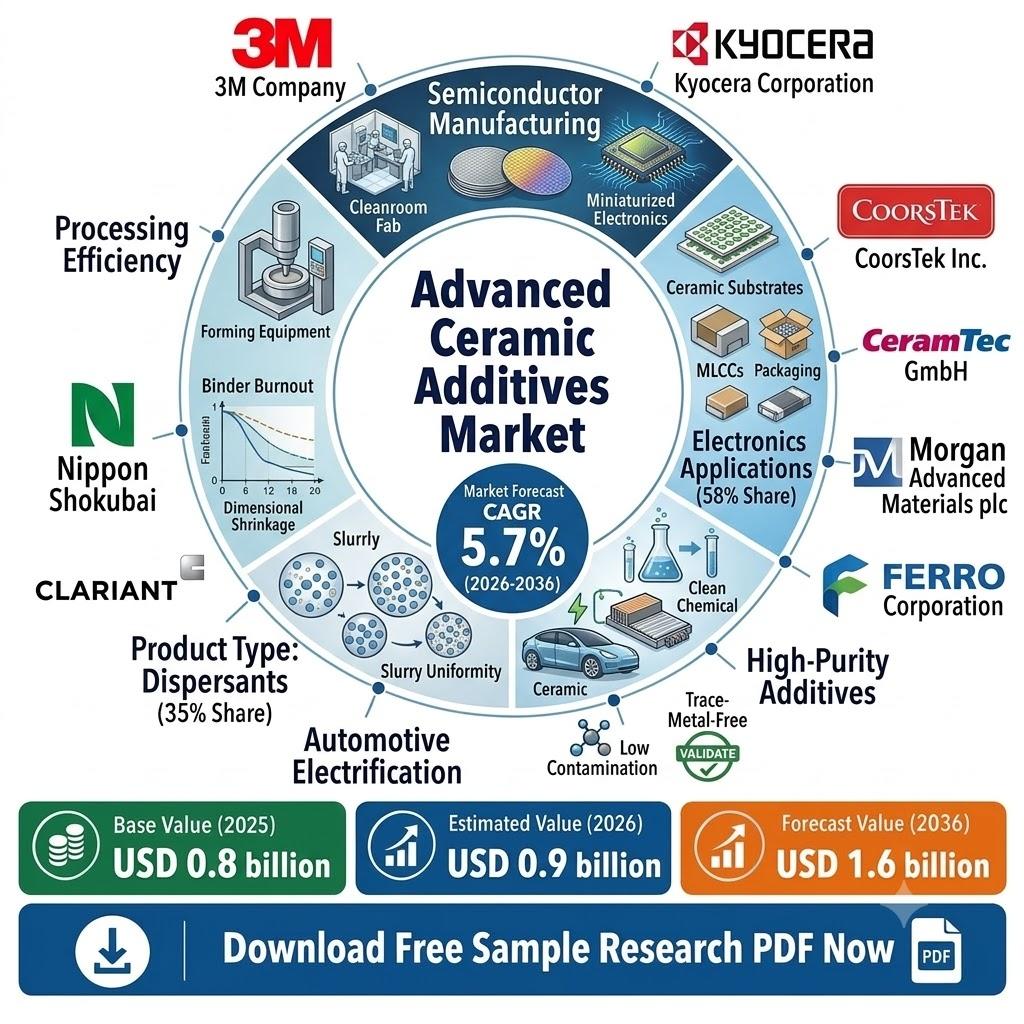
The advanced ceramic additives market is projected to grow at a 5.7% CAGR through 2036, driven by semiconductor expansion, electronics manufacturing, and automotive electrification.
October 31, 2026 — The global advanced ceramic additives market is projected to increase from USD 0.9 billion in 2026 to USD 1.6 billion by 2036, expanding at a compound annual growth rate (CAGR) of 5.7% during the forecast period, according to Fact.MR. The market was valued at USD 0.8 billion in 2025 and is expected to generate an additional USD 0.5 billion in revenue between 2026 and 2036.
Demand is gaining support from semiconductor fabrication investments and the growing use of advanced ceramics in electronic components. The expansion of U.S. semiconductor facilities under the CHIPS Act, China's electronics manufacturing capacity, and Europe's automotive electrification requirements are increasing the need for specialised ceramic processing additives.
Get detailed market forecasts, competitive benchmarking, and pricing trends: https://www.factmr.com/connectus/sample?flag=S&rep_id=14707
Semiconductor Manufacturing Reshapes Advanced Ceramic Additives Market Demand
Advanced ceramic additives include dispersants, binders, plasticizers, and defoamers used during ceramic processing. These materials control dispersion, slurry stability, and forming quality in electronics-grade and industrial-grade ceramic applications.
The shift toward miniaturised electronics and advanced semiconductor packaging is raising purity requirements. Manufacturers increasingly require low-contamination dispersants and binders with documented chemical compositions. Trace-metal-free formulations are becoming important procurement criteria, particularly for ceramic substrates used in semiconductor manufacturing.
Suppliers without cleanroom-compatible production processes and trace-metal validation face restrictions when competing for high-value semiconductor contracts. Long qualification timelines also influence purchasing decisions, as electronics manufacturers require documented material performance before approving suppliers.
According to Fact.MR analyst Shambhu Nath Jha, the market is developing along two distinct production requirements. Electronics-grade additives require stringent purity controls, while industrial-grade formulations serve different processing and performance needs. This structural divide is influencing supplier investments and product development strategies.
Dispersants Account for 35% of Product Demand
Dispersants are expected to hold a 35% share of the advanced ceramic additives market in 2026. Their role in slurry uniformity and particle distribution makes them particularly important in high-precision ceramic forming processes.
The competitive environment reflects this requirement. 3M expanded its additive portfolio in 2024 with low-ionic-contamination dispersant grades targeting semiconductor substrate manufacturers. Morgan Advanced Materials introduced binder systems in January 2025, supported by documented dimensional shrinkage and burnout profiles for alumina and silicon nitride ceramics.
These developments indicate a shift toward application-specific formulations. Buyers increasingly evaluate suppliers based on contamination control and compatibility with ceramic manufacturing processes rather than relying exclusively on standard additive specifications.
Electrical and Electronics Applications Lead the Market
Electrical and electronics applications are projected to account for 58% of market demand in 2026. Semiconductor substrates, multilayer ceramic capacitors (MLCCs), and advanced packaging components support this leading position.
Kyocera Corporation expanded advanced ceramics production capacity in 2024 to support semiconductor component and electronics substrate applications. The expansion contributed to higher additive procurement requirements associated with new manufacturing contracts.
CoorsTek introduced semiconductor-grade ceramic forming additive systems in March 2025. These systems target applications involving silicon carbide and alumina substrates, with validated low-contamination performance.
Automotive applications are also contributing to demand. According to the supplied Society of Automotive Engineers International research reference, automotive ceramic usage grew 8.1% in 2024, reflecting increasing integration in electric vehicle batteries and powertrains.
China Leads Country-Level Market Growth
China is projected to record the fastest growth among the countries assessed, with a CAGR of 6.7% through 2036. Semiconductor capacity expansion and electronics manufacturing investments are supporting domestic demand for advanced ceramic additives.
India follows with a projected CAGR of 6.0%, supported by Production Linked Incentive (PLI) programmes and expanding electronics manufacturing. The United States is expected to grow at 5.8%, reflecting semiconductor investments and demand from aerospace applications.
Japan is projected to register a 5.5% CAGR, supported by high-purity materials innovation and advanced ceramics manufacturing. Germany follows at 5.2%, with automotive electrification and industrial ceramic applications supporting demand.
Europe's regulatory environment is another influence. Updated EU automotive requirements in 2024 increased attention toward validated ceramic materials, including performance-documented binder and dispersant grades.
High-Purity Production Creates Competitive Opportunities
The market presents opportunities for suppliers investing in specialised production capabilities. High-purity manufacturing capacity remains limited, while semiconductor customers increasingly demand documented contamination controls and application-specific formulations.
Fact.MR identifies 3M Company, Kyocera Corporation, CoorsTek Inc., Morgan Advanced Materials plc, and CeramTec GmbH as key market participants.
Competition is increasingly determined by qualification depth and technical integration. Suppliers working closely with semiconductor manufacturers can align additive formulations with substrate requirements and production processes. This approach supports longer customer relationships once materials complete qualification.
However, high raw material costs and lengthy approval procedures remain constraints. New suppliers must also meet demanding documentation requirements before entering established electronics-grade supply chains.
Research Methodology and Market Outlook
Fact.MR's market assessment uses shipment volumes and pricing by additive grade, supported by 2024–2025 industry data. The methodology combines producer revenue information, application-level volumes, primary interviews, and industry output statistics.
The analysis covers more than 40 countries across Asia Pacific, North America, Europe, Latin America, and the Middle East and Africa. It evaluates demand by product type, application, end use, and regional market conditions.
Fact block: Fact.MR is a market research and consulting company that provides industry forecasts, market sizing, competitive intelligence, and strategic business analysis.
The full report examines semiconductor substrate demand, automotive ceramic applications, regional manufacturing investments, and competitive developments through 2036.
View Related Reports :
https://social.mytamam.com/blogs/841/Mining-Lubricants-Market-to-Reach-USD-5-45-Billion-by
https://ayushjadhavblogs.blogspot.com/2026/10/global-chemical-depolymerization-market.html
https://uddokta64.com/blogs/14962/Digital-PID-Control-and-Automation-Shape-the-Future-of-the
https://gulfsena.com/blogs/112090/Passenger-Cars-to-Account-for-60-of-Global-Automotive-Actuator
About Fact.MR
Fact.MR is a market research and consulting firm providing actionable intelligence, industry analysis, and strategic insights across global markets. The company delivers market forecasts, competitive assessments, and business intelligence to help organisations evaluate industry developments and identify growth opportunities.

 English
 Arabic
 French
 Spanish
 Portuguese
 Deutsch
 Turkish
 Dutch
 Italiano
 Russian
 Portuguese (Brazil)
 Greek