


Rheumatoid Arthritis Therapeutics Market Sees New Opportunities in Biologic Treatments
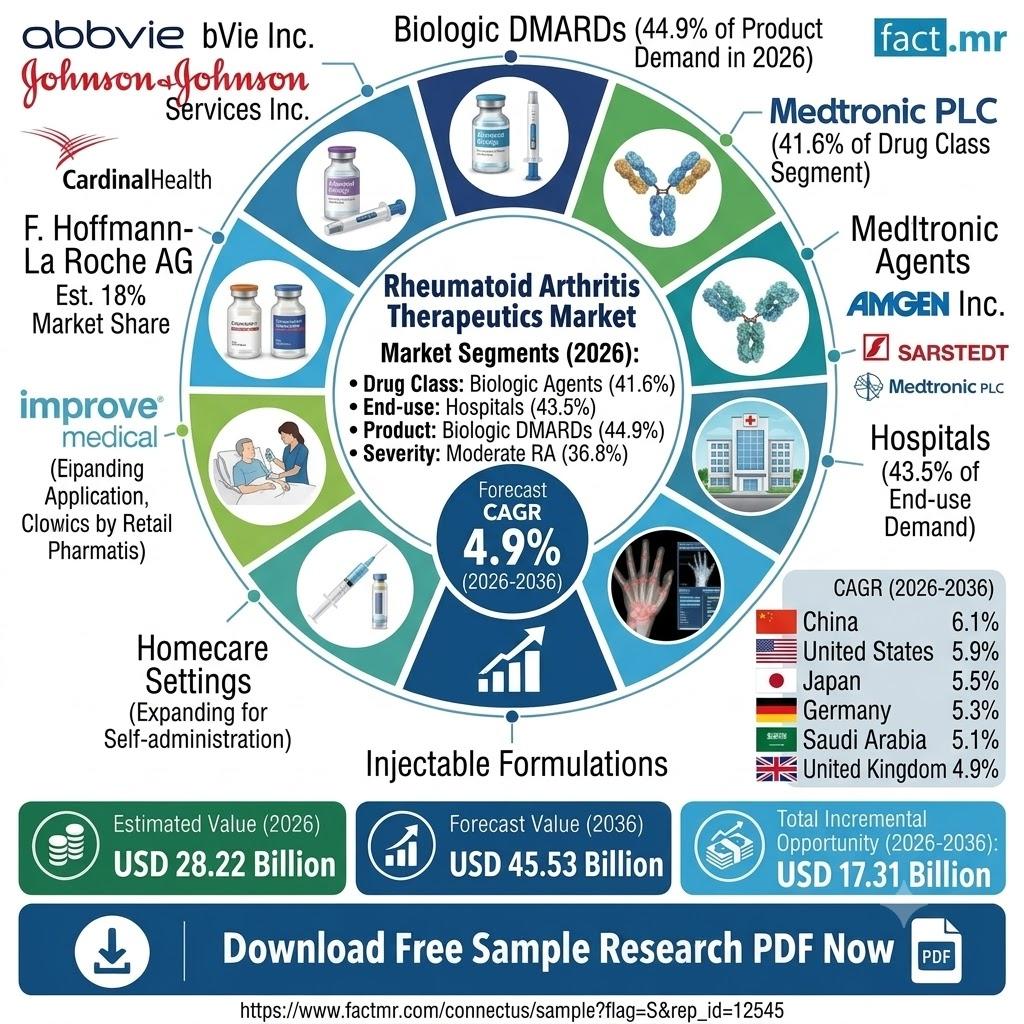
November 2, 2026 — The global rheumatoid arthritis therapeutics market is estimated at USD 28.22 billion in 2026 and is projected to reach USD 45.53 billion by 2036, expanding at a compound annual growth rate (CAGR) of 4.9% during the forecast period, according to Fact.MR. The market was valued at approximately USD 26.9 billion in 2025. Growing adoption of advanced biologic treatments, rising awareness of rheumatoid arthritis management, and improving access to specialist healthcare services are supporting market expansion.
The market is expected to generate an incremental opportunity of USD 17.31 billion between 2026 and 2036. Biologic disease-modifying antirheumatic drugs (DMARDs) will remain the leading product category, accounting for 44.9% of product demand in 2026. Biologic agents are projected to represent 41.6% of the drug class segment, while hospitals will account for 43.5% of end-use demand.
Get detailed market forecasts, competitive benchmarking, and pricing trends: https://www.factmr.com/connectus/sample?flag=S&rep_id=12545
Biologic Treatment Adoption Supports Market Expansion
The growing use of biologic therapies is an important factor shaping the rheumatoid arthritis therapeutics market. These treatments target specific components of the immune system involved in inflammation and disease progression. Their adoption is supported by established clinical protocols and increasing use among patients requiring advanced disease management.
Biologic DMARDs account for 44.9% of product demand in 2026. Tumor necrosis factor inhibitors, interleukin inhibitors, B-cell-targeted therapies, and T-cell co-stimulation modulators form important categories within this segment.
Conventional synthetic DMARDs continue to serve as an important treatment option. Methotrexate-based drugs, sulfasalazine, and leflunomide are widely used in rheumatoid arthritis management. Their established clinical use and availability across healthcare settings support continued demand.
Targeted synthetic DMARDs are also contributing to product development. Janus kinase (JAK) inhibitors offer an alternative treatment approach by targeting specific intracellular signalling pathways involved in inflammatory responses.
Biologic Agents Account for 41.6% of Drug Class Demand
Biologic agents are expected to hold 41.6% of the drug class segment in 2026. Their leading position reflects established use in patients requiring targeted treatment and sustained disease management.
Monoclonal antibodies represent an important category within biologic agents. Tumor necrosis factor-targeting antibodies and interleukin-targeting antibodies are used to manage inflammatory activity. Receptor fusion proteins and soluble receptor inhibitors also contribute to this segment.
Immunosuppressants and conventional synthetic agents maintain a significant role in treatment protocols. Folate antagonists and pyrimidine synthesis inhibitors are among the established therapeutic options.
Anti-inflammatory agents, including nonsteroidal anti-inflammatory drugs and corticosteroids, are used to manage pain and inflammation. These medicines support symptom control, although their role differs from therapies designed to modify disease progression.
Hospitals Remain the Leading End-Use Segment
Hospitals are projected to account for 43.5% of end-use demand in 2026. Their leading position reflects the need for specialist supervision, diagnostic support, and administration of certain advanced therapies.
Specialty clinics and rheumatology centres also contribute to market demand. These facilities provide ongoing disease monitoring and treatment adjustments for patients with different levels of disease activity.
Moderate rheumatoid arthritis represents 36.8% of disease severity demand in 2026. This segment includes patients requiring active disease management and treatment strategies aimed at controlling progression.
The market also covers early-stage and severe rheumatoid arthritis. Treatment requirements vary according to disease activity, patient response, and the need for long-term maintenance. Injectable and oral formulations serve different patient and clinical requirements, while homecare settings are supporting self-administration of suitable therapies.
China and the United States Lead Country-Level Growth
China is projected to register the highest country-level CAGR of 6.1% between 2026 and 2036. Expanding healthcare infrastructure, improving treatment access, and growing institutional adoption are supporting demand for rheumatoid arthritis therapeutics.
The United States market is forecast to expand at a CAGR of 5.9% during the same period. Established healthcare networks, demographic changes, and continued adoption of advanced treatment options are supporting its growth.
Japan is expected to record a CAGR of 5.5%, while Germany is projected to expand at 5.3%. Saudi Arabia is forecast to grow at 5.1%, followed by the United Kingdom at 4.9%.
These markets reflect different demand conditions. China benefits from expanding healthcare capacity and improving access to specialist treatment. The United States maintains demand through established clinical infrastructure and broad access to therapeutic products. Japan and Germany benefit from mature healthcare systems and established institutional procurement networks.
Competitive Landscape and Industry Positioning
The competitive landscape includes established pharmaceutical companies with broad therapeutic portfolios, regulatory experience, and strong institutional distribution networks.
AbbVie Inc., Johnson & Johnson Services Inc., and F. Hoffmann-La Roche AG hold established positions in the market through their product portfolios and geographic reach. Other major participants include Amgen Inc., Pfizer Inc., Bristol Myers Squibb Company, Novartis AG, UCB S.A., Regeneron Pharmaceuticals Inc., and Eli Lilly and Company.
Competition is shaped by clinical evidence, product differentiation, regulatory compliance, and access to healthcare distribution channels. Manufacturers are focusing on strengthening their therapeutic portfolios and expanding their presence across high-growth markets.
The growing importance of targeted therapies is also influencing competitive strategies. Companies with established biologic capabilities and specialised research programmes are positioned to address changing treatment requirements.
Pricing pressure and differences in reimbursement policies remain important market considerations. Regulatory requirements across countries can also increase development and commercialisation costs. These factors influence product accessibility, particularly in healthcare systems with limited treatment budgets.
Analyst Opinion
Shambhu Nath Jha, Principal Consultant at Fact.MR, says, "The rheumatoid arthritis therapeutics market is evolving beyond its traditional demand base. Growth is increasingly shaped by expanding institutional adoption, infrastructure scaling in emerging markets, and the shift toward higher-value products and services. Companies that combine reliable product performance with stronger distribution reach and digital engagement are better positioned to capture the next phase of market expansion."
Manufacturers that strengthen their presence in biologic therapies and improve access across emerging healthcare markets are expected to find new growth opportunities through 2036.
View Related Reports:
https://social.mytamam.com/blogs/841/Mining-Lubricants-Market-to-Reach-USD-5-45-Billion-by
https://ayushjadhavblogs.blogspot.com/2026/10/global-chemical-depolymerization-market.html
https://uddokta64.com/blogs/14962/Digital-PID-Control-and-Automation-Shape-the-Future-of-the
https://gulfsena.com/blogs/112090/Passenger-Cars-to-Account-for-60-of-Global-Automotive-Actuator
About Fact.MR
Fact.MR is a market research and consulting firm providing market intelligence, industry analysis, and strategic insights across multiple sectors. Its research combines primary interviews, secondary sources, and proprietary forecasting models to evaluate market size, growth patterns, competitive positioning, and emerging opportunities.

 English
 Arabic
 Spanish
 Portuguese
 Deutsch
 Turkish
 Dutch
 Italiano
 Russian
 Romaian
 Portuguese (Brazil)
 Greek