


Viral Vector Production Market to Gain USD 6.18 Billion in New Opportunities by 2036
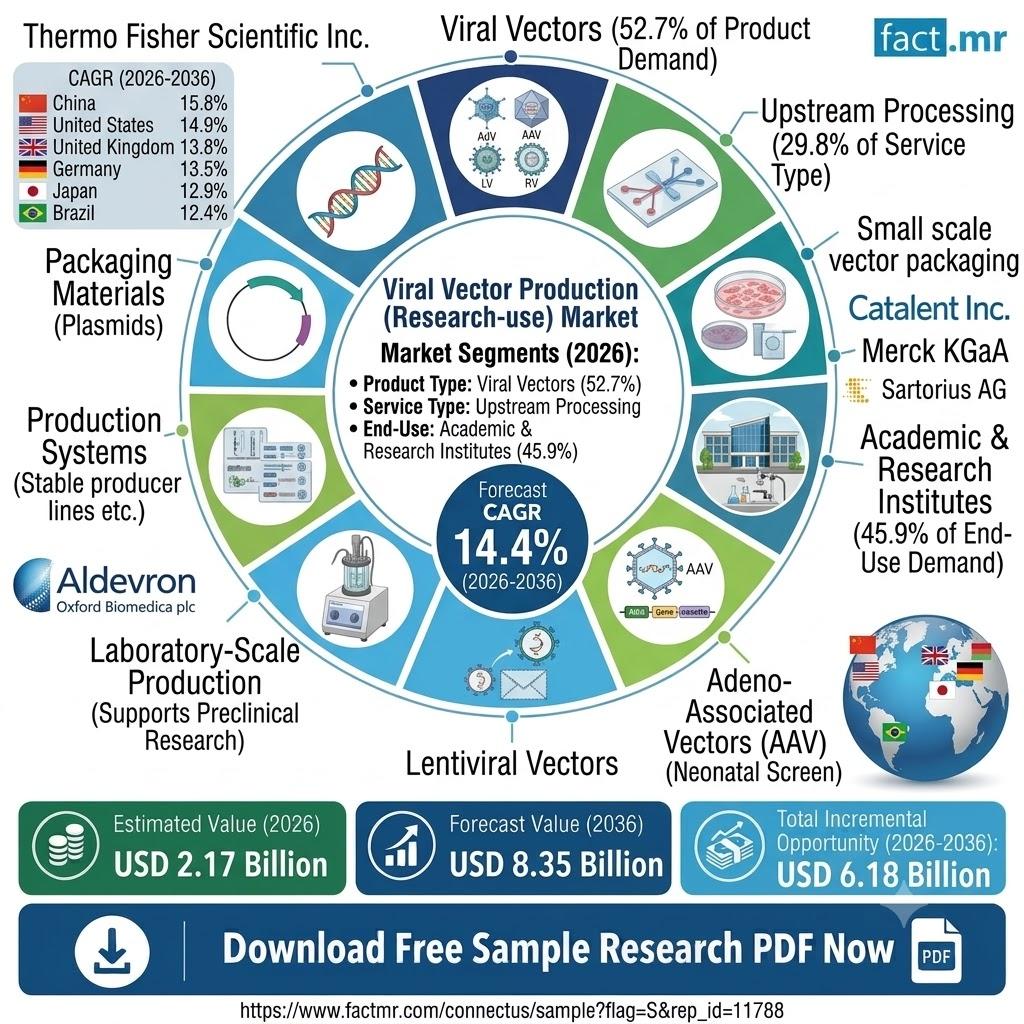
November 2, 2026 — The global viral vector production (research-use) market is estimated at USD 2.17 billion in 2026 and is projected to reach USD 8.35 billion by 2036, expanding at a compound annual growth rate (CAGR) of 14.4% during the forecast period, according to Fact.MR. The market was valued at approximately USD 1.9 billion in 2025. Growing investment in biotechnology research, increasing demand for viral vector-based studies, and expanding institutional production capabilities are supporting market expansion.
The market is expected to generate an incremental opportunity of USD 6.18 billion between 2026 and 2036. Viral vectors will remain the leading product type, accounting for 52.7% of product demand in 2026. Upstream processing services are projected to represent 29.8% of the service type segment, while academic and research institutes will account for 45.9% of end-use demand.
Get detailed market forecasts, competitive benchmarking, and pricing trends: https://www.factmr.com/connectus/sample?flag=S&rep_id=11788
Growing Biotechnology Research Supports Market Expansion
Increasing investment in biotechnology and advanced research programmes is an important factor shaping the viral vector production (research-use) market. Viral vectors are widely used in research applications involving gene delivery, genetic engineering, and the development of advanced therapeutic approaches.
Demand is supported by expanding research infrastructure and the need for reliable vector production systems. Academic institutions, biotechnology companies, and pharmaceutical research teams are increasing their use of specialised products and services to support experimental and preclinical activities.
Viral vectors account for 52.7% of product type demand in 2026. Adeno-associated viral vectors, lentiviral vectors, adenoviral vectors, and retroviral vectors form important categories within this segment.
Production systems and packaging materials also contribute to market demand. Transient transfection systems, stable producer cell lines, and specialised plasmids support different research and production requirements.
Upstream Processing Services Account for 29.8% of Service Type Demand
Upstream processing services are expected to hold 29.8% of the service type segment in 2026. Their position reflects the importance of cell culture, vector design, and transfection activities in viral vector production workflows.
Cell culture services cover adherent and suspension-based processes. These approaches support different production requirements depending on the vector type, research scale, and selected production system.
Transfection services also play an important role in upstream processing. Small-scale transfection and research-scale production help institutions prepare viral vectors for laboratory investigations and preclinical studies.
Downstream processing services contribute to the wider market through purification and quality control activities. Chromatography, ultrafiltration, analytical testing, and safety testing support the assessment of product purity and consistency.
Academic and Research Institutes Remain the Leading End-Use Segment
Academic and research institutes are projected to account for 45.9% of end-use demand in 2026. Their leading position reflects sustained research activity across universities, basic research laboratories, government research institutes, and public health laboratories.
Biotechnology companies also represent an important end-use category. Small and medium-sized firms use viral vector production capabilities to support early-stage research, while larger biotechnology companies require specialised production capacity for advanced research programmes.
Pharmaceutical companies and contract research organizations contribute to demand through research and development activities. Their requirements include preclinical research, outsourced research services, and specialised analytical support.
Production scale also influences purchasing patterns. Laboratory-scale production supports smaller research batches, while pilot-scale facilities help institutions advance process development and prepare material for larger preclinical studies.
China and the United States Lead Country-Level Growth
China is projected to register the highest country-level CAGR of 15.8% between 2026 and 2036. Expanding research infrastructure, rising investment in biotechnology, and growing institutional adoption are supporting demand for viral vector production solutions.
The United States market is forecast to expand at a CAGR of 14.9% during the same period. Established biotechnology research networks, regulatory development, and increasing market access are supporting its growth.
The United Kingdom is expected to record a CAGR of 13.8%, while Germany is projected to expand at 13.5%. Japan is forecast to grow at 12.9%, followed by Brazil at 12.4%.
These markets reflect different research and infrastructure conditions. China benefits from expanding institutional capacity and rising biotechnology investment. The United States maintains demand through established research networks and a strong biotechnology industry. The United Kingdom and Germany benefit from mature research ecosystems and established institutional procurement channels.
Competitive Landscape and Industry Positioning
The competitive landscape includes established life sciences and biopharmaceutical companies with specialised production capabilities, broad product portfolios, and institutional distribution networks.
Thermo Fisher Scientific Inc., Charles River Laboratories International, Inc., and Catalent Inc. hold established positions in the market through their research and production capabilities. Other major participants include Merck KGaA, Oxford Biomedica plc, Sartorius AG, Waisman Biomanufacturing, Aldevron (Danaher Corporation), Takara Bio Inc., and Lonza Group AG.
Competition is shaped by product quality, regulatory compliance, technical capabilities, and institutional relationships. Manufacturers and service providers are focusing on expanding their portfolios and strengthening their presence across high-growth research markets.
The growing importance of specialised production technologies is also influencing competitive strategies. Companies with established viral vector capabilities and integrated processing services are positioned to address changing institutional requirements.
Pricing pressure and differences in regulatory requirements remain important market considerations. Compliance costs across jurisdictions can affect production economics and cross-border supply efficiency. These factors influence purchasing decisions, particularly among smaller research institutions operating with limited budgets.
Analyst Opinion
Shambhu Nath Jha, Principal Consultant at Fact.MR, says, "The viral vector production (research-use) market is evolving beyond its traditional demand base. Growth is increasingly shaped by expanding institutional adoption, infrastructure scaling in emerging markets, and the shift toward higher-value products and services. Companies that combine reliable product performance with stronger distribution reach and digital engagement are better positioned to capture the next phase of market expansion."
Companies that strengthen their viral vector portfolios, expand specialised production services, and improve institutional access across emerging research markets are expected to find new growth opportunities through 2036.
View Related Reports:
https://social.mytamam.com/blogs/841/Mining-Lubricants-Market-to-Reach-USD-5-45-Billion-by
https://ayushjadhavblogs.blogspot.com/2026/10/global-chemical-depolymerization-market.html
https://uddokta64.com/blogs/14962/Digital-PID-Control-and-Automation-Shape-the-Future-of-the
https://gulfsena.com/blogs/112090/Passenger-Cars-to-Account-for-60-of-Global-Automotive-Actuator
About Fact.MR
Fact.MR is a market research and consulting firm providing market intelligence, industry analysis, and strategic insights across multiple sectors. Its research combines primary interviews, secondary sources, and proprietary forecasting models to evaluate market size, growth patterns, competitive positioning, and emerging opportunities.

 English
 Arabic
 Spanish
 Portuguese
 Deutsch
 Turkish
 Dutch
 Italiano
 Russian
 Romaian
 Portuguese (Brazil)
 Greek