


Generative AI for Business: 7 Practical Use Cases to Start With
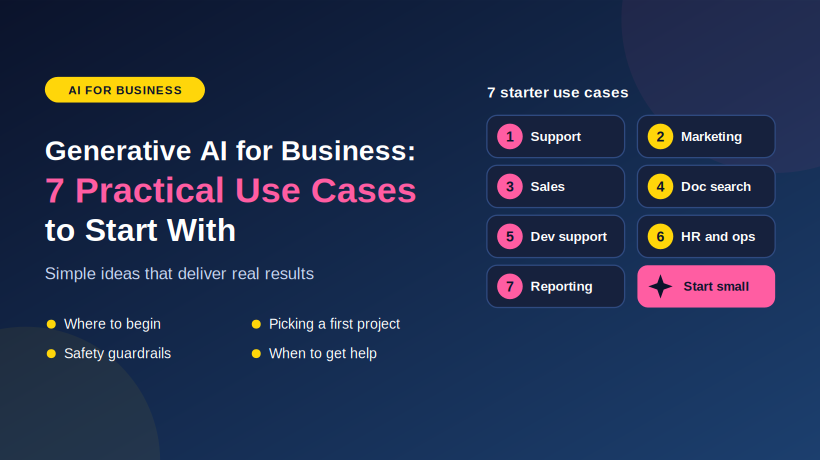
Using AI is no longer the hard part. Making it pay off is. McKinsey's State of AI 2026 survey, which gathered responses from 1,719 participants across 97 countries, found that 89 percent of respondents say their organizations regularly use AI in at least one business function, yet only 37 percent report any positive contribution to operating profit (EBIT). That gap suggests that many companies start with big ideas and unclear goals, instead of small projects with measurable results. To help you avoid that trap, here are seven generative AI use cases that are practical, easy to explain to your team, and realistic to begin with.
Seven Places Where Generative AI Earns Its Keep
- Customer support assistants: AI chatbots can answer common questions, summarize long ticket histories, and draft replies for human agents to review.
- Marketing content drafts: Teams can create first versions of emails, product descriptions, and social posts, then edit them to match the brand voice.
- Sales enablement: AI can summarize calls, suggest follow-up messages, and prepare proposal drafts, so salespeople spend more time with customers.
- Document summarization and search: Employees can ask questions about contracts, reports, and internal policies, and receive short answers with links to the original pages.
- Software development support: Developers use AI for code suggestions, test creation, and documentation, which speeds up routine work.
- HR and internal operations: AI can help write job descriptions, answer onboarding questions, and prepare training materials.
- Reporting and data insights: Managers can ask questions about their data in plain language and receive written summaries of dashboards and trends.
How to Pick Your First Project Without Overthinking It
A good starter project usually meets these four conditions:
- It solves a repeated task: Work that happens daily or weekly gives you plenty of chances to measure improvement.
- It has a clear success measure: Examples include hours saved, faster response times, or fewer manual errors.
- It has accessible data: The tool needs reliable information, such as help articles or past reports, to produce useful answers.
- It carries low risk: Begin with internal tasks or drafts that a person reviews before anything reaches a customer.
Guardrails That Protect Your Brand
Strong results depend on simple rules that everyone understands:
- Keep a human in the loop: Review AI output before publishing it or sending it to customers.
- Protect sensitive data: Do not paste confidential or personal information into public tools without approval.
- Check for accuracy: AI can sound confident while being wrong, so verify facts, numbers, and sources.
- Control access: Give each team member only the tools and data they need.
- Be transparent: Tell customers and employees when AI plays a role in a process, where it matters.
When It Makes Sense to Bring in Experts
Simple tools can work well for writing and summarizing. However, connecting AI to your own data, systems, and security requirements is a bigger task. In that case, generative AI development company can help you design the solution, test it safely, and fit it into your existing workflows. A good partner will also ask about your goals first, instead of pushing a tool before they understand the problem.
Final Thoughts: Start Small, Measure Honestly
Success with generative AI for business comes from focus, not from doing everything at once. In the same McKinsey survey, 80 percent of respondents said AI improved their own productivity, but that personal benefit does not automatically become company-wide profit. The lesson is to choose one use case, redesign the workflow around it, and track the results honestly before you expand.
Frequently Asked Questions
1. What is the easiest way to start with generative AI?
Choose one repetitive, low-risk task, such as drafting emails or summarizing documents, and test it with a small team.
2. Do I need technical skills to use generative AI?
Not for simple tools. Custom solutions connected to your data or systems usually need developers and security review.
3. Is generative AI safe for confidential business data?
It can be, but only with approved tools, clear policies, and proper access controls. Avoid sharing sensitive data with public tools.
4. How do I measure whether a use case is working?
Track a clear metric, such as time saved, response speed, or error rates, and compare it with the results before AI.
5. Will generative AI replace my employees?
It mostly handles routine parts of tasks, while people still provide judgment, creativity, and customer relationships.

 English
 Arabic
 French
 Spanish
 Portuguese
 Deutsch
 Turkish
 Italiano
 Russian
 Romaian
 Portuguese (Brazil)
 Greek