


Passenger Boarding Bridge Market to Expand 1.57X Over the Next Decade
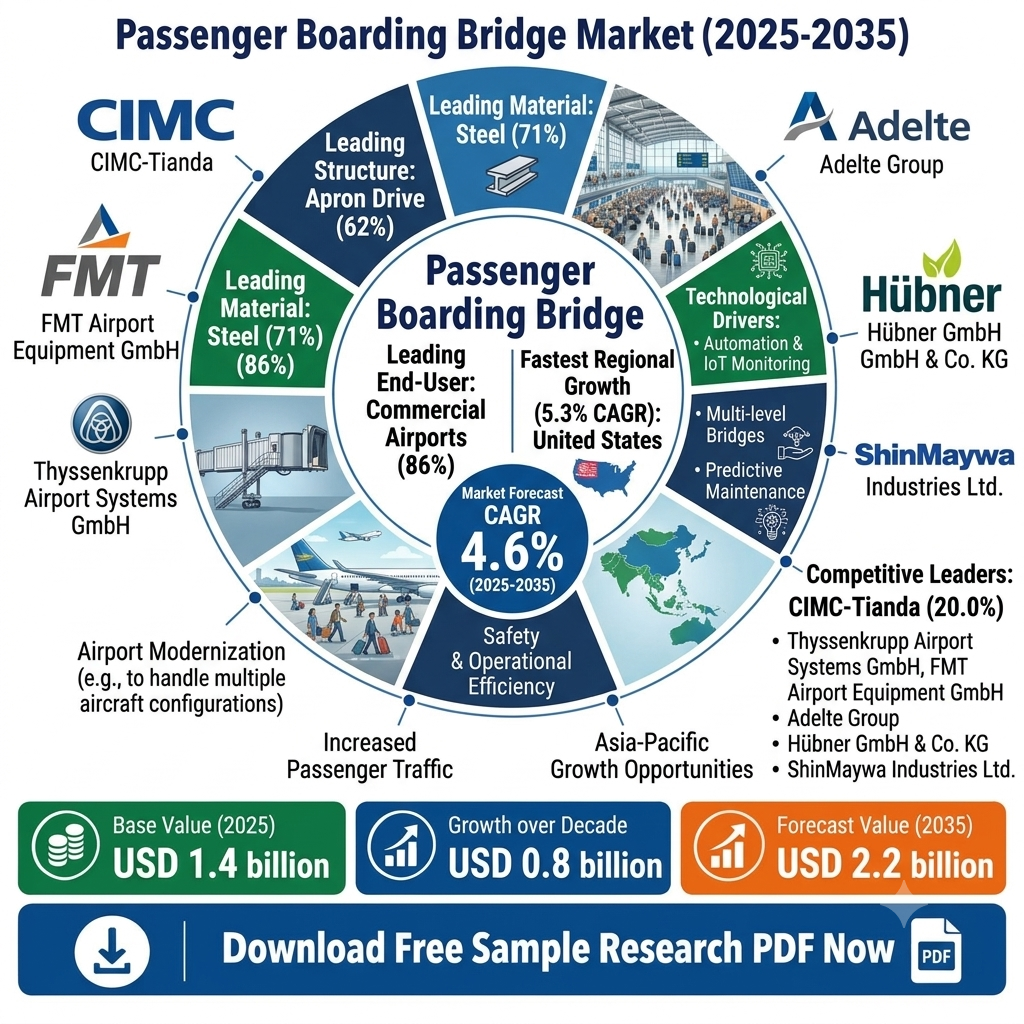
Global passenger boarding bridge market is projected to grow at a 4.6% CAGR from 2025 to 2035, driven by airport modernization and rising air travel demand.
November 4, 2026 — The global passenger boarding bridge market is projected to increase from USD 1.4 billion in 2025 to USD 2.2 billion by 2035, registering a compound annual growth rate (CAGR) of 4.6% during the forecast period, according to Fact.MR. The market will record an absolute value increase of USD 0.8 billion, representing total growth of 57.1% over the decade. Increasing air passenger traffic, airport expansion projects, and investments in advanced terminal infrastructure are supporting demand for modern passenger boarding systems.
Airports are prioritizing passenger safety and operational efficiency. Passenger boarding bridges provide enclosed, weather-protected access between airport terminals and aircraft, helping operators manage passenger movement while reducing exposure to outdoor conditions. Growing passenger volumes and the need to improve aircraft turnaround times are encouraging airport authorities to upgrade existing boarding infrastructure and invest in new installations.
Get detailed market forecasts, competitive benchmarking, and pricing trends: https://www.factmr.com/connectus/sample?flag=S&rep_id=6662
Passenger Boarding Bridge Market Gains from Airport Modernization
The passenger boarding bridge market is entering a period of continued infrastructure development. Between 2025 and 2030, the market is expected to increase from USD 1.4 billion to USD 1.7 billion, adding USD 0.3 billion. The remaining USD 0.5 billion in growth is projected between 2030 and 2035, taking the market to USD 2.2 billion.
Airport modernization is changing equipment requirements. Operators increasingly seek boarding bridges that can accommodate different aircraft configurations while supporting efficient passenger handling. Manufacturers are responding with automated height and length adjustment, energy-efficient motors, and Internet of Things (IoT)-enabled monitoring systems.
These features allow airport operators to monitor equipment conditions, coordinate bridge positioning, and identify maintenance requirements. Retractable and multi-level boarding bridge configurations are also gaining attention, particularly at busy international airports handling different aircraft categories.
The shift toward intelligent airport operations is creating additional opportunities for manufacturers. Digital monitoring and automated controls are becoming relevant considerations in new airport infrastructure projects.
Apron Drive Structures Hold a 62% Market Share
By structure, the apron drive segment is projected to account for 62.0% of the passenger boarding bridge market in 2025, making it the leading category. Its mobility and positioning flexibility allow airport operators to serve different aircraft types while maintaining operational efficiency.
Steel is expected to dominate the material segment with a 71.0% share in 2025. Its structural strength and durability make it a preferred material for boarding bridge construction across commercial airports and regional terminals.
Commercial airports represent the largest end-user category. The segment is projected to account for 86.0% of market demand in 2025, reflecting the extensive passenger handling requirements of commercial aviation facilities.
These figures highlight an important market characteristic: commercial airport operations remain the central source of demand, while apron drive configurations and steel construction account for the leading shares across their respective segments.
Asia Pacific Creates New Growth Opportunities
North America and Europe maintain established positions through developed airport networks and investments in infrastructure upgrades. Asia Pacific, however, is expected to experience the fastest regional growth as airport construction and aviation expansion continue across China, India, and Southeast Asia.
The United States is projected to record a 5.3% CAGR through 2035, the highest among the seven highlighted country markets. Mexico follows at 5.0%, while Germany is forecast to expand at 4.6%. France is expected to register 4.4% growth, followed by the United Kingdom at 4.1%.
South Korea and Japan are projected to record CAGRs of 4.0% and 3.8%, respectively.
Europe's passenger boarding bridge market is forecast to increase from USD 420 million in 2025 to USD 660 million by 2035, at a CAGR of 4.6%. Germany is expected to maintain its regional leadership, accounting for 25.1% of European market revenue in 2025.
Automation and Safety Shape Competitive Strategies
Technology development is becoming an important competitive factor. Manufacturers are focusing on automated boarding operations, intelligent monitoring, improved safety systems, and predictive maintenance capabilities.
However, the market faces constraints. High infrastructure costs, installation complexity, and regulatory compliance requirements can affect procurement decisions. Airport operators must also evaluate equipment lifecycle costs and compatibility with existing terminal infrastructure.
CIMC-Tianda leads the competitive landscape with a reported 20.0% market share. Other prominent participants include FMT Airport Equipment GmbH, Thyssenkrupp Airport Systems GmbH, Adelte Group, Hübner GmbH & Co. KG, and ShinMaywa Industries Ltd.
Manufacturers are increasingly competing through product development and integrated airport equipment capabilities. Regional service networks and technical support also remain important considerations for airport operators purchasing specialized boarding systems.
Industry Outlook
The passenger boarding bridge market is expected to benefit from continued airport infrastructure investment through 2035. Demand will depend on passenger traffic growth, terminal expansion, and the adoption of automated passenger handling technologies.
Fact.MR identifies the growing requirement for flexible boarding configurations as an important market consideration. Manufacturers that address operational reliability, passenger safety, and equipment monitoring requirements will be positioned to participate in upcoming airport modernization projects.
View Related Reports :
https://social.mytamam.com/blogs/1216/Automated-Breast-Ultrasound-System-Market-to-Reach-USD-2-1
https://ayushjadhavblogs.blogspot.com/2026/11/wireless-handheld-ultrasound-devices.html
https://acmingle.com/blogs/34983/Osseointegration-Implants-Market-to-Reach-USD-6-85-Billion-by
https://social.art-inpa.com/blogs/45769/Drug-Eluting-Stent-Market-Expected-to-Reach-USD-15-8
About Fact.MR
Fact.MR is a market research and consulting firm providing market intelligence, industry analysis, and strategic insights across global business sectors. The company delivers research covering market size, growth forecasts, competitive landscapes, emerging trends, and industry developments to support informed business decisions.

 English
 Arabic
 French
 Spanish
 Portuguese
 Deutsch
 Dutch
 Italiano
 Russian
 Romaian
 Portuguese (Brazil)
 Greek