


How Does a Modular IVF Lab Setup Company Support Digital Laboratory Infrastructure?
Introduction
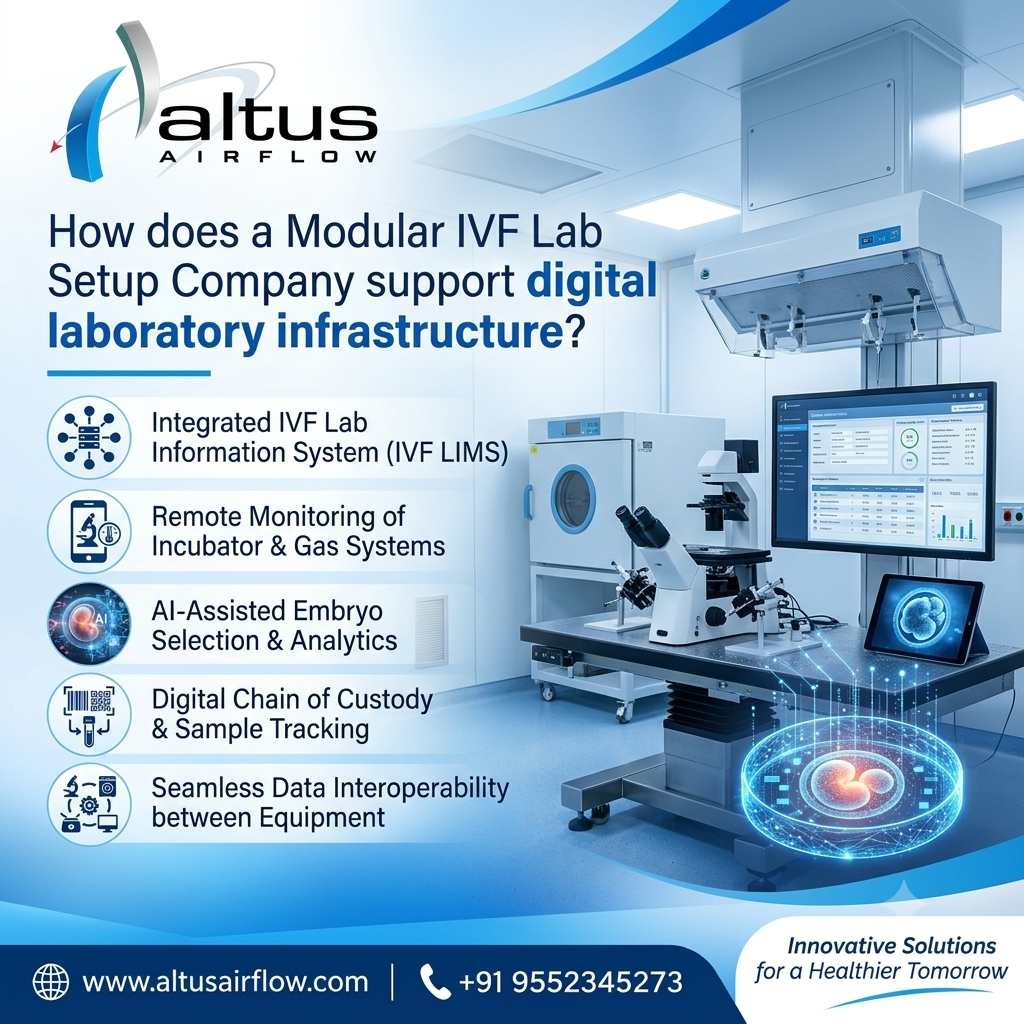
Altus Airflow recognises that modern IVF laboratories require more than specialised equipment and controlled environments. A Modular IVF Lab Setup Company supports digital laboratory infrastructure by integrating smart monitoring systems, connected equipment, data networks, and environmental control technologies into the laboratory design. These solutions help fertility centres monitor critical operating conditions, organise laboratory information, and improve coordination between equipment and staff. From temperature monitoring and alarm management to digital documentation and equipment connectivity, a well-planned digital infrastructure supports reliable laboratory operations while keeping future technology upgrades in mind.
1. Understanding Digital Infrastructure in an IVF Laboratory
Digital laboratory infrastructure refers to the connected technologies, monitoring systems, communication networks, and software platforms used to manage laboratory operations.
An IVF laboratory may contain incubators, microscopes, micromanipulation systems, cryopreservation equipment, refrigerators, and environmental monitoring devices. Digital integration helps these systems work within a coordinated technical environment.
A digital infrastructure plan may include:
-
Environmental monitoring systems.
-
Temperature and humidity sensors.
-
Equipment connectivity.
-
Laboratory information management systems.
-
Data storage and backup arrangements.
-
Network infrastructure.
-
Digital alarm notifications.
-
Access control and cybersecurity measures.
The objective is to create an organised environment where authorised personnel can access relevant information, monitor equipment status, and maintain appropriate records.
2. Smart Environmental Monitoring Systems
Environmental monitoring is an important part of IVF laboratory management. Temperature, humidity, and other specified environmental parameters may need regular monitoring according to laboratory procedures.
Digital monitoring systems use connected sensors to collect measurements and display them through a central platform.
Typical functions include:
Real-time monitoring: Displays readings from selected laboratory locations and connected equipment.
Continuous data recording: Stores measurements for review and documentation.
Trend analysis: Helps laboratory personnel identify recurring fluctuations or unusual patterns.
Alarm notifications: Alerts authorised staff when monitored values move outside configured limits.
Historical reports: Provides access to recorded information for internal review and quality management.
Sensors should be selected, installed, calibrated, and verified according to the intended application. Digital monitoring does not replace established laboratory procedures; it helps staff access information and respond to deviations more systematically.
3. Integration of Temperature and Humidity Sensors
Temperature and humidity monitoring may be required in different laboratory zones, including embryology work areas, equipment rooms, and storage locations.
A digital monitoring network can connect multiple sensors to a central display or monitoring platform.
Important features may include:
-
Sensor placement based on room layout.
-
Configurable operating limits.
-
Continuous or scheduled data collection.
-
Alarm settings for abnormal readings.
-
User access to historical measurements.
-
Calibration and verification records.
-
Reports for quality documentation.
For example, if a room temperature reading moves outside its configured range, the monitoring platform can generate an alert for authorised personnel. Staff can then investigate the condition and follow the laboratory's deviation-response procedure.
Sensor placement should be determined through environmental assessment rather than choosing locations only for convenience.
4. Digital Connectivity for IVF Laboratory Equipment
IVF laboratories use specialised instruments that may generate operational data, status information, and measurement records. Digital connectivity can help organise this information where equipment supports compatible communication interfaces.
Potentially connected equipment includes:
-
IVF incubators.
-
Time-lapse monitoring systems.
-
Microscopes and imaging devices.
-
Cryogenic storage monitoring systems.
-
Refrigerators and freezers.
-
Laboratory computers.
-
Environmental monitoring devices.
Depending on the equipment, connectivity may support remote status viewing, data transfer, event recording, or integration with approved laboratory software.
However, not every instrument supports the same connectivity features. Equipment selection should consider communication protocols, software compatibility, data export options, and manufacturer support.
5. Laboratory Information Management Systems
A Laboratory Information Management System (LIMS) can help organise laboratory information and workflows. Depending on the software, it may support sample identification, record management, procedure tracking, and reporting.
In an IVF setting, digital record management must be designed around the clinic's clinical processes and applicable privacy requirements.
Potential LIMS functions include:
Sample identification: Supports consistent identification and tracking of laboratory samples.
Workflow records: Helps document relevant stages of laboratory procedures.
User permissions: Restricts access according to assigned responsibilities.
Data retrieval: Allows authorised users to locate records when required.
Reporting: Supports the preparation of operational and quality-related reports.
A LIMS should be selected and configured with clinical and laboratory stakeholders. Its implementation requires appropriate validation, staff training, and procedures for handling system interruptions.
6. Digital Monitoring of Incubators and Cryogenic Storage
Incubators and cryogenic storage systems are important components of IVF laboratory operations. Their monitoring requirements depend on the equipment design, manufacturer specifications, and laboratory procedures.
Digital monitoring solutions can help staff observe selected parameters and identify equipment alarms.
For incubators, monitoring may involve:
-
Temperature readings.
-
Gas concentration information where supported.
-
Alarm status.
-
Door-opening events where available.
-
Recovery information after interruptions.
-
Equipment operating status.
For cryogenic storage, monitoring may include:
-
Storage temperature.
-
Liquid nitrogen level where applicable.
-
Sensor status.
-
Alarm conditions.
-
Historical measurement records.
These systems can provide useful operational information, but they should not replace manufacturer-recommended maintenance, calibration, or independent checks where required.
7. Building Management System Integration
A Building Management System (BMS) can provide centralised monitoring and control of selected building services.
In a modular IVF laboratory, BMS integration may cover compatible HVAC equipment, air handling units, temperature sensors, humidity monitoring, and other building infrastructure.
Possible benefits include:
-
Centralised HVAC status monitoring.
-
Visibility of environmental readings.
-
Equipment fault notifications.
-
Scheduled system operation.
-
Historical performance information.
-
Coordination of selected building services.
The integration should clearly distinguish between building-level controls and laboratory-specific equipment monitoring. Critical laboratory instruments may require independent monitoring systems with their own alarms and backup arrangements.
A well-planned interface helps avoid unnecessary duplication while ensuring that important alerts reach the appropriate personnel.
8. Digital Alarm and Notification Management
Digital alarm systems help laboratory personnel identify conditions that require attention. They can be configured to notify authorised users when monitored parameters exceed specified limits or when connected equipment reports a fault.
Alarm management may include:
Temperature alerts: Notifications for readings outside defined operating limits.
Humidity alerts: Warnings when relative humidity moves beyond configured ranges.
Equipment alarms: Notifications about faults or abnormal operating conditions reported by connected instruments.
Power failure alerts: Notifications when monitoring systems detect a power interruption.
Communication failure alerts: Warnings when sensors or connected devices stop transmitting data.
Alarm thresholds and escalation procedures should be defined by the laboratory's quality and technical teams. Staff should receive training on acknowledging alerts, documenting incidents, and taking appropriate action.
9. Network Infrastructure and Data Security
Digital laboratory systems depend on reliable network infrastructure. Poor connectivity can interrupt data transfer, monitoring, and access to laboratory software.
A digital infrastructure plan should consider:
-
Structured network cabling.
-
Secure wireless connectivity where appropriate.
-
Network switches and access points.
-
Separate network segments for critical devices where suitable.
-
Secure server or cloud arrangements.
-
Backup and recovery systems.
-
User authentication.
-
Access permissions.
-
Software updates and cybersecurity controls.
Healthcare facilities should work with qualified IT professionals to establish security policies. Patient and laboratory data should be protected through suitable access controls, encryption where supported, secure backups, and compliance with applicable privacy and data protection requirements.
10. Digital Documentation and Quality Management
Digital documentation can help laboratories maintain organised records and retrieve information when needed.
Depending on the software platform, digital records may include:
-
Equipment maintenance history.
-
Calibration records.
-
Environmental monitoring reports.
-
Validation and commissioning documents.
-
Staff training records.
-
Incident and deviation reports.
-
Standard operating procedures.
-
Audit trails.
Digital systems can reduce reliance on scattered paper records and improve the consistency of documentation. However, electronic records must be managed through defined procedures, appropriate access controls, and reliable backup arrangements.
The laboratory should also establish how records will be reviewed, retained, corrected, and retrieved during audits or inspections.
11. Supporting Digital Integration Through Modular Design
Digital infrastructure is easier to coordinate when network routes, power points, sensor locations, and equipment connections are considered during the initial laboratory design.
A modular approach can help organise these services within a planned layout.
Design considerations may include:
Cable routing: Providing organised pathways for power, network, and communication cables.
Service access: Ensuring that connections remain accessible for inspection and maintenance.
Sensor positioning: Allocating suitable locations for environmental monitoring devices.
Equipment placement: Planning workstations around equipment dimensions and connectivity requirements.
Future expansion: Allowing capacity for additional devices and monitoring points.
Ceiling coordination: Integrating lighting, HVAC outlets, sensors, and other services without creating installation conflicts.
This early coordination can reduce the need for disruptive modifications after the laboratory becomes operational.
12. Testing and Commissioning Digital Systems
Digital infrastructure must be tested before final handover. Installing sensors and connecting devices is not enough; their functionality and communication must be verified.
Commissioning activities may include:
-
Checking sensor installation and identification.
-
Verifying readings against suitable reference instruments.
-
Testing data transmission.
-
Checking alarm thresholds and notifications.
-
Confirming user permissions.
-
Reviewing historical data recording.
-
Testing backup and recovery arrangements.
-
Verifying integration with compatible equipment.
-
Documenting test results and corrective actions.
-
Training authorised laboratory personnel.
Where digital systems influence critical laboratory processes, the facility should establish suitable software validation and change-control procedures based on risk and applicable requirements.
13. How to Choose the Right Digital Infrastructure
Hospitals and fertility centres should evaluate digital requirements before selecting equipment or software.
Important considerations include:
-
Laboratory workflow and clinical requirements.
-
Compatibility with existing instruments.
-
Environmental monitoring needs.
-
Data storage and retention requirements.
-
Network reliability.
-
Cybersecurity provisions.
-
Alarm notification arrangements.
-
Software support and maintenance.
-
Staff training requirements.
-
Future technology expansion.
A multidisciplinary discussion involving embryologists, laboratory managers, biomedical engineers, IT teams, and facility engineers can help identify the right technical solution.
A digital system should solve a defined operational need rather than introduce unnecessary complexity. Its features must also be practical for daily use and supported throughout the equipment lifecycle.
Conclusion
Digital laboratory infrastructure helps IVF facilities coordinate environmental monitoring, equipment connectivity, data management, alarm notifications, and building services. Technologies such as connected sensors, LIMS platforms, BMS integration, digital equipment monitoring, and secure network systems can improve access to operational information and support consistent documentation. Successful implementation depends on compatibility, cybersecurity, staff training, system commissioning, and clear procedures for responding to alerts.
A Modular IVF Lab Setup Company can support digital integration by considering these requirements during laboratory planning, infrastructure installation, and technical coordination. Altus Airflow focuses on modular healthcare infrastructure and laboratory engineering, helping facilities plan connected systems alongside essential laboratory services. With careful design and appropriate testing, Altus Airflow supports the development of organised IVF laboratories that are prepared for evolving digital requirements.
Frequently Asked Questions (FAQs)
1. How does a Modular IVF Lab Setup Company support digital laboratory infrastructure?
A Modular IVF Lab Setup Company can coordinate environmental sensors, equipment connectivity, digital monitoring, network infrastructure, and laboratory information systems as part of the laboratory design.
2. What digital monitoring systems are used in IVF laboratories?
They may include temperature, humidity, pressure, incubator, and cryogenic storage monitoring systems.
3. Can IVF laboratory equipment connect to digital platforms?
Yes. Compatible equipment can transmit selected operational data to approved monitoring or laboratory software platforms.
4. What is the role of a LIMS in an IVF laboratory?
A LIMS helps organise sample information, laboratory records, workflow documentation, and reporting.
5. Can a BMS monitor IVF laboratory HVAC systems?
Yes. A compatible BMS can monitor selected HVAC equipment and environmental parameters.
Read Our Previous Blog ---------------> How do Modular IVF Labs Manufacturers help laboratories achieve accreditation?

 Arabic
 French
 Spanish
 Portuguese
 Deutsch
 Turkish
 Dutch
 Italiano
 Russian
 Romaian
 Portuguese (Brazil)
 Greek