


Growing Focus on Natural Tooth Preservation Drives Regenerative Dentistry Adoption
Increasing applications of regenerative endodontics are supporting market growth. Regenerative endodontic procedures aim to restore damaged dental pulp and support the development of healthy tissues within the root canal system. These approaches offer potential alternatives to conventional treatments in selected clinical cases. Growing research interest and advancements in biological treatment methods are expected to create additional opportunities during the forecast period.
Market Overview
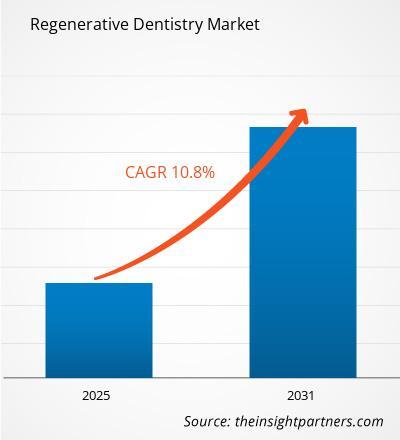
The Regenerative Dentistry Market was valued at US$2.32 billion in 2024 and is expected to reach US$4.72 billion by 2031, registering a CAGR of 10.8% during 2025–2031, according to The Insight Partners. The market is segmented by type into natural and synthetic biomaterials; by technology into tissue engineering, stem cell therapy, and others; by application into periodontal regeneration, endodontic regeneration, tooth reconstruction, bone regeneration, and others; by age group into adult and pediatric; and by end user into dental clinics, hospitals, and others.
Regenerative dentistry focuses on restoring damaged or lost dental and oral tissues using biomaterials, scaffolds, growth factors, and cell-based approaches. Rather than only replacing a missing or diseased structure, these treatments aim to help the body rebuild gum tissue, bone, and pulp. Growing use of tissue regeneration is expected to shape new trends in the market over the forecast period.
Rising dental disorders, an aging population, and demand for cosmetic dentistry are supporting market development. Manufacturers are responding with product innovation, partnerships, and a wider range of regenerative materials and solutions.
Download Sample PDF: https://www.theinsightpartners.com/sample/TIPRE00040964
Rising Prevalence of Dental Disorders and Aging Population
An aging global population is an important factor supporting the Regenerative Dentistry Market. Gum disease and tooth loss become more common with age, which increases demand for restorative and regenerative procedures. The WHO projects that one in six people worldwide will be aged 60 or over by 2030. In the US, roughly 70% of adults over 65 had periodontal disease in 2020, according to the CDC.
Tooth loss also varies widely by region and income level. Complete tooth loss among people aged 65–74 is estimated at up to 35% in upper-middle-income countries, compared with about 10% in low-income countries. Vulnerable groups, such as homeless populations, also carry a high oral disease burden, which highlights the need for solutions that restore lost dental structures.
Manufacturers and clinicians are focusing on biomaterials and stem cell therapies to meet this need. Continued growth in oral health problems may support demand across different markets.
Surging Demand for Cosmetic Dentistry
Patients increasingly want straighter, more natural-looking smiles, and this is encouraging uptake of implants, veneers, and gum contouring. Higher disposable incomes, social media influence, and minimally invasive techniques are supporting this trend. Dental implants appeal to patients because they look natural and are more comfortable than removable dentures. Younger patients are also choosing implants over bridges.
Access to advanced care is uneven. According to the report, 69% of the world’s 1.6 million dentists serve only 27% of the global population, while Africa holds about 1% of the dental workforce. Patients in Europe and the Americas therefore have wider access to advanced regenerative and cosmetic options.
Greater awareness of regenerative options and ongoing research may continue to support demand from both practitioners and patients.
Technological Advancements in Regenerative Dentistry
Technology is creating new opportunities in the market. Key innovations include:
-
3D printing and bioprinting: Patient-specific implants, crowns, bridges, and bone grafts can be produced with high precision, which can reduce surgery time.
-
Stem cell therapy: Stem cells from dental pulp and periodontal ligament are being studied for regenerating dental tissues. Services that collect and preserve stem cells from extracted teeth are also emerging.
-
PRP and PRF: Platelet-rich plasma and platelet-rich fibrin are used to support healing and implant integration in periodontal and implant procedures.
-
Regenerative materials: Bioactive glass and hydroxyapatite composites are improving graft performance and supporting faster recovery.
-
Artificial intelligence: AI supports diagnostics, treatment planning, and procedure precision.
-
Tissue engineering and scaffolds: Three-dimensional porous scaffolds provide structure and deliver cells or bioactive agents, which opens options beyond conventional root canal and vital pulp treatments.
These developments are enabling more patient-specific treatment and encouraging competition among manufacturers.
Strong Position of Dental Clinics and Periodontal Applications
Dental clinics are the main point of care for regenerative procedures, accounting for 59.8% of the market in 2024. Periodontal regeneration was the largest application segment, with a 35.7% share in the same year. Natural biomaterials led the type segment with a 68.3% share.
Tissue engineering is expected to be the fastest-growing technology segment, at a CAGR of 11.2%. The adult segment is expected to grow at 11% among age groups.
Top Players in the Regenerative Dentistry Market
The Regenerative Dentistry Market includes companies involved in dental biomaterials, implants, and regenerative solutions. The Insight Partners identifies the following companies among the participants covered in its report:
-
Dentsply Sirona Inc.
-
Geistlich Pharma AG
-
Evonik Industries AG
-
ZimVie Inc.
-
BioHorizons Inc.
-
Nobel Biocare Services AG
-
UBGEN
-
B&B Dental Implant Company
-
Botiss Biomaterials GmbH
-
Envista Holdings Corporation
-
3M
-
Institut Straumann AG
Market participants compete through product innovation, clinical performance, distribution networks, partnerships, and regulatory compliance. The list is not presented as a ranking.
Recent developments include Geistlich receiving MDR certification for its Chondro-Gide collagen membrane in July 2024. In February 2024, BioHorizons Camlog announced Striate+, a collagen membrane developed by Orthocell for bone and tissue regeneration, under a global distribution and manufacturing agreement.
Market Segmentation
The Regenerative Dentistry Market is segmented by type, technology, application, age group, end user, and geography.
By Type
-
Natural
-
Synthetic
By Technology
-
Tissue Engineering
-
Stem Cell Therapy
-
Others
By Application
-
Periodontal Regeneration
-
Endodontic Regeneration
-
Tooth Reconstruction
-
Bone Regeneration
-
Others
By Age Group
-
Adult
-
Pediatric
By End User
-
Dental Clinics
-
Hospitals
-
Others
By Geography
-
North America
-
Europe
-
Asia Pacific
-
South and Central America
-
Middle East and Africa
Regional Outlook
North America dominated the market with a 43.3% share in 2024 and is expected to keep its lead. The United States is the largest national market and is projected to grow at a CAGR of 11.1%. Demand is supported by a high burden of cavities and gum disease, along with active research into stem cell therapy and tissue engineering. Early clinical trials have shown encouraging results, though many studies are small and larger multicenter trials are still needed. The report’s regional analysis covers the US, Canada, and Mexico.
Europe is another significant market, with strong access to dental professionals and advanced cosmetic and regenerative treatments. The report covers the UK, Germany, France, Russia, Italy, and the rest of Europe.
Asia Pacific is expected to be the fastest-growing region, at a CAGR of 11.3% over the forecast period. China, India, Japan, Australia, and other regional markets are included.
South and Central America covers Brazil, Argentina, and other countries in the region. The Middle East and Africa covers South Africa, Saudi Arabia, the UAE, and other countries. Opportunities in both regions depend on healthcare access, affordability, and awareness.
Future Outlook
The market is expected to grow from US$2.32 billion in 2024 to US$4.72 billion by 2031, according to The Insight Partners. Growth is expected to be driven by aging populations, rising dental disorders, cosmetic dentistry demand, and advances in biomaterials, stem cell therapy, 3D printing, and AI. Minimally invasive solutions and digital integration may create further opportunities for manufacturers.
At the same time, the high cost of regenerative treatment remains a barrier to adoption. Regulatory requirements, the need for larger clinical trials, and competition will also influence market performance. Overall, the shift toward tissue regeneration and patient-specific care is expected to support the market’s development.
Related Reports –
Dental Regenerative Products Market Demand, Share & Growth by 2034
About Us
The Insight Partners, we provide comprehensive analysis and insights into market trends that empower businesses to make informed decisions. Our reports are designed to equip stakeholders with the necessary information to navigate the complexities of various industries, including healthcare, technology, and finance. We are dedicated to delivering high-quality research that enables our clients to achieve their strategic objectives.
Contact Us:
Contact Person: Ankit Mathur
E-mail: ankit.mathur@theinsightpartners.com
Phone: +1-646-491-9876
Also Available in : Korean German Japanese French Chinese Italian Spanish

 English
 French
 Spanish
 Portuguese
 Deutsch
 Turkish
 Dutch
 Italiano
 Russian
 Romaian
 Portuguese (Brazil)
 Greek