


Contact Lens Market Outlook Strengthens with Rising Vision Correction Demand
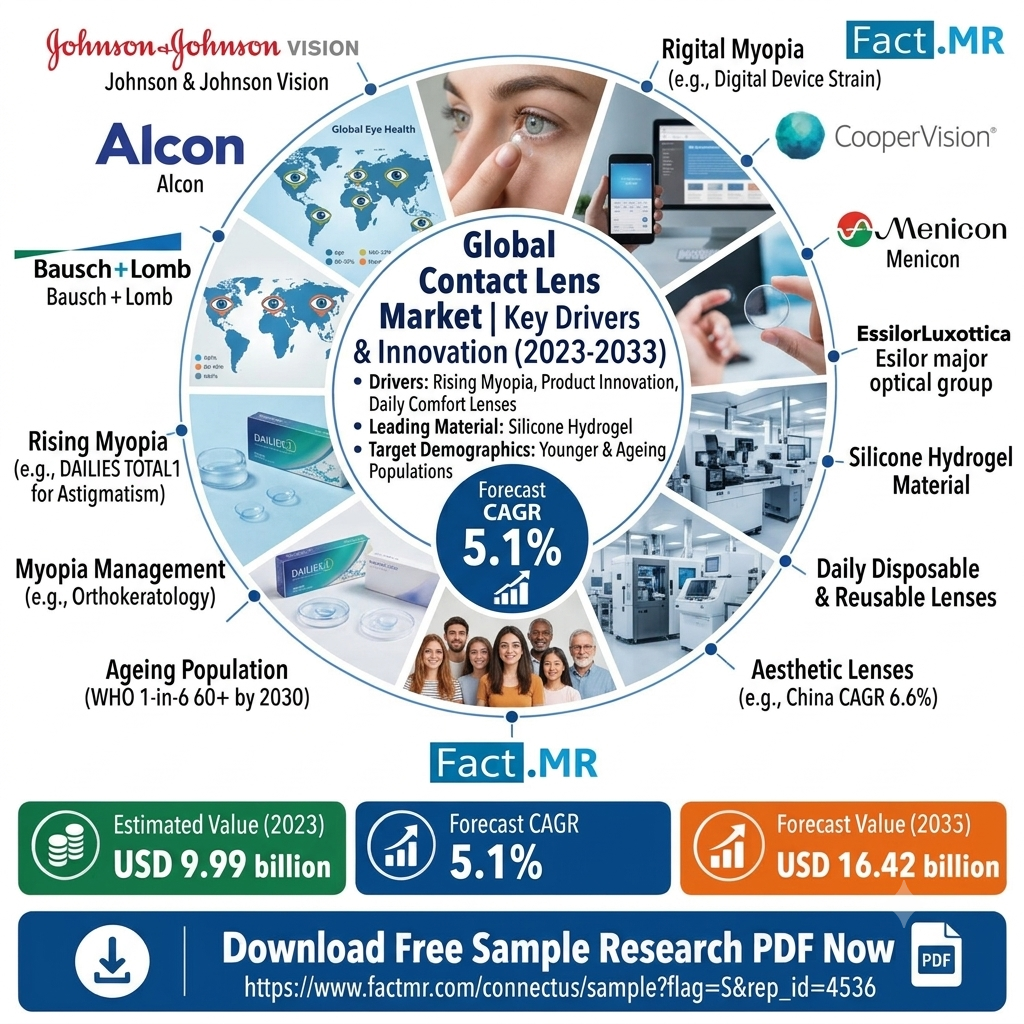
Global contact lens market is projected to grow at 5.1% CAGR through 2033, supported by rising myopia cases, product innovation, and demand for comfortable lenses.
November 4, 2026 The global contact lens market is projected to reach approximately USD 16.42 billion by 2033, increasing from USD 9.99 billion in 2023 at a compound annual growth rate (CAGR) of 5.1%, according to Fact.MR analysis. Rising cases of myopia and astigmatism, growing awareness of vision correction options, and improvements in lens materials are supporting demand across major markets. Increasing adoption among younger consumers and an ageing global population are also creating new opportunities for manufacturers.
The market is gaining attention as digital device usage and age-related eye conditions increase the need for vision care. According to the University of Medical Sciences, Iran, approximately 52% of the global population, representing 4,949 million people, could have myopia by 2050. The same projection estimates that 925 million people could experience extreme myopia.
Get detailed market forecasts, competitive benchmarking, and pricing trends: https://www.factmr.com/connectus/sample?flag=S&rep_id=4536
Myopia Management and Ageing Population Support Contact Lens Market Growth
Prolonged exposure to computers and smartphones is changing consumer eye-care requirements. Digital technology has expanded professional opportunities involving extended screen time, which is associated with increasing concerns about myopia. Millennials and Gen Z consumers are becoming important customer groups as awareness of vision correction options improves.
The ageing population represents another demand driver. The World Health Organization (WHO) predicts that one in six people worldwide will be aged 60 or older by 2030. The global population in this age group is expected to double by 2050. Age-related cataracts, glaucoma, macular degeneration, and diabetic retinopathy are increasing the need for accessible vision care.
Fact.MR analysis identifies these demographic changes as important factors supporting long-term demand for contact lenses.
Product Innovation Expands the Silicone Hydrogel Contact Lenses Segment
Manufacturers are investing in research and development to improve lens comfort, oxygen transmission, and suitability for different vision requirements. Silicone hydrogel is an important material in this development. The segment is estimated to register a CAGR of 4.9% during the forecast period.
Silicone hydrogel combines silicone with water-absorbing polymers. This material allows greater oxygen transmission through soft contact lenses, supporting comfort during extended wear. Its moisture-retaining properties also make it suitable for consumers seeking comfortable alternatives to conventional lens materials.
Daily disposable contact lenses and reusable products continue to serve different consumer requirements. Manufacturers are developing products that address convenience, affordability, and individual vision correction needs.
A notable product development came in January 2022, when Alcon introduced DAILIES TOTAL1® for Astigmatism. The product was identified as the first Water Gradient contact lens designed for astigmatic patients.
In July 2022, Bausch + Lomb launched Revive™ custom soft contact lenses in the United States. The product range includes spherical, multifocal, toric, and multifocal toric options, addressing patients with more complex vision requirements.
Contact Lens Market Growth Across the United States, China, and Japan
The United States remains a leading market, supported by healthcare expenditure, established optical retail networks, and early adoption of advanced eye-care technology. Contact lens demand in the country is projected to expand at a CAGR of 5.5% during the forecast period.
According to the Centers for Disease Control and Prevention (CDC), approximately 45 million Americans wear contact lenses, and nearly two-thirds of these users are women. The country also has more than 30,000 practicing optometrists, supporting access to professional eye-care services.
In October 2021, Blanchard Contact Lenses, a CooperVision Specialty EyeCare company, announced an expansion of its US product portfolio with Paragon CRT and Paragon CRT Dual Axis orthokeratology lenses. Both products are designed for myopia management.
China and Japan are also expected to record steady expansion. China is projected to grow at a CAGR of 6.6%, while Japan is expected to register 5.3% during the forecast period. Growing interest in aesthetic lenses among younger consumers is supporting demand in China.
Japan's market is benefiting from product approvals and technological developments in optometry. In March 2021, ACUVUE Theravision with ketotifen received approval from Japan's Ministry of Health, Labour and Welfare. The lens combines vision correction with an antihistamine intended to reduce allergic eye irritation.
Distribution Channels and Consumer Preferences Shape Competition
Optical stores and optometrists remain important purchasing channels. Professional fitting is particularly relevant because improperly fitted contact lenses can increase the risk of eye infections and discomfort. Consumers often prefer established brands and professional recommendations when selecting products.
Online purchasing is also part of the evolving distribution environment. However, access to professional guidance continues to influence purchasing decisions. In developed economies, insurance coverage and willingness to spend on eye-care products support demand for established brands.
Contact lenses are available across several categories, including gas permeable, silicone hydrogel, and hybrid materials. Product types include spherical, toric, and multifocal lenses. Applications extend beyond corrective vision to therapeutic, cosmetic, prosthetic, and lifestyle-oriented uses.
Competitive Landscape and Industry Developments
The global contact lens market features several established manufacturers, with a relatively limited number of major companies holding substantial market shares. Competition centres on product development, regulatory approvals, portfolio expansion, and international market access.
Johnson & Johnson Vision received FDA approval for ACUVUE® OASYS MAX 1-Day and ACUVUE® OASYS MAX 1-Day MULTIFOCAL. These photochromic lenses are designed to adjust visible light entering the eye while providing protection against blue light and UV rays.
In April 2021, Johnson & Johnson Vision entered a global strategic collaboration with Menicon to develop therapeutic eyewear aimed at slowing the progression of childhood myopia.
Fact.MR analysis observes that manufacturers are increasingly focusing on specialised products and material improvements to address changing consumer requirements.
As stated in the analysis, "The demand for contact lenses has been growing rapidly" as eye conditions, including myopia, become more prevalent across age groups. This trend reinforces the importance of innovation in vision correction and myopia management.
View Related Reports :
https://social.mytamam.com/blogs/1216/Automated-Breast-Ultrasound-System-Market-to-Reach-USD-2-1
https://ayushjadhavblogs.blogspot.com/2026/11/wireless-handheld-ultrasound-devices.html
https://acmingle.com/blogs/34983/Osseointegration-Implants-Market-to-Reach-USD-6-85-Billion-by
https://social.art-inpa.com/blogs/45769/Drug-Eluting-Stent-Market-Expected-to-Reach-USD-15-8
About Fact.MR
Fact.MR is a market research and consulting company that provides industry analysis, market forecasts, competitive intelligence, and strategic insights across multiple sectors. The company helps businesses understand market developments, evaluate emerging opportunities, and make informed decisions through data-driven research.

 English
 Arabic
 Spanish
 Portuguese
 Deutsch
 Turkish
 Dutch
 Italiano
 Russian
 Romaian
 Portuguese (Brazil)
 Greek