


Why Small Retail Displays Need Clear and Consistent Product Information
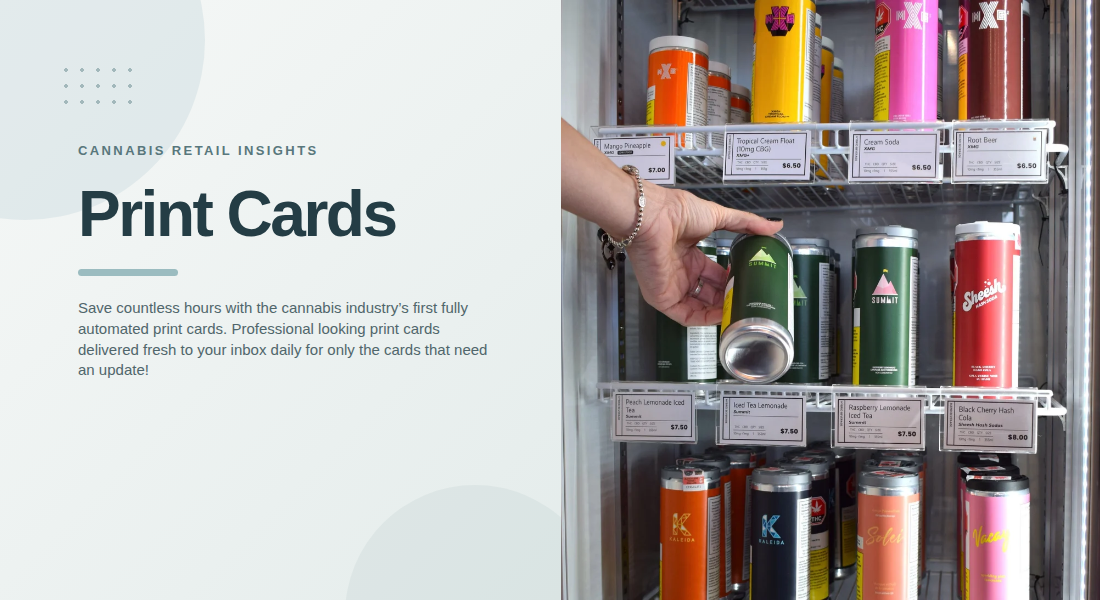
In cannabis retail environments, customers often make their initial product comparisons while looking at shelves, jars, and countertop displays. Limited display space makes it important to present useful details without creating visual clutter. Cannabis print cards offer retailers a practical way to communicate product information directly where customers view individual items.
Clear and consistent product cards can help customers understand product characteristics, recognize brands, and compare available options. They also support employees by making essential information easier to reference during customer conversations.
1. Make Important Product Details Visible
Small retail displays do not provide much room for lengthy descriptions. Retailers need to prioritize information that helps customers understand what they are viewing.
A product card can display details such as:
-
Product or strain name
-
Brand name
-
Product category
-
THC and CBD information where applicable
-
Flavor or aroma characteristics
-
Price and package details
Presenting these details in a structured format helps customers understand the product without searching through several information sources. Retailers should focus on relevant details rather than filling every available space with text.
2. Maintain Consistency Across Product Displays
When every product card uses a different layout, customers may need extra time to understand where important details are located. Consistent formatting creates a more familiar browsing experience.
Retailers can establish standard positions for product names, prices, cannabinoid information, and brand details. Using consistent typography, spacing, and visual elements also creates a more organized appearance.
This approach becomes especially valuable when a dispensary carries products from several brands. Even when the packaging and branding differ, a shared card format helps maintain a unified retail presentation.
3. Help Customers Compare Product Options
Customers may want to compare several products before making a selection. However, comparing information becomes difficult when details are displayed inconsistently or are missing from individual product descriptions.
Printed cards can make relevant characteristics easier to review. For example, customers may compare product formats, listed prices, cannabinoid information, or flavor descriptions.
The information should be presented in a straightforward way. Retailers should avoid using complicated descriptions that make simple product differences difficult to understand.
Clear comparisons can also help employees answer questions more efficiently because essential product details are already visible.
4. Use Limited Space More Effectively
Small displays require careful decisions about how information is arranged. Too much text can make a product card difficult to read, while too little information may leave customers with unanswered questions.
Retailers should prioritize the most useful details and remove unnecessary promotional language. Short labels, readable fonts, and sufficient spacing can make compact cards easier to scan.
The physical size of the card should also match the display area. Cards that are too large can cover product packaging or crowd nearby items, while very small cards may become difficult to read.
A balanced design helps preserve both visibility and organization.
5. Improve Brand Recognition at the Shelf
Product packaging is not always the only place customers look for brand information. A printed product card can reinforce a brand's name and make its products easier to recognize within a larger selection.
Retailers can include brand names and appropriate visual identifiers while keeping the overall card design consistent with store requirements.
This is particularly useful when several brands share the same product category. Clear identification helps customers distinguish between manufacturers without relying entirely on packaging differences.
Consistent presentation also gives brands a more professional appearance within the retail environment.
6. Keep Product Information Accurate
An attractive product card is only useful when its information is correct. Outdated prices, incorrect product details, and unavailable items can create confusion and additional work for employees.
Retail teams should establish a routine for checking printed information whenever inventory or product details change. Cards should be updated when necessary rather than remaining on displays after the information becomes outdated.
Accuracy is particularly important for details such as pricing, product availability, and cannabinoid information. Retailers should use verified product data and follow applicable labeling and advertising requirements.
7. Make Displays Easier for Employees to Maintain
Product cards do not only serve customers. They can also help employees maintain organized shelves and identify products more easily.
When each card follows a consistent structure, staff members can quickly recognize where information belongs and identify missing or outdated details.
For dispensaries with frequent inventory changes, manually creating and replacing cards can become repetitive. A structured printing process can reduce this workload and help maintain consistent presentation throughout the store.
Employees can then spend less time preparing individual cards and more time supporting daily retail operations.
8. Adapt Product Cards to Different Retail Categories
Not every cannabis product requires the same information. Flower, concentrates, edibles, and other product formats may have different characteristics that customers want to review.
Retailers should adapt card content to the relevant category while maintaining a consistent overall design. For example, strain-related details may be useful for flower displays, while format and package information may be more relevant for other categories.
This approach keeps cards informative without forcing every product into an identical information structure.
Supporting Consistent Printed Product Displays
Managing product cards across a changing inventory can require considerable attention. BudSense menu software offers Print Cards Pro, which supports multi-location retailers by automatically printing cards when updates are needed. Product information such as price, THC, CBD, strain, and flavor can help retailers maintain informative and consistent displays.
Final Thoughts
Small retail displays can communicate a great deal when product information is presented thoughtfully. Clear details, consistent formatting, readable layouts, and accurate updates help cannabis retailers maintain organized displays while supporting customer comparisons.
By treating product cards as an important part of retail merchandising, dispensaries can improve how information is presented at the shelf. A structured approach also makes it easier for employees to maintain displays as products and inventory change.
FAQs
1. What are cannabis print cards used for?
Cannabis print cards display important product information near retail items, helping customers review details while browsing.
2. What information should a cannabis product card include?
Depending on the product, useful details may include the product name, brand, category, price, THC, CBD, strain, and flavor information.
3. Why is consistent formatting important for product cards?
Consistent formatting makes information easier to locate and gives different product displays a more organized appearance.
4. How often should dispensaries update printed product cards?
Cards should be reviewed whenever relevant product information changes, including pricing, availability, or verified product details.
5. Can automated printing help manage cannabis product cards?
Yes. Automated printing can reduce repetitive preparation work and help retailers produce updated cards when product information changes.

 English
 Arabic
 French
 Spanish
 Portuguese
 Deutsch
 Turkish
 Dutch
 Italiano
 Russian
 Romaian
 Greek