


Air Conditioning System Market Set to Hit USD 216.4 Billion by 2034, with Daikin Industries, Mitsubishi Electric and Haier in Focus
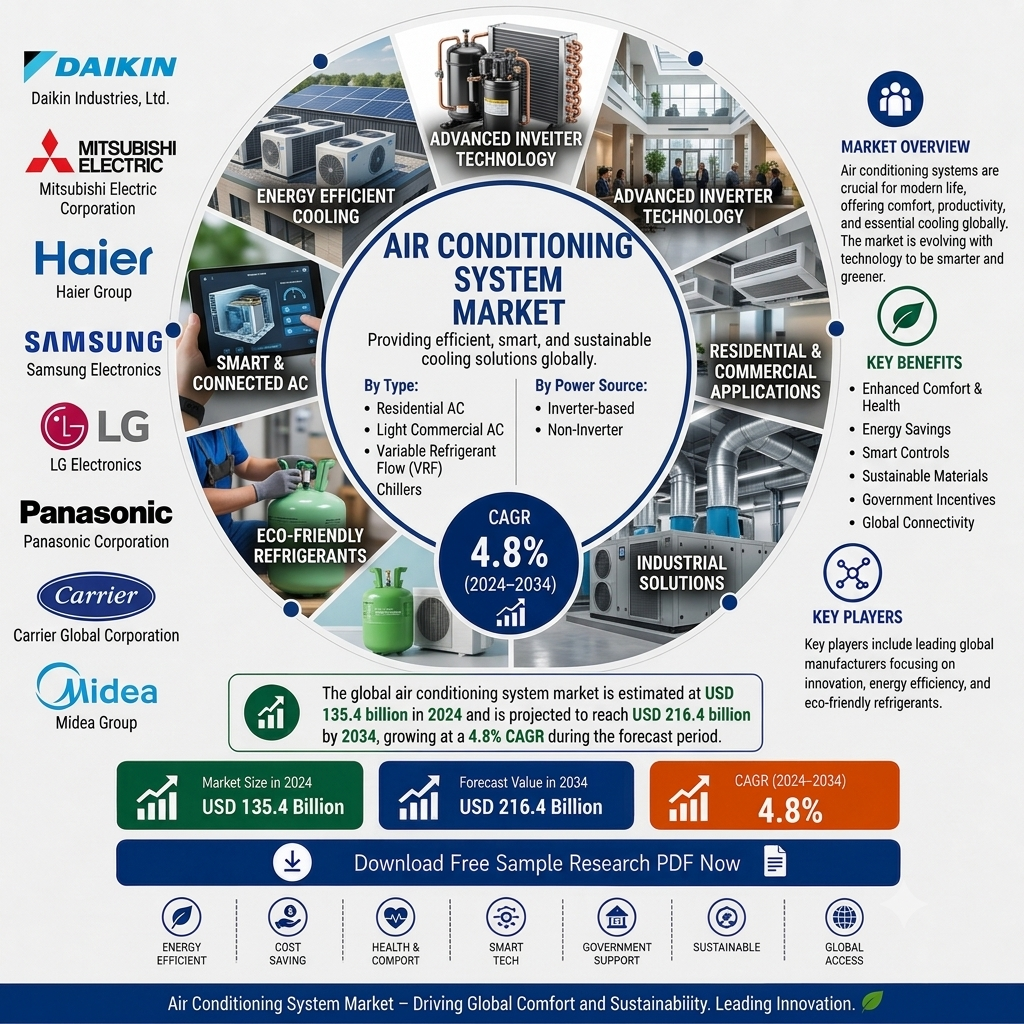
The global air conditioning system market is projected to increase from USD 135.4 billion in 2024 to USD 216.4 billion by 2034, expanding at a compound annual growth rate (CAGR) of 4.8% during the forecast period. Demand is being supported by construction activity, urbanization, rising temperatures, and growing consumer preference for energy-efficient and technologically advanced cooling systems.
Air conditioning systems are widely used across residential, commercial, and industrial environments, including homes, offices, retail spaces, healthcare facilities, entertainment venues, and data centers. Manufacturers are increasingly incorporating Internet of Things (IoT), automation, smart monitoring, and energy-management technologies into new systems.
Get detailed market forecasts, competitive benchmarking, and pricing trends: https://www.factmr.com/connectus/sample?flag=S&rep_id=411
Market Snapshot
- 2024 Market Value: USD 135.4 billion
- 2034 Forecast Value: USD 216.4 billion
- Forecast CAGR (2024–2034): 4.8%
- North America Share: 22.9% in 2024
- East Asia Share: 26.9% by 2034
- China Market Value: USD 27.8 billion by 2034
- Leading Product Type: Split air conditioning systems, with 36.5% share in 2024
- Leading End Use: Residential, valued at USD 53.1 billion in 2024
Smart HVAC and Energy Efficiency Shape Market Demand
Construction remains a major source of demand for air conditioning systems. New residential buildings, commercial facilities, industrial sites, and infrastructure projects require HVAC equipment to maintain indoor temperature and comfort. Population growth and urbanization are further increasing cooling requirements, particularly in warmer regions.
Split air conditioning systems represent the leading product category, with a market value of USD 49.4 billion in 2024. The segment is projected to reach USD 78.8 billion by 2034, expanding at a 4.8% CAGR. Government regulations and consumer interest in lower energy consumption are encouraging replacement of older systems with more efficient equipment.
Residential applications account for USD 53.1 billion in 2024 and are forecast to reach USD 85.5 billion by 2034. Commercial and industrial users are also increasing investments in HVAC systems as businesses prioritize worker comfort, indoor air quality, equipment cooling, and operational efficiency.
IoT is adding another layer to market development. Smart HVAC systems can enable remote monitoring, centralized management, and automated adjustments. In commercial buildings and data centers, these capabilities can help operators manage cooling demand and monitor equipment performance.
Canada and China Offer Strong Growth Opportunities
Canada's air conditioning system market is projected to expand at a 5.0% CAGR, increasing from USD 3.3 billion in 2024 to USD 5.3 billion by 2034. Demand is being supported by low-global-warming-potential refrigerants, variable refrigerant flow systems, inverter technology, and multi-zone cooling solutions.
China is forecast to grow at a 4.9% CAGR and reach USD 27.8 billion by 2034. The country is expected to account for 47.8% of the East Asia market by that year. Japan is projected to expand at a 4.9% CAGR, reaching USD 15.4 billion, with construction projects and new data centers creating additional demand.
North America is expected to remain a major regional market, while East Asia is projected to hold the largest regional share by 2034.
Competitive Landscape
The air conditioning system market includes global HVAC manufacturers competing through energy efficiency, smart technologies, product diversification, and geographic expansion. Key companies profiled in the Fact.MR report include Daikin Industries Ltd., Mitsubishi, Qingdao Haier, Samsung Electronics, Electrolux, LG Electronics, Panasonic, UTC, Hitachi, Gree Electric Appliances, Sharp Corp., Midea Group Co. Ltd., Carrier Corp., Fuji Electric, Honeywell International, and Ingersoll Rand.
Companies are investing in smart HVAC capabilities and improved airflow management. Daikin Industries invested in Wlab Ltd.'s Sensio Air division, which uses sensors, artificial intelligence, and IoT technology to monitor airborne allergens. Mitsubishi Electric developed airflow-control technology designed to analyze temperature distribution and airflow to improve comfort.
Energy consumption and greenhouse gas emissions remain key challenges for manufacturers. Regulatory requirements are pushing suppliers toward more efficient systems and lower-impact refrigerants, while high installation costs can slow adoption among price-sensitive customers.
To View Related Reports
https://social.art-inpa.com/blogs/46629/ESG-and-Sustainability-Advisory-Market-Heads-Toward-USD-85-5
https://sportgalax.com/read-blog/27216
https://afgbfh.blogspot.com/2026/11/esg-and-sustainability-advisory-market.html
About Fact.MR
Fact.MR is a market research and competitive intelligence provider delivering market intelligence, competitive analysis, and forecasting across global industries. Its research helps businesses evaluate market demand, understand competitive developments, and identify growth opportunities.

 English
 Arabic
 French
 Portuguese
 Deutsch
 Turkish
 Dutch
 Italiano
 Russian
 Romaian
 Portuguese (Brazil)
 Greek