


E-fuel Market Analysis: Industry Size, Technologies, Challenges, and Growth Potential 2026-2034
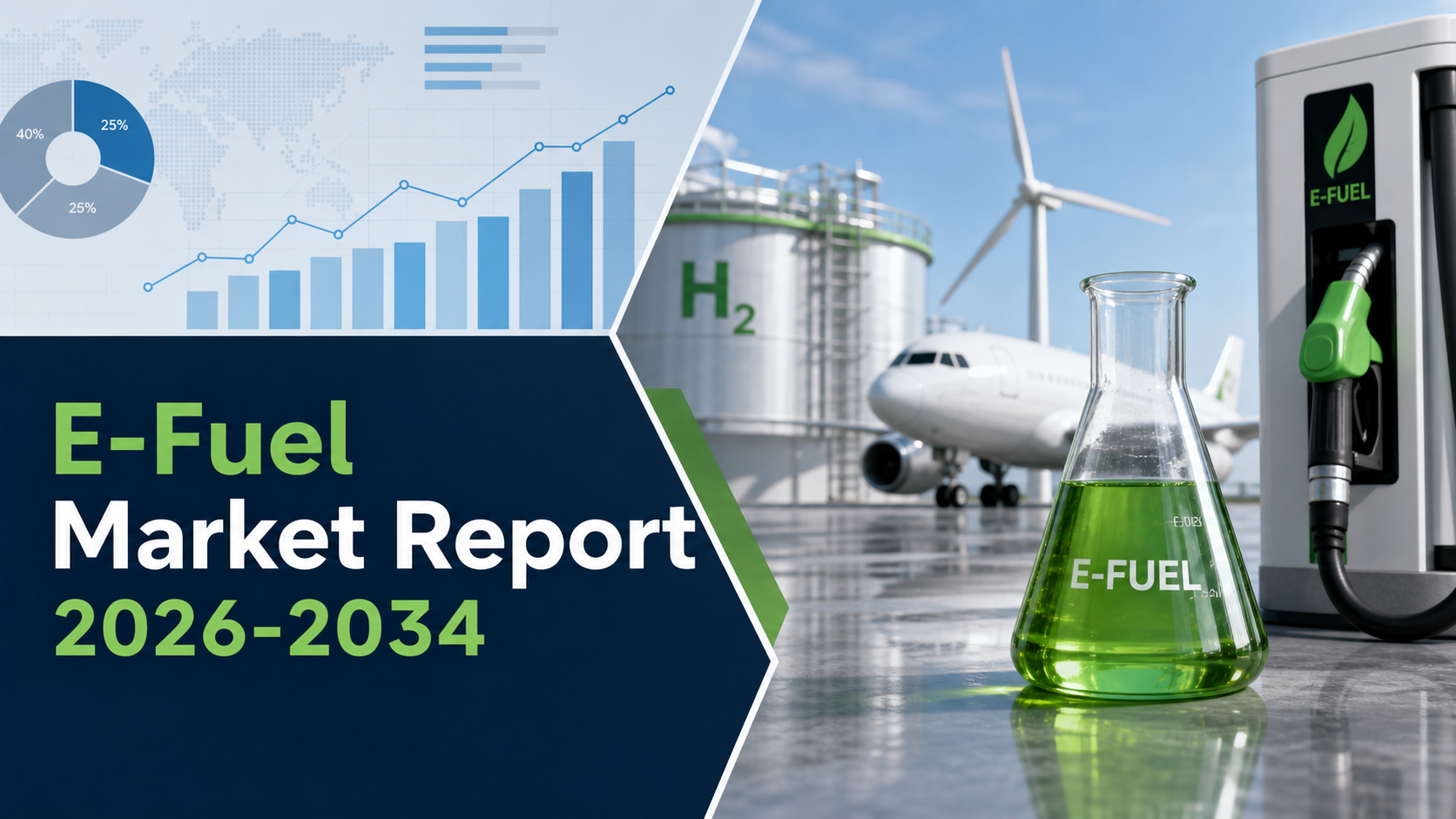
Market Overview:
According to IMARC Group’s latest research publication, “E-Fuel Market Size, Share, Trends and Forecast by Product, State, Production Method, Technology, End Use, and Region”, the global e-fuel market grew from USD 8.02 Billion in 2025 to USD 10.29 Billion in 2026. Looking forward, IMARC Group estimates the market to reach USD 75.34 Billion by 2034, exhibiting a CAGR of 28.25% from 2026-2034, with the industry undergoing rapid transformation and scale-up. North America currently dominates the market, holding a share of 32%.
This detailed e-fuels market analysis primarily encompasses industry size, business trends, market share, key growth factors, and regional forecasts. The report integrates research findings, market assessments, and data from different sources. It covers market dynamics such as drivers and challenges, and highlights growth opportunities, technological improvements, emerging trends, and innovations. It also provides a regional evaluation and a competitive landscape analysis.
How Power-to-Liquid Innovation Is Reshaping the Future of the E-Fuel Market
-
Power-to-liquid dominates the market with a 38% share, converting renewable electricity into green hydrogen via electrolysis that is then combined with captured carbon dioxide through Fischer-Tropsch synthesis or methanol pathways to produce high-quality liquid synthetic fuels.
-
In 2026, Nordic Norsk e-Fuel and Finnish stainless steel leader Outokumpu signed a Memorandum of Understanding to develop a CO-to-SAF Power-to-Liquid facility in Tornio, Finland, targeting 80,000–100,000 tons of sustainable aviation fuel annually and expected to reduce approximately 200,000 tons of CO₂ emissions.
-
In 2025, Electric Hydrogen was selected by Synergen Green Energy to supply 240 megawatts of electrolyzer capacity for a green ammonia project in the United States, highlighting the expanding scale of electrolyzer installations supporting the broader e-fuel ecosystem.
-
In 2025, Sasol Chemicals signed a Letter of Intent with INERATEC to supply its next-generation Fischer-Tropsch catalyst for e-SAF production, projected to increase plant capacity and enhance e-kerosene yields by 15% at INERATEC’s ERA ONE Power-to-Liquid facility in Frankfurt.
-
Electrolysis forms the foundational step in e-fuel production by splitting water molecules into hydrogen and oxygen using renewable electricity, with the resulting green hydrogen serving as the essential building block for all downstream e-fuel synthesis processes.
Grab a sample copy of this report: https://www.imarcgroup.com/e-fuel-market/requestsample
Key Trends in the E-Fuel Market
-
Growing Investment and Funding: In 2024, Swedish Liquid Wind secured €44 million in Series C funding to accelerate the development of ten Power-to-Liquid e-fuel facilities by 2027, converting biogenic CO₂ and renewable electricity into e-methanol for maritime and industrial applications, with modular plant designs projected to reduce approximately 200,000 tons of CO₂ per facility annually.
-
Technological Advancements in Production: Advanced catalysts and optimized chemical processes enable higher conversion rates and greater output of low-carbon fuels, with Sasol Chemicals and INERATEC collaborating to enhance e-kerosene yields by 15% at a Power-to-Liquid facility in Frankfurt.
-
Adoption of Low-Carbon E-Fuels in Maritime Transport: In 2025, the Zero Emission Maritime Buyers Alliance announced Hapag-Lloyd and North Sea Container Line as winners of its second e-fuel tender, enabling deployment of sustainable fuels in container shipping with over 90% reductions in lifecycle emissions.
-
Automotive Sector Adoption: E-fuels, including e-diesel, e-gasoline, and e-naphtha, provide high energy density and seamless compatibility with current vehicles, enabling fleet operators and individual consumers to transition to low-carbon mobility without significant modifications.
-
Expanding Regulatory Support: Governments worldwide are implementing stringent carbon emission reduction targets and renewable fuel mandates that are accelerating the adoption of synthetic fuels produced through power-to-liquid and power-to-gas pathways.
Growth Factors in the E-Fuel Market
-
Urgency to Decarbonize Hard-to-Abate Sectors: The intensifying urgency to decarbonize hard-to-abate sectors such as aviation, maritime shipping, and heavy-duty transportation is driving market growth, with governments implementing stringent carbon emission reduction targets.
-
Availability of Low-Cost Renewable Electricity: The rising availability of low-cost renewable electricity from wind and solar installations is improving the economic viability of e-fuel production, while advancements in electrolyzer technologies enhance efficiency and scalability of green hydrogen generation.
-
Corporate Sustainability Commitments: Environmental, social, and governance mandates are encouraging major transportation and logistics companies to procure carbon-neutral fuel alternatives, supporting broader market adoption across sectors.
-
Favorable Regulatory Frameworks: North America benefits from favorable regulatory frameworks and substantial federal investments in clean energy infrastructure, with the growing demand for sustainable aviation fuel across the transportation sector contributing to market expansion.
-
Strategic Investments and Commercialization: Capital inflows allow companies to expand infrastructure, scale operations, and commercialize sustainable fuel solutions, supporting decarbonization across transportation and industrial sectors while accelerating technological innovation.
Leading Companies Operating in the Global E-Fuel Industry:
-
Ceres Power Holdings plc
-
eFuel Pacific Limited
-
Exxon Mobil Corporation
-
Liquid Wind
-
Norsk e-Fuel AS
-
Saudi Arabian Oil Co.
-
Siemens Energy AG
E-Fuel Market Report Segmentation:
Breakup By Product:
-
E-Diesel
-
E-Gasoline
-
Ethanol
-
Hydrogen
-
E-Kerosene
-
E-Methane
-
E-Methanol
-
Others
E-gasoline accounts for 20% of the e-fuel market share, reflecting its growing adoption as a sustainable alternative to conventional gasoline. Its primary advantage lies in its full compatibility with existing internal combustion engine vehicles and the established fuel distribution network, eliminating the need for costly modifications to engines or refueling infrastructure, while reducing lifecycle greenhouse gas emissions.
Breakup By State:
-
Liquid
-
Gas
Liquid dominates the market with a share of 69%, driven by its versatility, high energy density, and compatibility with existing transportation infrastructure and internal combustion engines. This category includes synthetic gasoline, e-diesel, e-kerosene, and e-methanol, all of which can be integrated seamlessly into current fuel supply chains, with strong demand particularly evident in aviation and maritime transport where long-distance operations limit the feasibility of battery-electric alternatives.
Breakup By Production Method:
-
Power-to-Liquid
-
Power-to-Gas
-
Gas-to-Liquid
-
Biologically Derived Fuels
Power-to-liquid dominates the market with a 38% share, converting renewable electricity into green hydrogen via electrolysis combined with captured carbon dioxide through Fischer-Tropsch synthesis or methanol pathways. This method is particularly suitable for generating sustainable aviation fuel, e-diesel, and e-gasoline, offering drop-in solutions fully compatible with existing engines and fuel infrastructure while supporting large-scale decarbonization.
Breakup By Technology:
-
Hydrogen Technology (Electrolysis)
-
Fischer-Tropsch
-
Reverse-Water-Gas-Shift (RWGS)
Hydrogen technology (electrolysis) represents the leading segment with a market share of 35%, forming the foundational step in e-fuel production by splitting water molecules into hydrogen and oxygen using renewable electricity. Advancements in proton exchange membrane, alkaline, and solid oxide electrolyzer technologies are improving conversion efficiency while reducing capital and operational costs, with growing government support through subsidies and tax credits accelerating deployment worldwide.
Breakup By End Use:
-
Automotive
-
Marine
-
Industrial
-
Railway
-
Aviation
-
Others
Automotive holds 30% of the market share, representing the largest segment because of the growing need to decarbonize conventional internal combustion engines while utilizing existing fuel infrastructure. In 2024, Infinium successfully commenced production at its Corpus Christi facility, generating approximately 8,300 litres of e-fuel daily from water and CO₂ using renewable energy-powered electrolysis, offering near-net-zero carbon alternatives for hard-to-decarbonize sectors such as trucking and aviation.
Breakup By Region:
-
North America (United States, Canada)
-
Europe (Germany, France, United Kingdom, Italy, Spain, Others)
-
Asia Pacific (China, Japan, India, South Korea, Australia, Indonesia, Others)
-
Latin America (Brazil, Mexico, Others)
-
Middle East and Africa
North America, holding 32% share of the market, maintains a leading position attributed to strong federal policy support, abundant renewable energy resources, and substantial private sector investments in commercial-scale production facilities. In 2025, US-based e-fuel start-up Twelve secured a strategic investment from United Airlines, adding to USD 728 Million raised, aiming to produce e-SAF from green hydrogen and captured CO₂ at its AirPlant One facility in Washington.
Europe is progressing rapidly, driven by a robust regulatory framework and expanding commercial-scale production capabilities. In 2025, Europe’s largest green hydrogen-based e-fuels plant, operated by INERATEC GmbH in Frankfurt, commenced commercial operations, producing synthetic crude oil using biogenic CO₂ and by-product hydrogen. Asia-Pacific is gaining momentum, with Toyota Motor Corporation and partners showcasing vehicles powered by e-fuels at Expo 2025 in Osaka, Japan, demonstrating practical low-emission applications in real-world scenarios.
Recent News and Developments in the E-Fuel Market
-
February 2026: HIF Global and German eFuel One GmbH signed a Heads of Agreement to supply 100,000 tons annually of certified e-Methanol, sourced from HIF’s planned Paysandú, Uruguay facility and complying with international sustainability standards including EU RED III RFNBO requirements.
-
November 2025: Greenlyte Carbon Technologies launched the world’s first LiquidSolar SNG plant in Duisburg, Germany, marking a major milestone toward industrial-scale synthetic fuel production, backed by EU and North Rhine-Westphalia funding, with plans to scale to e-methanol production by 2027.
-
2025: HIF Global received the first US approval for an e-fuels design pathway under California’s Low Carbon Fuel Standard, enabling production of e-SAF, e-Naphtha, and e-Diesel, and supporting its 1.4 mtpa Texas project.
-
2024: HIF Global announced its first Brazilian e-fuels initiative by signing a land reservation agreement with the Port of Açu to develop an e-methanol facility expected to produce up to 800,000 tons per year of e-methanol, utilizing port infrastructure and Brazil’s renewable energy potential.
Note: If you require specific details, data, or insights that are not currently included in the scope of this report, we are happy to accommodate your request. As part of our customization service, we will gather and provide the additional information you need, tailored to your specific requirements. Please let us know your exact needs, and we will ensure the report is updated accordingly to meet your expectations.
About Us:
IMARC Group is a global management consulting firm that helps the world’s most ambitious changemakers to create a lasting impact. The company provide a comprehensive suite of market entry and expansion services. IMARC offerings include thorough market assessment, feasibility studies, company incorporation assistance, factory setup support, regulatory approvals and licensing navigation, branding, marketing and sales strategies, competitive landscape and benchmarking analyses, pricing and cost research, and procurement research.
Contact Us:
IMARC Group
134 N 4th St. Brooklyn, NY 11249, USA
Email: sales@imarcgroup.com
Tel No:(D) +91 120 433 0800
United States: +1-201-971-6302

 English
 Arabic
 Spanish
 Portuguese
 Deutsch
 Turkish
 Dutch
 Italiano
 Russian
 Romaian
 Portuguese (Brazil)
 Greek