


Airbag Harness Market Growth, Revenue Analysis Industry Outlook, Forecast Analysis By Fact.MR
A decision brief from Fact.MR for automotive manufacturers, wire harness suppliers, automotive component manufacturers, OEM procurement leaders, vehicle safety system developers, electrical engineers and investors.
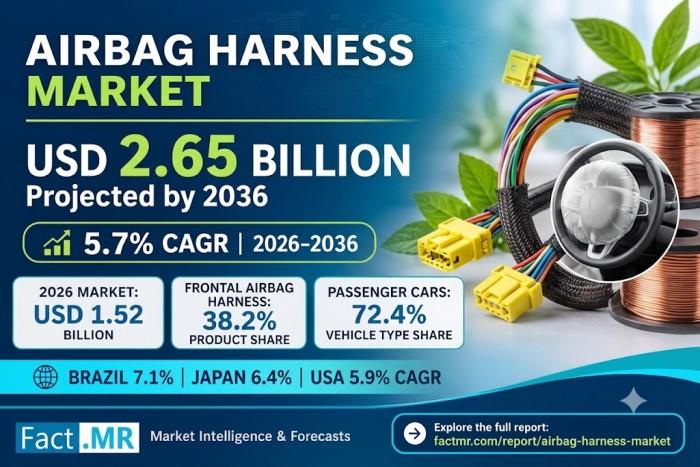
Rockville, Maryland, 5 November 2026 – The global airbag harness market reached USD 1.44 billion in 2025 and is projected to increase from USD 1.52 billion in 2026 to USD 2.65 billion by 2036, expanding at a CAGR of 5.7% during the forecast period, according to Fact.MR. The market is gaining momentum as automotive manufacturers strengthen occupant protection systems, adopt multi-airbag cabin architectures and respond to increasingly stringent vehicle safety requirements.
Market expansion reflects the implementation of global NCAP crash safety requirements, increasing installation of side curtain and knee airbags, and expanding electric vehicle production. Airbag harnesses provide critical electrical connections between airbag control units, sensors and pyrotechnic inflators. Their ability to transmit reliable deployment signals under demanding operating conditions makes them essential components of modern supplemental restraint systems.
Vehicle manufacturers are increasingly incorporating advanced restraint configurations across passenger vehicles. The growing number of airbags in vehicle cabins is creating demand for specialised frontal, side, knee and curtain airbag harnesses. At the same time, electric vehicle platforms are encouraging manufacturers to develop lightweight wiring networks that maintain electrical reliability while reducing vehicle weight.
Brazil is projected to lead country-level growth with a CAGR of 7.1% through 2036, followed by Japan at 6.4% and the United States at 5.9%. Germany is expected to expand at 5.6%, while the United Kingdom records a projected CAGR of 4.0%. These markets reflect different opportunities arising from vehicle production, automotive safety requirements, advanced electronics engineering and manufacturing investments.
Manufacturers, procurement teams and investors can examine the latest market forecasts, product segmentation and regional opportunities in Fact.MR's research.
Get a Sample of the Detailed Market Study:
The Short Version
- The global airbag harness market reached USD 1.44 billion in 2025 and is projected to increase from USD 1.52 billion in 2026 to USD 2.65 billion by 2036, expanding at a CAGR of 5.7%.
- Frontal airbag harnesses account for the leading product segment with a 38.2% share in 2026.
- Passenger cars dominate vehicle-type demand, representing 72.4% of the market in 2026.
- OEM sales channels account for 81.7% of the market, reflecting the importance of direct integration into vehicle manufacturing processes.
- Copper represents 50.1% of the market by material type in 2026, supported by its electrical conductivity, tensile strength and fatigue resistance.
- Brazil leads country-level growth with a projected CAGR of 7.1%, followed by Japan at 6.4% and the United States at 5.9%.
Three Numbers That Matter
USD 2.65 billion: Projected global airbag harness market value by 2036.
USD 1.52 billion: Estimated global airbag harness market valuation in 2026.
5.7%: Projected compound annual growth rate between 2026 and 2036.
These figures highlight the commercial opportunity for automotive wiring manufacturers, restraint system suppliers and electrical component producers. Companies that combine reliable electrical connections, lightweight conductor materials, automated manufacturing and strong OEM relationships can address increasing requirements across passenger cars and commercial vehicle platforms.
Where Growth Is Strongest
Fact.MR identifies Brazil as the fastest-growing country in the airbag harness market, supported by stricter vehicle crash safety requirements, modernisation of domestic passenger vehicle assembly plants and expanding commercial truck production.
Japan and the United States also offer significant opportunities through advanced automotive electronics engineering, extensive vehicle manufacturing and established safety regulations. Germany remains an important market due to its premium vehicle manufacturing base, while the United Kingdom offers opportunities across luxury sports cars, commercial vans and automotive aftermarket distribution.
- Brazil: Highest-growth country – Projected CAGR: 7.1% – Growth opportunity: Passenger vehicle assembly modernisation, Latin NCAP safety requirements and commercial truck production.
- Japan: Advanced automotive engineering market – Projected CAGR: 6.4% – Growth opportunity: Automotive electronics, Kei car safety upgrades and precision wiring technologies.
- United States: Large automotive manufacturing market – Projected CAGR: 5.9% – Growth opportunity: Pickup trucks, SUVs, NHTSA crash safety requirements and electric vehicle production.
- Germany: Established premium automotive market – Projected CAGR: 5.6% – Growth opportunity: Luxury vehicle production, advanced automotive engineering and stringent VDA quality standards.
- United Kingdom: Specialist automotive market – Projected CAGR: 4.0% – Growth opportunity: Luxury sports car manufacturing, commercial van assembly and automotive aftermarket safety parts distribution.
Why These Markets Matter
Brazil: Brazil is projected to record the highest country-level CAGR of 7.1% through 2036. Strict Latin NCAP safety requirements, modernisation of domestic passenger vehicle assembly plants and expanding commercial truck production are supporting demand. Major wiring harness manufacturers operate dedicated production facilities in Brazil, supplying automotive assembly operations associated with Stellantis, Volkswagen, General Motors and Toyota.
Japan: Japan is expected to expand at a CAGR of 6.4%. Its established automotive electronics industry, advanced manufacturing capabilities and safety upgrades across lightweight Kei cars are supporting market development. Japanese manufacturers, including Yazaki, Sumitomo Electric and Furukawa Electric, are advancing precision automated crimping, miniature terminals and flexible flat cable technologies for compact automotive electrical architectures.
United States: The United States is forecast to register a CAGR of 5.9%. Significant pickup truck and SUV production, stringent Federal Motor Vehicle Safety Standards and increasing electric vehicle manufacturing are supporting demand for reliable airbag harness systems. Automotive assembly plants require customised restraint wiring assemblies that can accommodate different vehicle models and trim configurations.
Germany: Germany is projected to grow at a CAGR of 5.6%. Premium automotive manufacturing and advanced engineering capabilities across BMW, Mercedes-Benz and Audi are creating opportunities for specialised wiring suppliers. Manufacturers can focus on lightweight conductor materials, precision connector engineering and compliance with VDA automotive quality requirements.
United Kingdom: The United Kingdom is expected to record a CAGR of 4.0%. Luxury vehicle manufacturing, commercial van production and an established automotive aftermarket are supporting demand. Manufacturers can explore opportunities through specialised restraint wiring configurations, genuine OEM replacement harnesses and stronger relationships with automotive component distributors.
Who Is Moving: Dated Developments and Key Players
The competitive landscape includes established automotive safety system suppliers, global wiring harness manufacturers and specialised electrical component producers. Their market positioning depends on electrical reliability, connector engineering, conductor materials, automated manufacturing capabilities and long-term supply agreements with automotive OEMs.
Developments Highlighted in the Report
The report highlights several technological and manufacturing developments shaping competition in the airbag harness industry.
Automated Manufacturing: Wire harness manufacturers are deploying high-speed automated crimping presses equipped with 100% inline crimp force monitoring and laser-based visual inspection cameras. These technologies help reduce assembly defects in safety-critical restraint circuits.
Connector Engineering: Automotive suppliers are standardising modular squib connector interfaces incorporating integrated shorting bars and mechanical connector position assurance (CPA) clips. These components help prevent accidental pyrotechnic deployment during vehicle assembly and maintenance handling.
Lightweight Wiring: Global wiring harness manufacturers are developing hybrid copper-aluminium wiring solutions to reduce vehicle weight while maintaining electrical reliability.
Zonal Electrical Architectures: Vehicle engineering teams are transitioning towards zonal electronic architectures that position localised restraint control modules closer to individual airbag locations. This approach can reduce individual harness lengths and overall wiring mass.
Manufacturing Expansion: Global wiring harness producers are establishing dedicated manufacturing facilities in cost-competitive locations, including Mexico, Morocco and Eastern Europe, to support just-in-sequence deliveries to automotive assembly plants.
Key Players Profiled by Fact.MR
- Autoliv Inc.
- ZF Friedrichshafen AG
- Aptiv PLC
- Sumitomo Electric Industries Ltd.
- Lear Corporation
- Yazaki Corporation
- Furukawa Electric Co. Ltd.
- Leoni AG
- Nexans S.A.
- TE Connectivity Ltd.
Autoliv Inc. maintains a leading position in automotive passive safety systems through airbag modules, steering wheel clocksprings and restraint technologies. ZF Friedrichshafen AG participates in the market through its passive safety division, supplying occupant restraint systems and airbag wiring networks.
Aptiv PLC operates across vehicle electrical architectures, lightweight wiring harnesses and automotive connectors. Sumitomo Electric Industries Ltd. and Yazaki Corporation participate through automotive wiring harnesses, precision terminals and electrical distribution systems.
Lear Corporation integrates electrical distribution systems with automotive seating assemblies, including seat-mounted side airbag wiring. Furukawa Electric Co. Ltd. specialises in steering roll connectors, lightweight wiring harnesses and precision electrical components.
Leoni AG supplies automotive cables and restraint harness sub-assemblies, while Nexans S.A. participates through specialised automotive wiring cables. TE Connectivity Ltd. supplies automotive connectors, CPA clips and high-reliability terminal contacts used in airbag harness assemblies.
The competitive opportunity extends beyond increasing production volumes. Manufacturers must maintain electrical continuity, low signal latency, connector reliability and resistance to vibration, humidity and thermal cycling. Automated inspection and precision manufacturing remain important considerations for suppliers seeking long-term automotive OEM contracts.
Where to Act
Strengthen Frontal Airbag Harness Production: Frontal airbag harnesses account for 38.2% of the market in 2026. Manufacturers can strengthen their product portfolios by developing reliable steering wheel and front-passenger airbag wiring assemblies that meet automotive safety and quality requirements.
Develop Passenger Vehicle Applications: Passenger cars represent 72.4% of the market in 2026. Suppliers can address increasing multi-airbag installations by offering specialised frontal, side, knee and curtain airbag harness configurations for different vehicle platforms.
Prioritise OEM Partnerships: OEM channels account for 81.7% of the market. Manufacturers can strengthen commercial opportunities through early-stage vehicle design collaboration, long-term supply agreements and integration with automotive assembly operations.
Invest in Lightweight Conductor Materials: Copper represents 50.1% of the market in 2026. Manufacturers can explore copper-clad aluminium alloy wiring and hybrid conductor technologies to reduce wiring weight while maintaining electrical conductivity and mechanical strength.
Expand Automated Manufacturing Capabilities: Automated crimp force monitoring, laser inspection and precision terminal assembly can help suppliers improve quality control and reduce manufacturing defects in safety-critical electrical connections.
Target High-Growth Automotive Markets: Brazil and Japan offer attractive country-level growth opportunities, with projected CAGRs of 7.1% and 6.4%, respectively. Suppliers can evaluate local manufacturing partnerships, regional OEM relationships and distribution capabilities to strengthen their market presence.
Where to Be Careful
- Manufacturing Complexity: Custom vehicle wiring harnesses require precise routing, connector placement and integration with different vehicle architectures. Complex multi-branch assemblies can increase manufacturing challenges.
- Raw Material Price Volatility: Changes in high-purity copper and engineering fluoropolymer prices can influence manufacturing costs, pricing strategies and supplier margins.
- Automotive Safety Recall Liabilities: Airbag harnesses are safety-critical components. Electrical connection failures, signal interference or connector defects can compromise proper airbag deployment and expose manufacturers to significant financial and legal liabilities.
- Manual Assembly Dependencies: Continued dependence on manual labour for complex wiring harness assemblies can increase production variability and quality control challenges.
- Packaging Space Constraints: Congested door pillars, dashboard consoles and roof structures can restrict harness routing and make integration more difficult.
- Electromagnetic Interference: Electrical noise from adjacent vehicle electronics and electric powertrain systems can affect sensitive restraint circuits. Shielding and appropriate wiring design remain important considerations.
The commercial priority should be to balance electrical reliability, material efficiency, manufacturing precision and competitive pricing. Companies must also strengthen engineering capabilities to address changing vehicle architectures and increasingly complex occupant protection systems.
Analyst Perspective
Shubham Patidar, Principal Consultant at Fact.MR, is the report's lead analyst.
The report identifies global vehicle safety regulations, increasing adoption of multi-airbag configurations and expanding electric vehicle platform production as important factors shaping the airbag harness market. Its analysis also highlights the importance of electrical reliability, automated crimping, precision connector engineering and lightweight conductor materials.
The findings underline the importance of developing wiring assemblies capable of maintaining reliable electrical performance under continuous thermal cycling, cabin vibration and humidity exposure. Manufacturers must also adapt to changing vehicle electrical architectures and strengthen their capabilities in automated inspection, connector design and material engineering.
Unlock Actionable Insights from the Complete Report:
Questions for Your Next Planning Meeting
- Which airbag harness product categories offer the strongest commercial opportunities across passenger cars and commercial vehicles?
- Can our existing manufacturing capabilities meet increasing OEM requirements for precision crimping, connector reliability and electrical performance?
- How can we reduce harness weight through copper-clad aluminium alloy and other lightweight conductor materials without compromising electrical reliability?
- Which high-growth automotive markets, particularly Brazil and Japan, should receive greater attention in our expansion strategy?
- How can automated inspection, modular connector engineering and zonal wiring architectures improve our competitive position in automotive safety supply chains?
Explore More Related Studies Published by Fact.MR Research
Driving Support System ECU Market
About Fact.MR
Fact.MR is a market research and consulting firm providing market intelligence, industry analysis and strategic insights to businesses across multiple sectors.
Its research covers market sizing, forecasts, competitive landscapes, segment analysis, country-level opportunities and industry developments. Fact.MR supports manufacturers, investors, procurement teams and business leaders with information for strategic planning and commercial decision-making.
Media Contact
Fact.MR
Email: sales@factmr.com
Website: https://www.factmr.com

 English
 French
 Spanish
 Portuguese
 Deutsch
 Turkish
 Dutch
 Italiano
 Russian
 Romaian
 Portuguese (Brazil)
 Greek