


Corrugated Box Market Forecast Signals Growing Investment In Automated Packaging And Converting Technologies
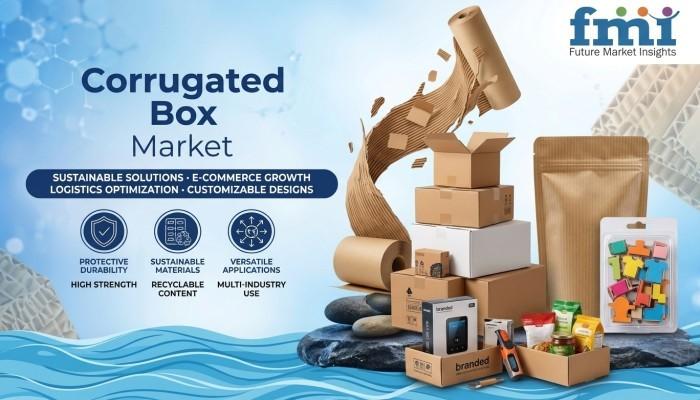
The global corrugated box market is projected to increase from USD 179.8 billion in 2026 to USD 273.9 billion by 2036, registering a compound annual growth rate (CAGR) of 4.3% over the forecast period. The market was valued at USD 172.4 billion in 2025, with the forecast indicating an additional USD 94.1 billion in industry value between 2026 and 2036, according to Future Market Insights (FMI).
Demand is being shaped by e-commerce fulfillment, food and beverage distribution, export manufacturing and the replacement of selected plastic packaging formats with fiber-based alternatives. Converters are also responding to shipper requirements for right-sized cartons, reliable stacking strength and packaging that can run on automated case-erecting and palletizing lines.
Get detailed market forecasts, competitive benchmarking, and pricing trends:
https://www.futuremarketinsights.com/reports/sample/rep-gb-302
KEY MARKET TAKEAWAYS
- Market Valuation: USD 179.8 billion in 2026, projected to reach USD 273.9 billion by 2036.
- Growth Rate: The market is forecast to expand at a 4.3% CAGR from 2026 to 2036.
- Leading Segment: Regular Slotted Containers are projected to account for 57.9% of FEFCO box style demand in 2026.
- Fastest-Growing Country: Vietnam is projected to lead the profiled markets at a 5.6% CAGR through 2036.
- Core Growth Driver: E-commerce parcel shipments, food distribution and export-oriented manufacturing are sustaining demand for corrugated transit packaging.
INDUSTRY SHIFTS & MARKET DYNAMICS
Corrugated boxes remain central to the movement of food, beverages, consumer goods and industrial products through distribution networks. Online retailers and fulfillment operators are increasingly focused on carton dimensions because oversized packages add freight costs and require additional void-fill material. Right-sized die-cut mailers and on-demand box-making systems allow fulfillment centers to match carton dimensions more closely to individual orders.
Food and beverage distribution provides another consistent source of demand. Fresh produce growers, meat processors, dairy businesses and beverage manufacturers depend on corrugated cases and ventilated trays for product movement between production sites, warehouses and retailers. FMI estimates that food and beverage will account for 41.8% of end-use sector demand in 2026.
Manufacturing choices are also changing. Recycled Testliner Medium is forecast to represent 63.9% of linerboard furnish demand in 2026, supported by recovered cardboard collection and established recycling networks. At the same time, converters must maintain compression strength and moisture resistance as they work to reduce board weight. Repeated recycling shortens cellulose fibers, while humidity can weaken cartons stored in refrigerated or damp environments.
These constraints place greater emphasis on furnish selection, starch adhesive application, flute geometry and moisture management. Packaging plants are also investing in automated converting equipment and inline printing to maintain consistent output. Flexographic Post-Print Inline is expected to account for 61.3% of printing-process demand in 2026, reflecting the efficiency of printing, slotting and gluing within a single production sequence.
REGIONAL MARKET SUMMARY
FMI projects the following country-level growth rates for the 2026–2036 period:
- Vietnam: 5.6% CAGR, supported by electronics, footwear and seafood export manufacturing.
- Mexico: 5.3% CAGR, driven by nearshoring in automotive and appliance manufacturing and agricultural exports.
- Brazil: 5.1% CAGR, supported by competitive kraftliner production and chilled protein and fruit exports.
- India: 5.1% CAGR, with automated corrugator upgrades and organized e-commerce fulfillment contributing to demand.
- China: 4.7% CAGR, supported by parcel sortation networks and recycled testliner converting.
The United States is projected to expand at 3.8%, while the United Kingdom and Germany are forecast to record CAGRs of 3.7% and 3.6%, respectively. These markets reflect demand from established retail, grocery and industrial packaging channels.
ANALYST INSIGHTS
"Fulfillment centers no longer tolerate shipping air inside oversized cartons; the profit pool in corrugated converting is shifting toward right-sized die-cut mailers, micro-flute retail trays, and single-pass digital print runs that double as store displays."
— Nandini Roy Choudhury, Principal Consultant, Future Market Insights.
The shift toward dimensionally efficient packaging creates opportunities for converters that can combine structural design with high-speed production. Right-sized mailers, retail-ready cases and engineered inserts can help packaging suppliers serve customers seeking lower material use without compromising transit protection.
COMPETITIVE LANDSCAPE
The competitive environment includes integrated containerboard producers, vertically integrated Asian packaging groups and specialist fiber-based packaging companies. Integrated manufacturers can coordinate paper production with converting operations, while regional converters compete through delivery networks, product specifications and customer requirements.
Notable companies covered in FMI's analysis include Smurfit Westrock plc, International Paper Company, Packaging Corporation of America, Mondi plc, Oji Holdings Corporation, Rengo Co., Ltd., Cascades Inc. and Stora Enso Oyj.
Competition is influenced by access to recovered fiber, virgin kraftliner capacity, converting technology and the ability to supply different flute profiles and box formats. Investment in digital printing, automated case production and lightweight board structures also shapes product development across the industry.
ABOUT THE REPORT
The FMI report examines the global corrugated box market from 2026 to 2036, covering market value, segment shares, country-level growth and competitive developments.
The analysis includes FEFCO box style, board wall construction, printing process, linerboard furnish and end-use sector.
Related Report Links:
https://www.openpr.com/news/4681292/consumer-packaging-industry-analysis-in-india-to-exceed-usd
https://www.openpr.com/news/4681308/tableware-market-is-anticipated-to-exceed-usd-24-79-billion
FMI Custom Research: Strategic Intelligence for Confident Decision-Making
In today’s rapidly evolving business environment, leadership teams need more than market data—they need clear, actionable intelligence tailored to their strategic objectives. FMI’s Custom Research solutions are designed around the specific business questions organizations need answered, enabling executives to evaluate growth opportunities, validate investments, assess competitive dynamics, and reduce uncertainty before making critical decisions. By combining deep industry expertise, primary research, and proprietary market intelligence, FMI delivers insights that help organizations move from assumptions to evidence-based strategies with greater speed and confidence.
Business Impact
FMI helps organizations transform market complexity into strategic clarity, enabling leadership teams to identify growth opportunities faster, optimize resource allocation, strengthen competitive positioning, and make high-stakes business decisions with confidence.
To explore how FMI Custom Research can support your strategic priorities, please connect with our team at – sales@futuremarketinsights.com
About Future Market Insights (FMI)
Future Market Insights, Inc. (FMI) is an ESOMAR-certified, ISO 9001:2015 market research and consulting organization, trusted by Fortune 500 clients and global enterprises. With operations in the U.S., UK, India, and Dubai, FMI provides data-backed insights and strategic intelligence across 30+ industries and 1200 markets worldwide.

 English
 Arabic
 French
 Spanish
 Portuguese
 Deutsch
 Turkish
 Dutch
 Russian
 Romaian
 Portuguese (Brazil)
 Greek