


Global Snacks Industry Forecast at USD 983.77 Billion by 2036; India Leads at 5.4%, USA 5.0%, Germany 4.7%
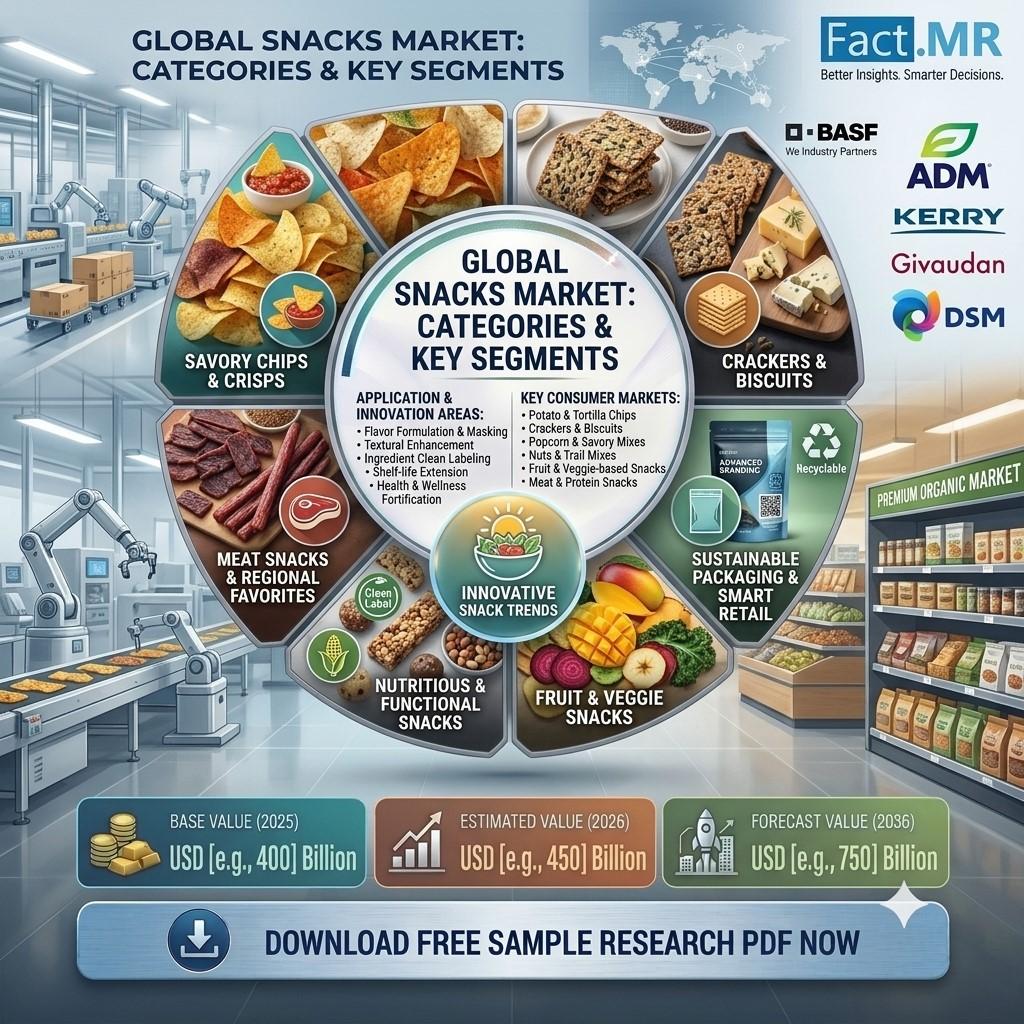
Sales of snacks are expected to increase from USD 598.23 billion in 2026 to USD 983.77 billion by 2036, registering a 5.1% CAGR over the forecast period. According to Fact.MR, the market was valued at USD 550.37 billion in 2025 and is anticipated to generate an additional USD 385.54 billion between 2026 and 2036. Expanding packaged food consumption, growing demand for convenient eating options, and increasing interest in premium and health-positioned snacks are supporting market development.
Changing consumer preferences are influencing snack purchasing across developed and emerging economies. Consumers increasingly seek products that offer convenience, distinctive flavors, and nutritional benefits. Manufacturers are responding through product reformulation, new flavor introductions, and differentiated packaging formats. Rising disposable incomes and expanding organized retail networks are also making packaged snacks more accessible, particularly in developing markets.
Get detailed market forecasts, competitive benchmarking, and pricing trends:
https://www.factmr.com/connectus/sample?flag=S&rep_id=50
Salty Snacks Retain Dominant Market Position
By product type, salty snacks are projected to account for 35.0% of the global snacks market in 2026. Potato chips, tortilla chips, extruded corn snacks, and pretzels represent important products within this category. Their established consumer acceptance, frequent repeat purchases, and availability across retail channels support continued market leadership.
Flavor innovation is a major factor influencing salty snack demand. Manufacturers are introducing regional flavors, premium ingredients, and different portion sizes to attract consumers and encourage repeat purchases. Fact.MR highlights that PepsiCo's Lay's and Doritos brands introduced 47 new flavor variants globally during the first half of 2024, illustrating the importance of product diversification.
Health-conscious consumption is also shaping this segment. Manufacturers are developing products with reduced sodium, improved ingredient profiles, and portion-controlled packaging. These developments allow established snack brands to address changing dietary preferences while maintaining their appeal among mainstream consumers.
Maize and wheat represent the leading source and ingredient category, accounting for 35.0% of market demand in 2026. Their cost advantages, processing versatility, and established agricultural supply chains support widespread use in extruded, baked, and fried snack products. Manufacturers can also use these ingredients to develop whole-grain and fortified snack alternatives.
India, USA, and Germany Show Strong Growth Potential
India is expected to register the highest growth among the countries highlighted in the report, with snack demand advancing at a 5.4% CAGR from 2026 to 2036. Organized retail expansion across Tier 2 and Tier 3 cities is improving packaged snack availability. Rising disposable incomes are also encouraging consumers to purchase branded products, creating opportunities for domestic and international manufacturers. Wider distribution networks and changing consumption habits are expected to support continued market expansion.
The United States is projected to grow at a 5.0% CAGR during the forecast period. Demand is supported by premium salty snacks, protein-rich products, and health-positioned alternatives. Consumers are increasingly purchasing snacks as convenient substitutes for traditional meals, while private-label products and bulk-buying formats are gaining attention among value-conscious households. Manufacturers are responding by expanding product portfolios and introducing new formulations across retail channels.
Germany is forecast to advance at a 4.7% CAGR through 2036. Consumer interest in organic products, clean-label ingredients, and nutritionally improved snack options is influencing product development. Reformulation of products high in fat, sugar, or salt, alongside nutrition-labeling considerations, is encouraging manufacturers to adjust ingredients and product positioning. Demand for plant-based and specialty snacks is also contributing to market diversification.
Across Europe, food manufacturers are placing greater emphasis on ingredient transparency and products designed for specific dietary preferences. In Asia Pacific, traditional flavors remain important, although consumers are increasingly exploring healthier alternatives. These regional differences are encouraging manufacturers to adapt product development and marketing strategies to local purchasing behavior.
Competitive Landscape
Competition in the global snacks market includes multinational food manufacturers and established regional brands with extensive distribution networks. Key companies profiled by Fact.MR include PepsiCo Inc., Nestlé S.A., Mondelez International Inc., Intersnack Group GmbH & Co. KG, General Mills Inc., ITC Limited, Britannia Industries Limited, and Calbee Inc.
Manufacturers are competing through flavor innovation, product differentiation, retail availability, and premium positioning. Established companies benefit from recognized brands and established distribution relationships, while regional manufacturers can respond to local tastes and pricing preferences. Product quality, ingredient sourcing, and sustainability performance are also influencing competitive positioning.
Fact.MR identifies growing importance in supplier compliance capabilities and distribution infrastructure. Companies seeking expansion across international markets must address varying food standards, labeling requirements, and consumer expectations. Investment in product development and reliable supply networks is therefore expected to remain important.
Product Innovation and Regulatory Developments Shape the Market
The snacks industry is experiencing a shift toward products that combine convenience with improved nutritional positioning. Whole-grain formulations, protein-rich snacks, plant-based ingredients, and reduced-sodium alternatives are creating opportunities for manufacturers to reach health-conscious consumers.
Regulatory developments are also influencing product strategies. Restrictions affecting the promotion of certain foods high in fat, sugar, or salt have encouraged reformulation and portion-control initiatives in markets such as the United Kingdom. Meanwhile, European sustainability and nutrition policies are encouraging greater attention to ingredient composition and product labeling.
Manufacturers are also exploring packaging improvements and more efficient production processes to address operating costs and environmental expectations. Continued innovation in flavors, ingredients, and product formats is expected to support consumer engagement as competition increases.
As packaged snack consumption expands across emerging markets and premiumization continues in established economies, manufacturers that respond to changing dietary preferences and regional consumer demand are expected to remain well positioned through 2036.
Top Reports:
https://adamaamresearch.blogspot.com/2026/11/dioxin-analyzer-market-size-to-reach.html
https://net-pals.com/blogs/66427/Dioxin-Analyzer-Market-Forecast-at-USD-459-7-Million-by
https://acmingle.com/blogs/35724/Global-Dioxin-Analyzer-Market-Projected-at-USD-459-7-Million
https://ikofficial.com/blogs/64094/Dioxin-Analyzer-Market-Poised-for-Expansion-Through-2036-China-4
About Fact.MR
Fact.MR is a market research and consulting company providing market intelligence, competitive analysis, and forecasting across global industries. Its research supports businesses with data-driven insights into emerging markets, technology trends, competitive dynamics, regional opportunities, and changing demand patterns.

 English
 Arabic
 French
 Portuguese
 Deutsch
 Turkish
 Dutch
 Italiano
 Russian
 Romaian
 Portuguese (Brazil)
 Greek