


Industrial Valve Market Set to Hit USD 123.9 Billion by 2034, with Emerson, Flowserve and Schlumberger in Focus
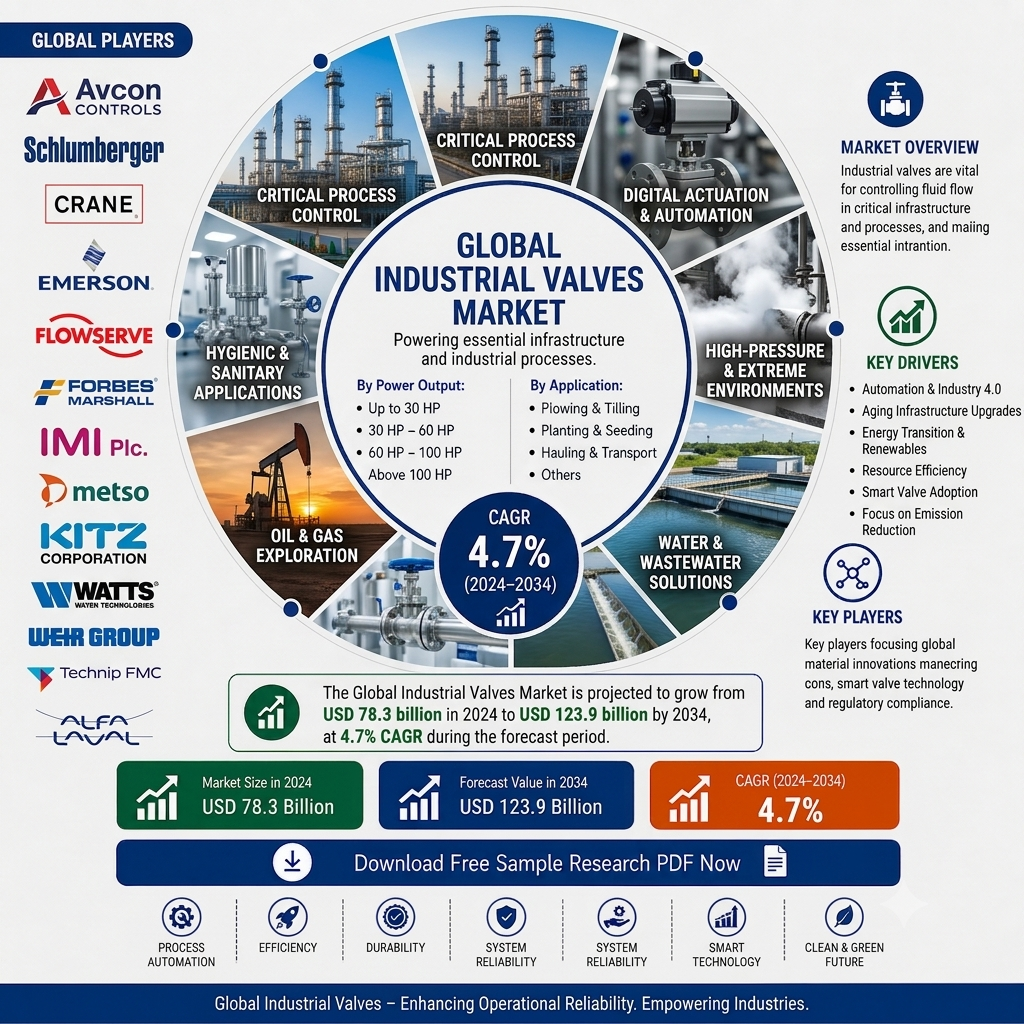
The global Industrial Valve Market is projected to increase from USD 78.3 billion in 2024 to USD 123.9 billion by 2034, expanding at a 4.7% CAGR during the forecast period, according to Fact.MR. Industrial valves are essential for controlling, directing, and isolating the flow of liquids and gases across complex industrial systems, making their performance critical to operational safety and efficiency.
Manufacturers are increasingly incorporating advanced technologies, including artificial intelligence (AI), machine learning, and the Internet of Things (IoT), into valve design and production. These technologies can support predictive maintenance, real-time flow management, risk reduction, and improved equipment performance across industrial facilities.
Request full Report Pricing and sample Report: https://www.factmr.com/connectus/sample?flag=S&rep_id=4545
Industrial Valve Market Snapshot
The market is expected to create an absolute opportunity of USD 45.6 billion between 2024 and 2034. Check valves account for a leading position by valve type, with the segment valued at USD 18.6 billion in 2024 and projected to reach USD 29.1 billion by 2034, expanding at a 4.6% CAGR.
Check valves are widely used to prevent backflow and are particularly suitable for systems handling low or variable flow rates. Their relatively simple design can also reduce the likelihood of clogging when managing contaminated fluids.
By end use, Oil & Gas represents the largest segment, valued at USD 19.8 billion in 2024 and projected to reach USD 31.2 billion by 2034. Valves are used throughout upstream, midstream, and downstream operations to regulate flow, isolate equipment, and support safe processing.
Nuclear Power and Water Management Create New Demand
The construction and upgrading of power-generation infrastructure are supporting demand for high-performance industrial valves. Nuclear power plants require hundreds of valves to regulate water and steam while supporting safety-related functions.
Advances in materials and manufacturing are allowing valves to operate under high-pressure and high-temperature conditions. This is increasing their relevance in demanding power-generation environments, where reliability and resistance to vibration and corrosion are critical.
Water distribution is another area where technology is changing valve applications. AI-driven systems can analyze flow conditions, identify potential disruptions, and optimize responses within water networks. Such systems can support pressure and flow control while helping utilities manage energy consumption and operational risks.
China and Japan Strengthen Regional Opportunities
China is projected to expand at a 4.8% CAGR from 2024 to 2034, accounting for 48.3% of the East Asian industrial valve market by 2034. Expansion of industrial activity and demand from manufacturing and energy infrastructure are supporting the country's market position.
In Japan, the market is projected to grow at a 4.9% CAGR, reaching USD 9.5 billion by 2034. Growing use of industrial valves in pharmaceutical manufacturing is contributing to demand, particularly where precise fluid handling and contamination control are required.
Canada is projected to expand at 4.8%, with its market increasing from USD 1.8 billion in 2024 to USD 2.8 billion by 2034. Infrastructure development and efforts to improve industrial equipment performance are supporting market growth.
Competitive Landscape
The industrial valve market is highly competitive, with manufacturers focusing on acquisitions, geographic expansion, product development, and technology integration. Key companies profiled by Fact.MR include Avcon Controls Pvt. Ltd., Schlumberger Limited, Crane, Emerson Electric Co., Flowserve Corp., Forbes Marshall, IMI Plc., Metso Corporation, KITZ Corporation, Watts Water Technologies, Weir Group Plc., TechnipFMC Plc., KSB SE & Co. KGaA, and Alfa Laval Corporate.
Product innovation remains a key competitive strategy. Emerson introduced its Crosby J-Series pressure relief valve product line with features designed to support balanced operation against backpressure and remote detection of bellows ruptures. KSB has also developed additively manufactured diaphragm valves using specialized alloyed materials for pharmaceutical applications.
Manufacturers face challenges related to high capital requirements, product reliability, regulatory compliance, and varying certification requirements across markets. Maintaining consistent quality across global production facilities is also becoming increasingly important as customers demand dependable delivery and performance.
To View Related Reports
https://afgbfh.blogspot.com/2026/11/motorcycle-accessory-market-to-record.html
https://sohomoy.com/blogs/78272/Motorcycle-Accessory-Market-Growth-Trajectory-Points-to-USD-21-05
About Fact.MR
Fact.MR is a market research and competitive intelligence provider delivering market intelligence, competitive analysis, and forecasting across global industries. Its research helps businesses evaluate market demand, understand competitive developments, and identify growth opportunities.

 English
 Arabic
 French
 Spanish
 Portuguese
 Deutsch
 Turkish
 Italiano
 Russian
 Romaian
 Portuguese (Brazil)
 Greek