


Why Is Your Pond Water Still Green After Installing a Pond Filter?
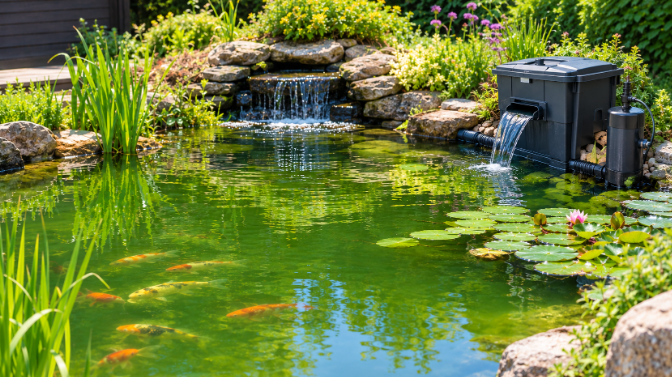
Installing a pond filter is an important step toward maintaining clean, healthy water, but it does not guarantee that your pond will become clear straight away. If the water remains green despite running a filter, the issue may be related to microscopic algae, excessive sunlight, nutrient buildup, or a filtration system that is not suited to your pond. Green pond water is usually caused by free-floating algae that multiply in response to sunlight and available nutrients. While a pond filter helps remove debris and supports the breakdown of fish waste, some filtration systems cannot remove microscopic algae on their own.
The good news is that replacing your filter is not always necessary. By understanding why the water is green, you can identify the most appropriate solution, avoid unnecessary expenses, and maintain a healthier environment for your fish and aquatic plants.
Microscopic Algae May Be Passing Through the Filter
One of the most common causes of green pond water is free-floating algae. These microscopic organisms remain suspended throughout the water, giving it a green or cloudy appearance. Unlike leaves and other visible debris, they are small enough to pass through many standard mechanical filtration systems. Pond filters generally perform different functions. Mechanical filtration traps solid particles, while biological filtration provides a surface for beneficial bacteria that help break down ammonia and other waste products. Although both are important for pond health, neither necessarily removes all the microscopic algae responsible for green water.
Would a UV Clarifier Help?
If your pond water is consistently green, a properly sized ultraviolet (UV) clarifier may help. It exposes water passing through the unit to UV light, which damages suspended algae and helps them clump together so they can be captured by the filtration system. A UV clarifier works best as part of a suitable filtration setup rather than as a complete replacement for a pond filter. Its effectiveness depends on factors such as the unit's capacity, water flow, lamp condition, and pond volume.
Before purchasing one, check the manufacturer's recommendations and confirm that your existing filter can capture the algae after treatment.
Too Much Sunlight Is Encouraging Algae Growth
Even a well-maintained pond can develop green water when it receives direct sunlight for much of the day. Sunlight provides the energy algae need to grow, and warm conditions can encourage their populations to increase rapidly. This is particularly common in shallow ponds or those with little aquatic plant cover. If the water turns greener during warmer months, sunlight may be contributing to the problem. Fortunately, you do not necessarily need to relocate the pond or install expensive equipment to reduce sunlight exposure. Floating aquatic plants can provide partial shade, while a suitable shade structure may help limit direct sunlight. However, avoid covering the entire pond surface with vegetation. Fish need adequate oxygen exchange, and excessive plant growth can create additional maintenance problems.
The goal is balance: reduce excessive sunlight without depriving fish and aquatic plants of the conditions they need to thrive.
Excess Nutrients Are Feeding the Algae
Sometimes, the filter is working correctly, but the pond continues to receive more nutrients than the system and surrounding ecosystem can manage. Fish waste, uneaten food, decomposing leaves, dead plant material, and fertilizer runoff can introduce nitrogen and phosphorus into the water. These nutrients support algae growth, allowing green water to return even after filtration improvements. Overfeeding is one issue worth checking first. Uneaten food breaks down in the pond, adding organic waste and increasing the workload on the filtration system. Similarly, accumulated leaves and decaying vegetation can gradually contribute to nutrient buildup.
A few simple maintenance habits can make a meaningful difference:
-
Feed fish appropriate amounts and remove uneaten food.
-
Clear leaves and decaying plant material before they accumulate.
-
Prevent fertilizer-rich garden runoff from entering the pond.
-
Test water quality if green water persists despite regular cleaning.
If nutrient levels remain high, consider where the excess nutrients are entering the pond instead of relying solely on stronger filtration. Addressing the source can help reduce recurring algae growth.
Is Your Pond Filter the Right Size?
Not every pond filter can handle every pond. A system designed for a small ornamental pond may struggle when installed in a larger pond or one containing many fish. Filter capacity depends on more than water volume. Fish stocking levels, feeding rates, waste production, debris, and the type of filtration media all affect how well the system performs. For example, a koi pond with a high fish population generally places a greater demand on biological filtration than a lightly stocked garden pond of the same size.
How to Check Your Filter's Capacity
Start by estimating your pond's actual water volume and comparing it with the manufacturer's recommendations. Check whether the stated capacity applies to a lightly stocked pond or a pond with a substantial fish population. Also consider the pump's flow rate. Water must pass through the filter at a rate suitable for the equipment to work effectively. A pump that delivers too much or too little flow for the system may affect performance.
If the filter is undersized, upgrading it or adding a compatible filtration stage may be necessary. However, if the water is green because of suspended algae, a larger filter alone may not solve the problem unless the system also provides an appropriate way to control those algae.
A Dirty Filter May Be Restricting Water Flow
A pond filter can gradually lose efficiency as debris accumulates inside its media. Leaves, fish waste, sludge, and other particles may restrict water movement, reducing the amount of water that passes through the filtration system. You may notice weaker water flow from the pump, more debris inside the filter, or water quality that deteriorates despite regular operation. Cleaning is important, but the method matters. Mechanical filter media may need frequent rinsing, while biological media requires more careful handling to preserve beneficial bacteria.
Avoid cleaning all biological media aggressively or replacing it all at once without a suitable plan. Disrupting the bacterial community can affect the filter's ability to process fish waste, potentially causing ammonia or nitrite levels to rise.
Follow the manufacturer's maintenance instructions and check water quality after significant filter maintenance, particularly if the pond contains fish.
Your New Filter May Need Time to Establish
A newly installed pond filter does not immediately develop a mature biological filtration system. Beneficial bacteria need time to establish themselves on the media and begin processing ammonia produced by fish waste. This process is often called biological cycling. During this period, the filter may not yet be capable of handling the pond's full biological load. However, there is an important distinction: a filter that needs time to establish is not necessarily the same as a filter that cannot remove suspended algae. Even a mature biological filter may leave the water green if microscopic algae continue to multiply.
If your pond has recently received a new filter, avoid adding more fish or increasing feeding while the system is stabilizing. Test ammonia and nitrite regularly, and make sure the filter is operating according to the manufacturer's instructions. Allowing the biological system to establish can improve overall water quality, but persistent green water may require a separate approach.
A Practical Plan for Clearing Green Pond Water
Rather than replacing equipment or adding treatments immediately, work through the problem in a logical order. This can help you avoid spending money on a solution that does not address the actual cause. Start by identifying what you see. Uniformly green water often indicates suspended microscopic algae, while long green strands attached to pond surfaces suggest filamentous algae. Brown or muddy water may have a different cause, such as suspended sediment.
Next, inspect the pump and filter. Check for blockages, weak water flow, damaged components, or media that needs cleaning. Review the filter's capacity if your pond is heavily stocked or has grown over time. Then address the conditions that support algae growth. Remove decomposing material, manage fish feeding, reduce excessive sunlight where practical, and prevent nutrient-rich runoff from entering the pond.
If the water remains green and suspended algae are the likely cause, consider whether a properly sized UV clarifier is appropriate for your setup. Give the system time to respond and make changes gradually. Avoid introducing several treatments at once, as doing so can make it difficult to identify what is working and may affect fish health.
Should You Use Algae-Killing Chemicals?
Algaecides and other chemical treatments may be available for pond algae control, but they should not be the first response to every green-water problem.
When large quantities of algae die, their decomposition can consume dissolved oxygen. This may stress fish, particularly in warm weather or ponds with inadequate aeration. Some products can also be unsuitable for particular fish, plants, or pond conditions.
If you are considering a treatment, check that it is specifically labelled for your pond's intended use, follow the instructions carefully, and understand the precautions for fish and aquatic plants. Where the cause is uncertain, seek advice from a qualified pond or aquatic professional before applying chemicals.
Can Green Pond Water Harm Your Fish?
Green water does not automatically mean that your pond is unhealthy. Algae are a natural part of aquatic ecosystems, and the appearance of green water alone cannot establish whether the pond is safe for fish. The concern is that dense algae growth can contribute to significant oxygen fluctuations. Oxygen levels may fall overnight because algae and other organisms continue to respire without photosynthesis. When large algae blooms die and decompose, oxygen demand can increase further.
Watch your fish for changes in behaviour, including:
-
Gasping at the water surface.
-
Unusual lethargy or reduced activity.
-
Loss of appetite or abnormal swimming.
-
Sudden deaths or signs of distress.
These symptoms can indicate a serious water-quality problem and should not be ignored. Check dissolved oxygen, ammonia, and nitrite where possible, and improve aeration if appropriate for your pond. If fish are in distress, seek prompt advice from an aquatic professional.
Remember that clear water is not necessarily healthy water. Regular water testing remains important, even when your pond looks clean.
How to Prevent Green Water From Returning?
Once the pond becomes clearer, maintaining consistent conditions can help reduce the likelihood of another algae bloom. No single maintenance routine works for every pond, but a few practices are useful for most systems.
Keep up with routine maintenance. Remove fallen leaves, clear accumulated debris, and inspect the pump and filter regularly. Follow the manufacturer's recommended cleaning schedule rather than waiting until water flow becomes noticeably restricted.
Manage feeding and stocking levels. Avoid overfeeding fish, and make sure your filtration system is appropriate for the number and type of fish you keep.
Maintain a balanced pond environment. Partial shade and suitable aquatic plants may help reduce algae growth, provided they do not overwhelm the pond or interfere with oxygen exchange.
Monitor water quality. Periodic testing can reveal problems that are not visible from the surface. This is especially important in koi ponds and other systems with substantial fish populations.
Finally, check your filtration equipment at the start of the warmer season and after major changes to the pond. A system that worked well previously may need maintenance or adjustment as fish grow, stocking levels change, or debris loads increase.
Final Thoughts
If your pond water is still green after installing a pond filter, the problem may be caused by suspended algae, excessive sunlight, nutrient buildup, restricted water flow, or a filtration system that does not suit your pond. The most effective solution begins with identifying the cause. Improve routine maintenance, reduce unnecessary nutrient inputs, check the filter's capacity, and consider a UV clarifier when free-floating algae are responsible for the green appearance.
If you need guidance on choosing suitable pond filtration equipment, GC Tek can be a useful option to consider when comparing solutions for your pond's needs. Rather than relying on repeated treatments or replacing equipment without a clear reason, focus on the pond's overall conditions. A suitable filtration system, balanced fish population, consistent maintenance, and regular water-quality checks can help you maintain clearer water and a healthier environment for aquatic life.
Frequently Asked Questions
-
Why is my pond still green even though the filter is running?
The filter may be removing debris and processing waste without removing microscopic algae. Excess sunlight, high nutrient levels, and unsuitable filtration can also contribute to persistent green water.
-
How long does it take for a pond filter to clear green water?
There is no fixed timeframe. The result depends on the cause of the green water, the filtration equipment, the pond's conditions, and whether suspended algae are being controlled effectively. A newly installed filter may also need time to establish beneficial bacteria.
-
Will a UV clarifier clear green pond water?
A properly sized and correctly installed UV clarifier can help control free-floating algae when used with suitable filtration. It does not replace mechanical or biological filtration, and it may not solve other causes of cloudy water.
-
Should I clean my pond filter if the water turns green?
Inspect the filter for blockages and restricted flow, then clean it according to the manufacturer's instructions. Avoid unnecessarily aggressive cleaning of biological media, as this can disrupt beneficial bacteria.
-
Is green pond water always harmful to fish?
No. Green water is not automatically dangerous, but dense algae blooms can contribute to oxygen fluctuations and other water-quality problems. Monitor fish behaviour and test the water when necessary.

 English
 Arabic
 French
 Portuguese
 Deutsch
 Turkish
 Dutch
 Italiano
 Russian
 Romaian
 Portuguese (Brazil)
 Greek