


Water Feature Lighting: A Better Way to Light Fountains

A fountain can be the centerpiece of a garden by day, yet fade into the background after sunset. Thoughtful water feature lighting helps people see the fountain’s shape and movement without making the whole yard feel overlit. The key is deciding what should catch the eye: the falling water, a sculptural centerpiece, or the basin itself.
Before choosing fixtures, consider where people will view the fountain and how its water moves. A small vertical jet, a tiered fountain, and a broad cascade each call for a different lighting approach. Fixture placement, beam spread, water clarity, and the surrounding landscape all affect what the finished scene looks like.
Decide what people should notice first
Start by watching the fountain operate from the main seating or viewing area. Does the water rise in a narrow jet, spill over several tiers, or fall across a wide surface? The most effective lighting usually emphasizes that motion, rather than lighting every part of the fountain and nearby garden equally.
For a simple vertical spray, aim to reveal the stream from its source through its arc. With a tiered fountain, you may want to show how water moves from one level to the next. A broad cascade may benefit from a wider, more even wash that brings out the surface texture.
Then look at the fountain’s surroundings. A dark wall, plants, stonework, or a sculpture can become part of the composition. Lighting the water against a darker backdrop can make its shape easier to see, while a softly lit nearby plant may give the scene more depth. Avoid treating every feature as a focal point. A clear visual hierarchy helps the fountain stand out without competing with itself.
Place fixtures to reveal movement
The position of a fixture changes where shadows fall and how clearly the water reads. An underwater fixture aimed toward a jet or cascade can make the moving water visible against its surroundings. Concealing the light source from the usual viewing positions can also help reduce direct glare. Water reflects light, so check the view from several angles, including nearby windows and seating areas.
Fixture distance matters, too. A beam that is too narrow may highlight only a small patch. A broad beam may spread light across more of the fountain or basin, but can also wash out the contrast that defines the water’s movement. Choose beam characteristics according to the feature and the manufacturer’s product information, then adjust the aim where the fixture allows it.
For fountains viewed from multiple sides, consider how the effect appears from each direction. One carefully aimed fixture may work for a compact, one-sided feature. A larger fountain or one seen from all sides may need a more balanced arrangement. Plan around the actual viewing area rather than assuming the best angle is the same everywhere.
Match color to the fountain and landscape
Light color influences the scene’s mood and the way materials appear. Warm white can give a stone fountain a softer, traditional look. A cooler white may suit a contemporary setting or a pale masonry surface. Color-changing light can create a more dramatic display, but changing colors continuously may distract from the water itself.
Think about nearby exterior lighting as well. A warm fountain beside cool-white path lights can look visually disconnected. You do not have to use identical light everywhere, but the colors should feel intentional together. If the fountain will be used for everyday evening enjoyment, a restrained, consistent setting may be easier to live with than a display built around frequent color changes.
Water clarity also affects the result. Suspended debris or algae may become more visible when illuminated, and cloudy water can soften the effect. Before adding more light, make sure the fountain is clean and operating as intended. A strong fixture cannot compensate for water that obscures the feature.
Choose a fixture for the actual application
Fountain lights must be designed for the environment where they will be installed. A fixture intended for landscape use above ground is not automatically suitable for submersion. Check the product’s installation instructions and listing, including whether it is designed for underwater use and what power supply or connection method it requires.
Compare products by the details that affect your project:
-
Application: Confirm the fixture is designed for submersible use in the intended type of water feature.
-
Voltage and power supply: Match the fixture with its specified transformer or power components.
-
Beam and adjustability: Consider whether the beam can suit a narrow jet, tiered structure, or wider cascade.
-
Construction and materials: Check the product details for materials appropriate to the installation environment.
-
Maintenance access: Plan how the fixture can be reached for cleaning, inspection, or service.
AQLightingGroup’s underwater and fountain light includes options such as submersible LED fixtures and different fixture styles. Their category can help you compare product types, but the specifications for the exact model should guide your final choice. AQLightingGroup lists both 12-volt products and other configurations, so confirm the voltage and compatible components for each fixture before planning the installation.
Treat electrical safety as part of the design
Water features require careful electrical planning. Select a fixture listed for the intended underwater application, and follow its instructions for the luminaire, power supply, connections, and installation depth. Do not assume that a low-voltage label alone establishes that a product is suitable for submersion.
Applicable electrical requirements depend on the installation and local code. The International Residential Code includes provisions for underwater luminaires, including listed equipment and ground-fault protection or a qualifying transformer or power supply in applicable installations. UL also identifies UL 676 as the standard for underwater luminaires and submersible junction boxes.
For this reason, have a qualified electrician review the setup when wiring, transformer selection, bonding, or code compliance is involved. Keep connections and power components in the locations specified by the manufacturer, and make sure planned maintenance can be performed safely. The fixture should also be installed securely so it remains aimed where intended.
Check the effect after dark
Once the water feature is running and the lights are installed, view it from the places people actually use: a patio, a path, a window, or a nearby seating area. Look for direct glare, bright reflections, dark gaps, or areas where the water appears flat. If a fixture can be aimed, small adjustments may improve the effect without adding another light.
Keep lenses and fixtures clear according to their care instructions, and inspect the installation as part of routine fountain maintenance. Leaves, mineral deposits, or algae can change how the light passes through the water. If the appearance changes, check cleanliness and aim before deciding the system needs more fixtures.
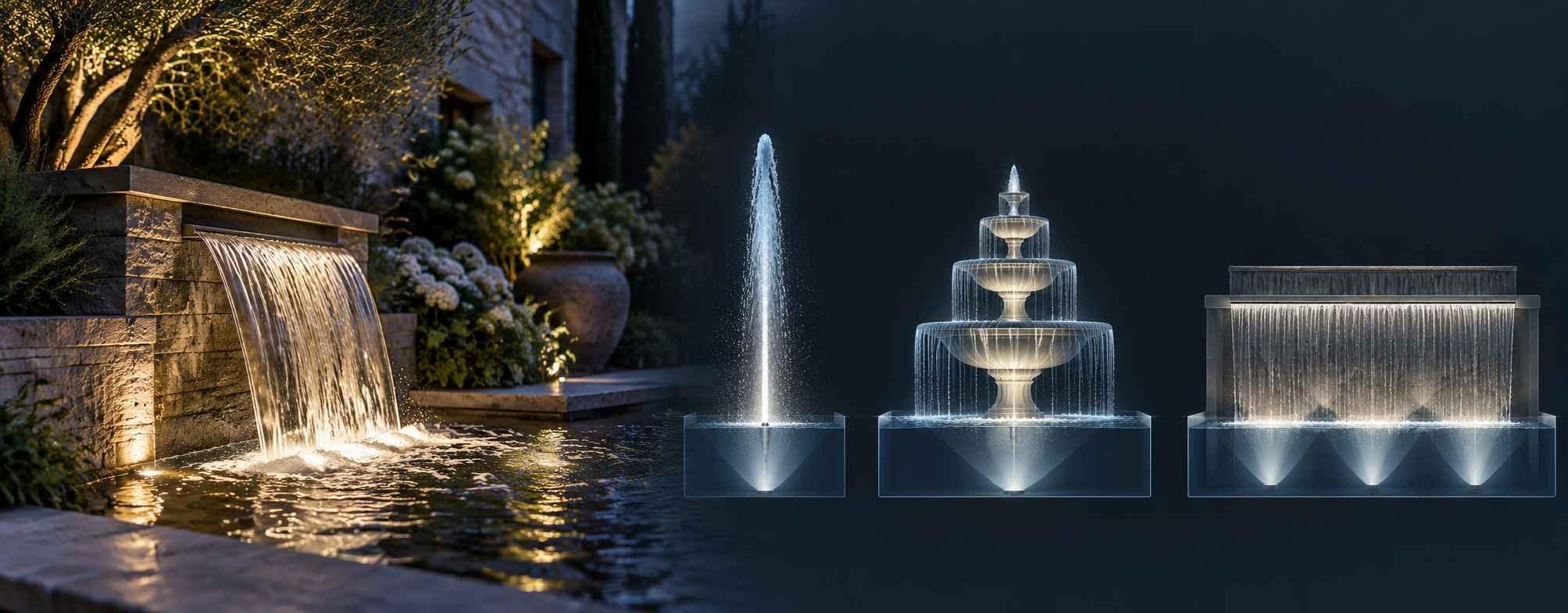
AQ Lighting offers a range of underwater and fountain lighting products for residential and landscape projects. Their product details can help you compare the available styles and specifications. Start with the fountain’s shape, how people view it, and the effect you want, then choose a fixture designed for that exact installation.
FAQs:
-
What is the best way to light a small fountain?
Start by identifying the water movement you want to show, then position a submersible fixture to reveal it from the main viewing angle. Check for glare and reflections from nearby seating. -
Can regular landscape lights be used underwater?
Only use fixtures specifically designed and listed for the intended underwater application. An outdoor rating alone does not confirm that a light can be submerged. -
Should fountain lights be warm white or cool white?
Either can work. Warm white often suits traditional stone or brick, while cooler white may complement a contemporary design. Consider nearby outdoor lights so the scene feels cohesive. -
Does water clarity affect fountain lighting?
Yes. Cloudy water, algae, and floating debris can make the illuminated water look hazy or uneven. Clean and maintain the fountain before increasing light output. -
Do underwater fountain lights need a transformer?
It depends on the fixture’s voltage and design. Use only the power supply and components specified for the exact product, and consult a qualified electrician about installation requirements.

 English
 Arabic
 French
 Spanish
 Portuguese
 Turkish
 Dutch
 Italiano
 Russian
 Romaian
 Portuguese (Brazil)
 Greek