


Automated Truck Market Set to Hit USD 94.28 Billion by 2036, with TuSimple, Waymo and Einride in Focus
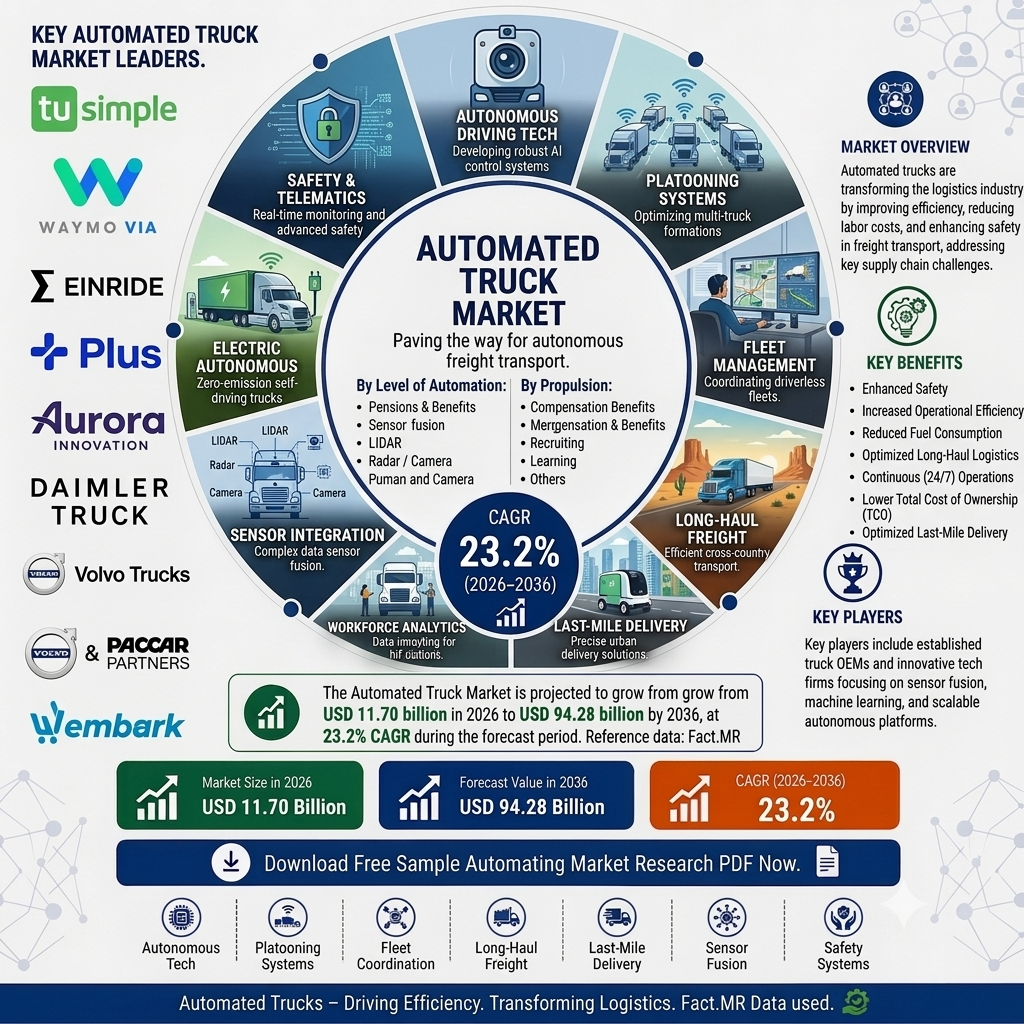
The global Automated Truck Market is projected to increase from USD 11.70 billion in 2026 to USD 94.28 billion by 2036, expanding at a 23.2% CAGR during the forecast period, according to Fact.MR. The market was valued at USD 9.50 billion in 2025. Persistent shortages of commercial truck drivers, rising linehaul labor costs, and growing demand for continuous freight operations are encouraging fleet operators to evaluate automated trucking systems as a commercial procurement category.
Automated trucks combine autonomous driving systems with sensor suites, computing platforms, high-definition mapping, vehicle-to-everything communication, and software for perception, planning, and control. The market includes purpose-built autonomous trucks and retrofit autonomy kits for commercial freight vehicles operating across defined environments such as highways, ports, and distribution facilities.
Request full Report Pricing and sample Report: https://www.factmr.com/connectus/sample?flag=S&rep_id=5350
Automated Truck Market Snapshot
The market is expected to create an absolute opportunity of USD 82.58 billion between 2026 and 2036. SAE L2-L3 Driver-Assist leads the autonomy segment with a 54.0% share in 2026, reflecting the current preference for commercial systems that provide advanced driver assistance while retaining human operational control.
By application, Long-Haul Freight accounts for 48.0% of market demand in 2026. Highway-focused freight operations offer favorable conditions for automation because of defined routes, extended travel distances, and the potential to improve fleet utilization.
By powertrain, Diesel Hybrid-Autonomy holds the leading position with a 62.0% share in 2026, supported by established fleet infrastructure, range requirements, and the transitional role of hybrid systems in commercial transportation.
Driver Shortages Accelerate Automation Investment
A structural shortage of qualified truck drivers is one of the strongest economic catalysts for automated trucking. The American Trucking Associations estimated a shortage of approximately 82,000 drivers in the United States in 2024, with the deficit potentially exceeding 160,000 by 2031 without intervention.
Labor costs are also influencing fleet economics. Driver compensation is estimated to represent 35% to 40% of total linehaul operating expenses, strengthening the business case for technologies that can support longer operating windows and reduce dependence on driver availability.
E-commerce expansion is creating another demand opportunity. Automated trucks can support freight movement across distribution networks and, in selected applications, last-mile delivery. Fleet operators are increasingly assessing automation alongside logistics optimization, safety improvements, and service reliability requirements.
United States Leads Country Growth
The United States is projected to record the fastest growth among the countries covered by Fact.MR, expanding at a 28.1% CAGR from 2026 to 2036. Regulatory framework development and deployment of Level 4 highway systems are supporting commercial automation activity across major freight corridors.
Mexico follows with a projected 26.4% CAGR, benefiting from its position within major cross-border freight routes. Germany is expected to expand at 24.5%, supported by autonomous truck trials and digital infrastructure development.
France is projected to grow at 23.2%, while South Korea, the United Kingdom, and Japan are expected to register CAGRs of 21.5%, 21.0%, and 19.8%, respectively.
Competitive Landscape
The automated truck market features established automotive manufacturers, autonomous vehicle developers, and technology companies competing through artificial intelligence, sensor integration, autonomous driving software, regulatory readiness, and commercial deployment capabilities.
Key companies profiled by Fact.MR include TuSimple Holdings Inc., Waymo LLC (Alphabet Inc.), Einride AB, Plus (Plus.ai), Aurora Innovation Inc., Daimler Truck Holding AG, Volvo Autonomous Solutions, PACCAR Inc., and Embark Technology Inc.
TuSimple leads the market with a 12.0% share, according to Fact.MR, with a focus on autonomous trucking technology and long-haul freight applications. Other participants are developing automated driving platforms, autonomous freight solutions, electric truck technologies, and integrated fleet systems.
Competition is increasingly determined by safety validation, regulatory compliance, sensor and AI capabilities, infrastructure compatibility, and the ability to transition pilot programs into scalable commercial deployments. High technology-development costs, infrastructure requirements, regulatory uncertainty, and safety validation remain important challenges.
To View Related Reports
https://afgbfh.blogspot.com/2026/11/baru-nuts-market-set-to-grow-to-usd-760.html
https://sportgalax.com/read-blog/27360
About Fact.MR
Fact.MR is a market research and competitive intelligence provider delivering market intelligence, competitive analysis, and forecasting across global industries. Its research helps businesses evaluate market demand, understand competitive developments, and identify growth opportunities.

 English
 Arabic
 French
 Spanish
 Deutsch
 Turkish
 Dutch
 Italiano
 Russian
 Romaian
 Portuguese (Brazil)
 Greek