


Refuse-Derived Fuel Market Sees Rising Demand from Cement Plants
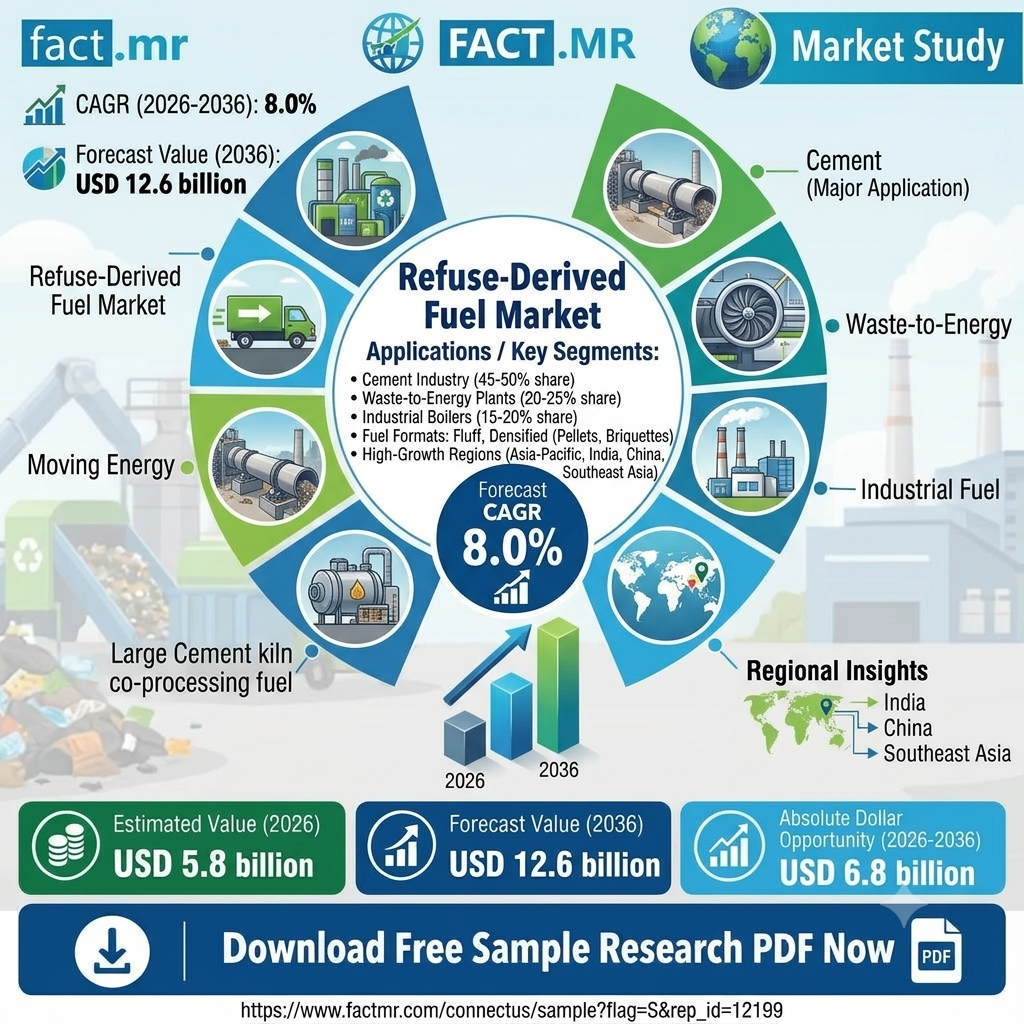
The global Refuse-Derived Fuel (RDF) market is projected to increase from USD 5.8 billion in 2026 to USD 12.6 billion by 2036, expanding at a compound annual growth rate (CAGR) of 8.0%, according to Fact.MR. Rising municipal solid waste generation, tighter landfill regulations, and industrial demand for cost-competitive alternative fuels are supporting this expansion. The market is expected to create an additional USD 6.8 billion opportunity over the forecast period.
The shift is becoming increasingly economic. Cement manufacturers are adopting RDF to reduce dependence on conventional fuels, while waste management operators are developing processing facilities that convert discarded materials into usable industrial energy. India, China, and Southeast Asia are emerging as important growth markets as waste volumes and industrial fuel requirements increase.
Get detailed market forecasts, competitive benchmarking, and pricing trends: https://www.factmr.com/connectus/sample?flag=S&rep_id=1461
Refuse-Derived Fuel Market Growth Driven by Industrial Economics
The refuse-derived fuel market is moving beyond its traditional waste disposal role. Industrial users are evaluating RDF as a practical fuel option, particularly where landfill charges and conventional fuel prices influence operating costs.
Fact.MR estimates that RDF production costs range from USD 20 to USD 45 per ton for processing. In developed markets, tipping fees can range from USD 60 to USD 120 per ton, helping offset processing expenses. Under favorable conditions, waste disposal revenue can even create a negative effective fuel cost.
On an energy-equivalent basis, RDF can offer a 15%–35% cost advantage over imported coal in regions with high tipping fees. This advantage remains relevant despite RDF's lower calorific value of 2,500–4,500 kcal/kg compared with coal at 5,500–6,500 kcal/kg.
Logistics remains a critical consideration. Transportation accounts for approximately 15%–30% of delivered RDF costs. Fact.MR estimates that transportation beyond 150–200 kilometers can weaken project economics, making proximity between waste collection facilities and industrial consumers essential.
Cement Industry Leads Refuse-Derived Fuel Applications
The cement industry represents the largest application segment, accounting for approximately 45%–50% of global RDF consumption. Cement kilns require substantial thermal energy, creating opportunities for substituting conventional fuels with processed municipal and commercial waste.
RDF can replace approximately 20%–40% of cement kilns' thermal energy requirements without significant infrastructure modifications. Leading European facilities have already achieved substitution rates exceeding 30%, while emerging markets generally operate at 5%–15%.
Waste-to-energy plants account for another 20%–25% of RDF applications. Industrial boilers contribute approximately 15%–20%, with power generation and other industrial uses representing the remaining demand.
Fluff RDF and densified formats, including pellets and briquettes, form the principal product categories. Densified RDF is gaining attention because improved handling and transportation efficiency can support industrial distribution.
Asia-Pacific Emerges as a High-Growth Regional Market
Europe remains the most mature regional market, supported by established waste management infrastructure, landfill restrictions, and carbon pricing mechanisms. Germany, the United Kingdom, Sweden, and the Netherlands have developed established RDF supply chains.
The region accounts for approximately 35%–40% of global market value. European cement manufacturers are also increasing alternative fuel consumption as environmental requirements influence industrial operations.
Asia-Pacific accounts for approximately 30%–35% of market value and is expected to outpace other regions in growth. India is projected to register a 9% CAGR, while China is expected to expand at 8.5%. Southeast Asian markets are forecast to grow at more than 9%.
India's Solid Waste Management Rules, 2026, introduce stronger waste recovery requirements, including a target to increase RDF substitution in industrial fuel consumption to 15% over the coming years. This creates additional demand for consistent waste processing and fuel supply.
North America is expected to record moderate growth of 5%–6%, while the Middle East is gradually developing RDF infrastructure through waste management and energy diversification initiatives.
Project Economics and Fuel Quality Shape Investment Decisions
Project profitability depends heavily on tipping fee structures, processing costs, logistics, and long-term industrial supply agreements.
Fact.MR estimates capital expenditure at USD 80–150 per ton of annual processing capacity. Operating expenses, excluding feedstock, generally range between USD 15 and USD 30 per ton.
Under favorable market conditions, RDF facilities can achieve internal rates of return (IRRs) of 12%–18%, with typical payback periods of four to seven years. However, a 20% decline in tipping fees or a 15% increase in logistics costs can reduce project IRRs by 300–500 basis points.
Fuel quality presents another challenge. Municipal solid waste composition can vary by up to 35% between regions. Organized collection and segregation systems can improve calorific consistency by 15%–20%, supporting more reliable industrial applications.
Competitive Landscape and Industry Developments
The competitive landscape includes municipal waste operators, private recyclers, equipment manufacturers, and integrated waste-to-energy companies.
Key companies operating in the refuse-derived fuel market include SUEZ Recycling and Recovery UK Ltd., Renewi, Biffa, Veolia, FCC Austria Abfall Service AG, Estre Ambiental Inc., EcoUrja, Carley Group Plc, Tana Oy, and Andritz Mewa GmbH.
Technology investments are becoming an important competitive factor. SUEZ and Veolia are developing advanced sorting and fuel processing capabilities to improve RDF consistency. Meanwhile, equipment providers such as Andritz Mewa and Hitachi Zosen support processing infrastructure across the value chain.
A notable development came in March 2026, when Veolia's New Urban Energy project in the Czech Republic began decommissioning coal-fired boilers to introduce multi-fuel systems powered primarily by RDF. The project is expected to supply more than 50% of district heating requirements through waste-derived fuel.
About Fact.MR
Fact.MR is a market research and consulting firm providing industry intelligence, market forecasts, competitive analysis, and strategic insights across global industries. The company combines primary research, secondary validation, market sizing, and economic modelling to help businesses evaluate market opportunities and make informed decisions.

 English
 Arabic
 French
 Spanish
 Portuguese
 Deutsch
 Turkish
 Italiano
 Russian
 Romaian
 Portuguese (Brazil)
 Greek