


MRI Coils Market Segmentation by Coil Type, Field Strength, Application, and End User
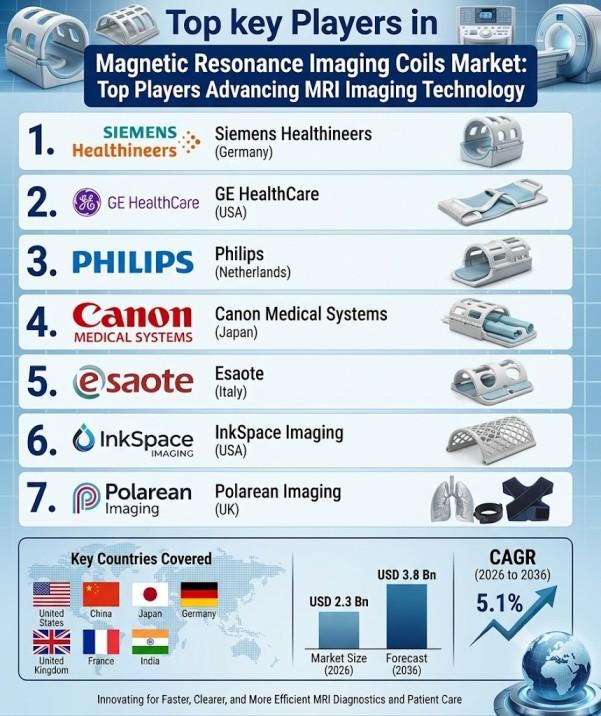
The global magnetic resonance imaging coils market is forecast to increase from USD 2.3 billion in 2026 to USD 3.8 billion by 2036, expanding at a 5.1% CAGR, according to Future Market Insights (FMI). The market represents an incremental opportunity of USD 1.5 billion over the forecast period. Hospitals are expected to account for 56.7% of the market in 2026, while phased array coils hold 52.4% of the design segment.
👉 Get Detailed Market Forecasts, Competitive Benchmarking, and Pricing Trends:
https://www.futuremarketinsights.com/reports/sample/rep-gb-16638
Scanner renewal is strengthening replacement demand
MRI coil purchasing is increasingly linked to scanner upgrades and workflow requirements. FMI notes that new MRI platforms require coils matched to field strength, receiver channels, anatomy coverage and software workflows. Diagnostic imaging centers are also looking for lighter coil sets that can reduce setup time across repeated outpatient examinations.
Recent procurement and regulatory activity illustrates the shift. In February 2025, the All India Institute of Medical Sciences Bhopal published a tender for a new 3T MRI system under a PPP model that required RF coils for head and extremity imaging and asked bidders to specify channels and acceleration factors for each array coil. In September 2025, the United States Food and Drug Administration cleared Fujifilm's ECHELON Synergy MRI system, with RF coil comparisons included in the regulatory documentation.
In May 2025, United Imaging Healthcare described the uMR Jupiter 5T with a whole-body eight-channel parallel transmit coil, further highlighting the importance of coil and scanner compatibility.
Where growth is fastest
- India — 7.1% CAGR: Diagnostic imaging capacity expansion and medical-device policy pressure are supporting growth. FMI also points to replacement demand as hospitals expand MRI access.
- United Kingdom — 6.4% CAGR: Scanner-access gaps and imaging backlogs are keeping equipment renewal commercially relevant.
- China — 6.2% CAGR: High-end medical-device policy support and local MRI equipment development are supporting demand.
- United States — 5.7% CAGR: A large MRI-capable facility network and active equipment-clearance cycles sustain replacement demand.
- Japan — 4.8% CAGR: Deep imaging-equipment availability provides a large replacement base even as growth remains measured.
- Germany — 4.7% CAGR: High MRI scan volumes and substantial hospital imaging capacity support recurring coil renewal.
- France — 4.5% CAGR: MRI capacity and continued imaging activity support steady replacement spending.
What leads the market
- Phased array coils — 52.4% share in 2026: Multiple receiver elements provide broader coverage and support faster imaging workflows, making phased array designs the leading design category.
- Surface coils — 45.2% share in 2026: Targeted anatomy examinations keep surface coils central to routine MRI use.
- 5T coils — 48.6% share in 2026: Continued reliance on 1.5T scanner capacity across hospital and outpatient rooms supports this field-strength category.
- Neurological imaging — 41.3% share in 2026: Brain and spine examinations generate recurring demand in hospital MRI suites.
- Hospitals — 56.7% share in 2026: High scan volumes across multiple specialties support regular replacement and backup-coil purchasing.
The hurdle
High replacement costs can slow upgrades at smaller imaging centers. FMI identifies coil replacement expense as the principal restraint, particularly where capital budgets are tight. Buyers must also consider compatibility with existing scanner platforms, regulatory documentation and service support before committing to replacement equipment.
Flexible designs provide an opportunity to address another procurement priority: easier handling and improved patient comfort. FMI says these products can gain traction in high-throughput outpatient rooms and comfort-focused MRI suites.
Recent developments
Three dated developments illustrate the direction of the market:
- April 2026 — Philips: Received S. FDA 510(k) clearance for the Smart Fit TorsoCardiac 1.5T coil.
- January 2025 — InkSpace Imaging: Received S. FDA clearance for a 1.5T 24-channel MR coil for Siemens Healthineers Magnetom MRI scanners.
- November 2024 — Polarean Imaging: Received S. clearance for XENOVIEW 3T Chest Coil use with compatible GE HealthCare MRI systems.
The companies profiled by FMI are Siemens Healthineers, GE HealthCare, Philips, Canon Medical Systems, Esaote, InkSpace Imaging and Polarean Imaging. The competitive analysis says scanner-platform owners benefit from broad compatibility, while specialist suppliers compete through lighter designs, targeted clearances and compatibility with multiple scanner platforms.
Analyst perspective
Anurag Sharma, Principal Consultant for Healthcare at Future Market Insights, observes:
“Coil suppliers are moving closer to scanner workflow decisions. Buyers now compare comfort and compatibility before price. Hospitals will reward coil platforms reducing repositioning and repeat scans. Suppliers with clear regulatory proof and platform coverage should gain a stronger buying route.”
Access Full Report: https://www.futuremarketinsights.com/reports/magnetic-resonance-imaging-coils-market
What this means for MRI equipment buyers and suppliers
- Treat compatibility as a procurement requirement, not a technical afterthought. Scanner field strength, receiver channels, anatomy coverage and software workflows all affect whether a coil can be integrated into an existing imaging environment.
- Prioritize replacement planning around scanner upgrades. FMI links coil demand closely to platform renewal. Hospitals and imaging centers can reduce procurement disruption by aligning coil replacement schedules with MRI upgrade cycles.
- Compare total operating value rather than purchase price alone. High replacement costs remain a restraint, while flexible designs and faster setup can support workflow efficiency. Buyers should assess compatibility, service coverage, handling requirements and replacement availability alongside upfront cost.
Related Reports:
- Clinical Trials Market - https://www.futuremarketinsights.com/reports/clinical-trials-market
- Lung Cancer Surgery Market - https://www.futuremarketinsights.com/reports/lung-cancer-surgery-market
- Veterinary Vaccines Market - https://www.futuremarketinsights.com/reports/veterinary-vaccines-market
About Future Market Insights (FMI)
Future Market Insights (FMI) is a global market intelligence and consulting firm providing comprehensive market research, competitive intelligence, and strategic business insights across industries. The firm delivers detailed forecasts, technology analysis, and data-driven recommendations that support informed decision-making for manufacturers, investors, distributors, and policymakers worldwide.
For Press & Corporate Inquiries
Rahul Singh
AVP – Marketing and Growth Strategy
Future Market Insights, Inc.
+91 8600020075
For Sales – sales@futuremarketinsights.com

 English
 Arabic
 Spanish
 Portuguese
 Deutsch
 Turkish
 Dutch
 Italiano
 Russian
 Romaian
 Portuguese (Brazil)
 Greek