


Plant-based Fish Market to Hit USD 3.78 Billion by 2036, Led by Good Catch, Impossible Foods and Nestlé
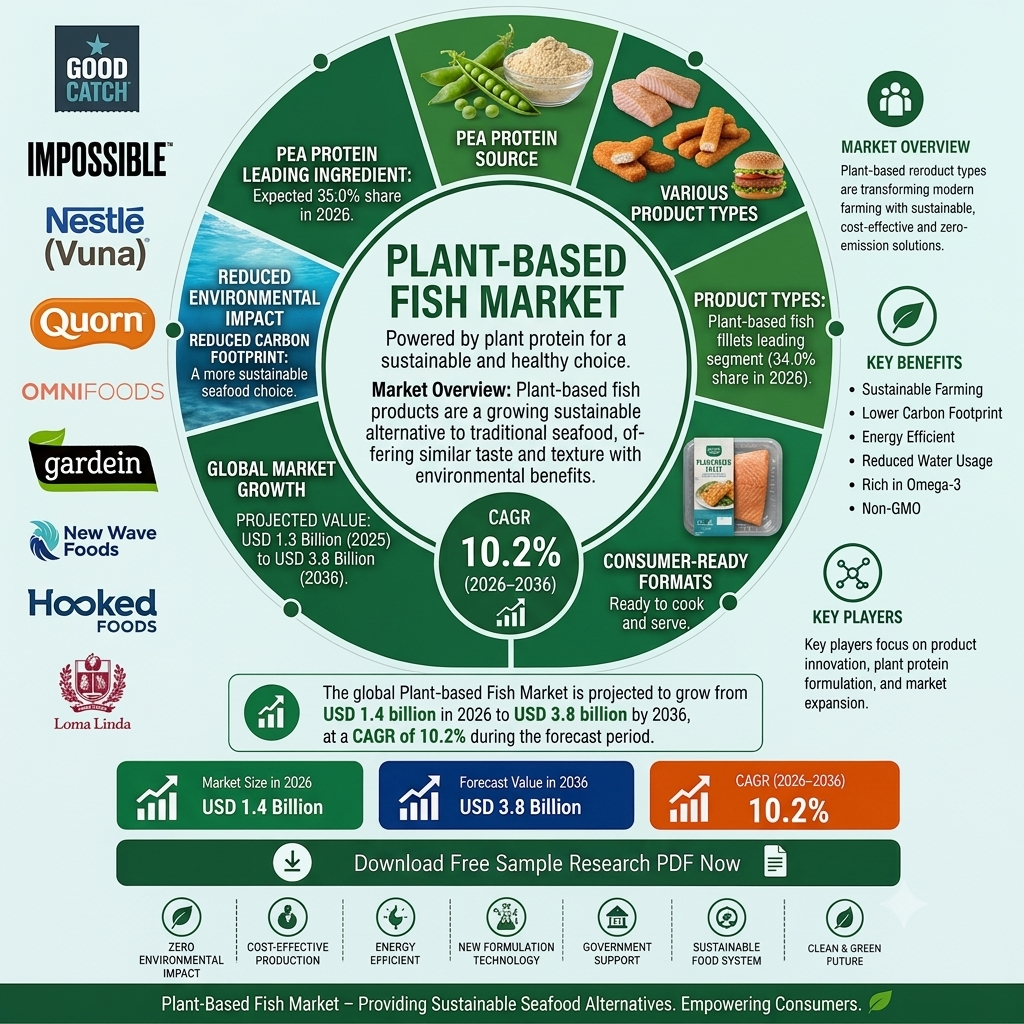
The global plant-based fish market is valued at USD 1.3 billion in 2025 and is projected to reach USD 3.78 billion by 2036, expanding at a 10.2% CAGR from 2026 to 2036, according to Fact.MR. Demand is being supported by health-conscious eating, sustainability concerns linked to ocean fishing, flexitarian diets, and improvements in food processing technologies that help plant-based seafood more closely replicate the taste and texture of conventional fish.
Plant-based fish is moving beyond a niche alternative-protein category as retailers and foodservice providers expand product availability. Major supermarkets and online grocery platforms are increasingly placing plant-based seafood alongside conventional seafood and other meat alternatives, improving visibility and encouraging consumer trial.
Request full Report Pricing and sample Report: https://www.factmr.com/connectus/sample?flag=S&rep_id=5728
Plant-based Fish Market Outlook
Plant-based fish products are designed to replicate the taste, texture, and appearance of conventional seafood using plant-derived proteins and specialized processing technologies. The category includes fillets, fish fingers and nuggets, fish cakes, tuna-style products, salmon alternatives, and prawn and shrimp alternatives.
Product quality remains central to market development. High-moisture extrusion is helping manufacturers create fibrous textures that better reproduce the flake and mouthfeel associated with fish, while fermentation-based processing can provide umami and oceanic flavor profiles. High-moisture extrusion accounts for 40% of processing technology demand in 2026, according to Fact.MR.
However, the category continues to face a product quality gap compared with conventional seafood. Higher prices, typically 30% to 60% above conventional frozen fish, and limited consumer awareness can also restrict adoption in price-sensitive markets.
Plant-based Fish Fillets Lead Product Demand
Plant-based fish fillets account for 34% of product revenue in 2026, making them the leading product segment. White fish, cod-style, haddock-style, tilapia-style, and salmon-style alternatives are attracting consumers seeking familiar seafood formats.
Pea protein leads the source ingredient segment with a 35% share in 2026. Its neutral flavor profile, functional versatility, and positioning as an alternative to soy and wheat gluten make it a preferred ingredient for plant-based fish formulations.
Frozen products account for 52% of the product-form segment, supported by established retail distribution economics and consumer familiarity with frozen seafood products.
United States Leads Country-Level Growth
The United States is projected to record an 11.5% CAGR through 2036, making it the fastest-growing major market analyzed by Fact.MR. Developed plant-based seafood retail infrastructure, strong brand visibility, and expanding foodservice adoption are supporting market growth.
Mexico follows with a 10.8% CAGR, supported by high seafood consumption, growing awareness of plant-based foods, and expanding retail distribution. Germany is projected to grow at 10.0%, while France and the United Kingdom are expected to expand at 9.6% and 9.1%, respectively.
South Korea and Japan are also emerging as important markets, with projected CAGRs of 8.7% and 8.4%, respectively. Their high seafood consumption creates a substantial addressable consumer base for alternative seafood products.
Competitive Landscape
The plant-based fish market remains highly fragmented, with companies competing through product quality, processing capabilities, brand strength, and distribution reach. Key players profiled by Fact.MR include Good Catch, Impossible Foods, Nestlé (Vuna), Quorn, OmniFoods, Gardein, New Wave Foods, Hooked Foods, Loma Linda, Sophie's Kitchen, Vivera, The Vegetarian Butcher (Unilever), Gathered Foods, Konscious Foods, ISH Food Company, Current Foods, and BlueNalu.
Good Catch holds an estimated 10% share in 2026, supported by its dedicated plant-based seafood portfolio and U.S. retail distribution. Impossible Foods is leveraging its established alternative-protein brand presence, while Nestlé participates through its Vuna plant-based tuna products. Quorn, OmniFoods, and Gardein are also expanding their positions across regional seafood-alternative markets.
To View Related Reports
https://afgbfh.blogspot.com/2026/11/generator-market-set-to-grow-to-usd-468.html
https://social.art-inpa.com/blogs/48281/Generator-Market-Revenue-Outlook-Targets-USD-46-8-Billion-by
https://sportgalax.com/read-blog/27477
About Fact.MR
Fact.MR is a market research and competitive intelligence provider delivering market intelligence, competitive analysis, and forecasting across global industries. Its research helps businesses evaluate market demand, understand competitive developments, and identify growth opportunities.

 English
 Arabic
 French
 Portuguese
 Deutsch
 Turkish
 Dutch
 Italiano
 Russian
 Romaian
 Portuguese (Brazil)
 Greek