


How LMS Software Development Is Transforming Modern Education and Corporate Training
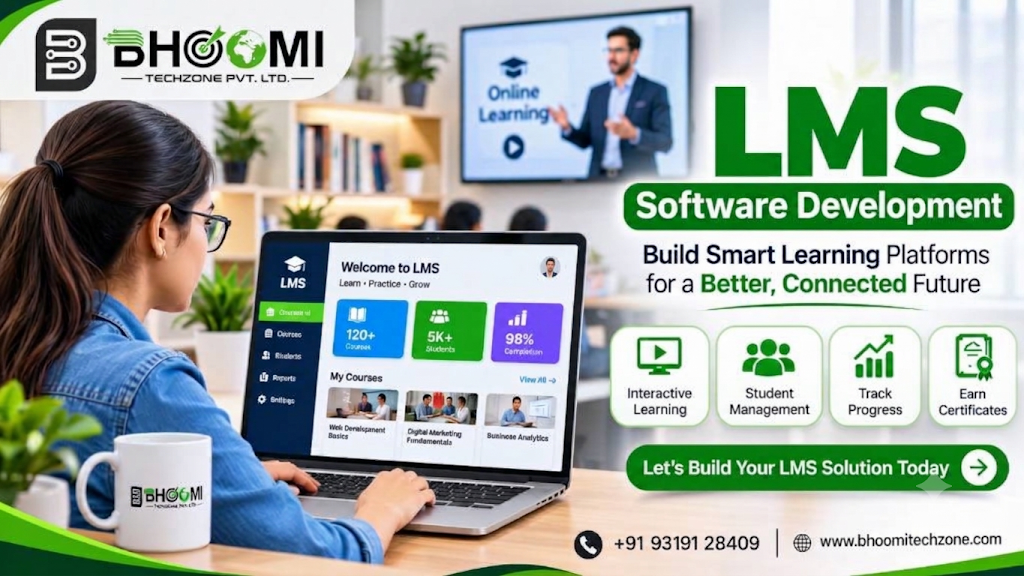
Quick Answer:LMS software development is the process of creating a digital learning platform to manage courses, students, instructors, assessments and training activities. A custom Learning Management System (LMS) can include live classes, online examinations, progress tracking, certificates and payment integrations, helping educational institutions and businesses manage learning in one place.
Digital learning has changed the way educational institutions, coaching centres and businesses deliver training. Students expect flexible access to study materials, while organizations need better ways to manage employee learning and monitor training performance. Managing these activities through separate tools, spreadsheets and manual processes can become difficult as the number of learners increases.
A Learning Management System (LMS) helps bring these activities together on one digital platform. Through LMS software development, organizations can create a centralized system to manage courses, learners, instructors, assessments, progress reports and training resources.
Whether an institution wants to launch online courses or a company needs an employee training platform, the right LMS can make learning more organized, accessible and measurable.
What Is LMS Software Development?
LMS software development is the process of designing and building a digital platform that helps organizations create, deliver, manage and track educational or training activities.
An LMS can be used to upload learning materials, enroll students, conduct online assessments, organize live classes, issue certificates and monitor learner performance.
Depending on business requirements, an LMS may be developed as a web application, mobile application or a combination of both.
Common users include:
-
Schools, colleges and universities
-
Coaching and training institutes
-
Corporate learning and development teams
-
Online education businesses
-
Professional certification providers
-
EdTech startups
Why Are Organizations Investing in LMS Platforms?
Traditional learning methods often involve manual attendance records, physical assignments, separate communication channels and time-consuming reporting. These processes can become difficult to manage when an organization serves hundreds or thousands of learners.
An LMS can help address these challenges by providing:
Centralized course management: Learning materials, recorded sessions, assignments and other resources can be organized in one place.
Flexible learning access: Learners can access available courses and resources through supported devices and schedules.
Progress monitoring: Instructors and administrators can review course completion, assessment results and learner activity.
Simplified administration: Enrollment, user management, notifications and reporting can be handled through a unified platform.
Scalable learning delivery: Organizations can expand their course offerings and learner base as their requirements grow.
Essential Features of an Effective LMS
The features of an LMS should be selected according to its users, learning model and operational requirements. Some commonly required features include:
1. User and Role Management
An LMS generally supports different user roles, such as administrators, instructors, students and corporate learners. Each role should have suitable permissions and access to relevant platform functions.
2. Course and Content Management
Administrators and instructors should be able to create courses, organize lessons, upload documents, share videos and manage learning materials.
3. Online Assessments and Quizzes
Assessment tools allow instructors to create quizzes, assignments and examinations. Automated evaluation can also reduce manual work for objective-type tests.
4. Learner Progress Tracking
Progress dashboards can display course completion, assessment scores, learning activity and other relevant performance indicators.
5. Live Classes and Communication
Depending on the requirements, an LMS can integrate video conferencing, discussion forums, announcements, messaging and notifications.
6. Certificates and Reports
Organizations may need automated certificate generation and reports to track course completion, learner performance and training outcomes.
7. Mobile-Friendly Access
A responsive interface helps learners use the platform across desktops, tablets and smartphones. A dedicated mobile application may be considered when the learning experience requires additional mobile capabilities.
Custom LMS Development vs. Ready-Made LMS
Organizations generally have two options: use an existing LMS product or invest in custom LMS development.
A ready-made LMS can be suitable when standard features meet the organization's requirements and implementation speed is a priority. However, customization may be limited by the product's available features, pricing structure or integration options.
Custom LMS development is useful when an organization needs specific workflows, unique user roles, specialized reporting, third-party integrations or a branded learning experience.
|
Factor |
Ready-Made LMS |
Custom LMS |
|
Initial setup |
Usually faster |
Requires planning and development |
|
Customization |
Depends on the product |
Designed around requirements |
|
Integrations |
Limited to supported options |
Can be planned for specific systems |
|
Ownership and control |
Depends on the provider |
Depends on the agreed development model |
|
Cost structure |
Subscription or licensing fees may apply |
Project and ongoing maintenance costs |
The right option depends on the organization's budget, technical requirements, expected number of users and long-term plans.
Technology Considerations for LMS Development
The technology stack affects an LMS platform's performance, maintainability, security and scalability. The selection should be based on the project's requirements rather than choosing technologies simply because they are popular.
A typical LMS technology architecture may include:
-
Frontend: React, Angular or Vue.js for the user interface.
-
Backend: Node.js, PHP, Python or another suitable server-side technology.
-
Database: MySQL, PostgreSQL or MongoDB, depending on the data structure.
-
Cloud infrastructure: Cloud hosting and storage services for deployment and scaling.
-
Integrations: Payment gateways, video conferencing, email services and third-party learning tools.
The final architecture should account for expected traffic, data security, content delivery, integrations and future expansion.
Important Steps in the LMS Software Development Process
Building an LMS requires more than developing individual features. A structured process helps ensure that the platform meets actual learning and business needs.
Step 1: Requirement Analysis
The development team identifies the target users, learning workflows, essential features, integrations and project objectives.
Step 2: UI/UX Design
The interface is planned for administrators, instructors and learners. Navigation should be simple and consistent across supported devices.
Step 3: Architecture Planning
The technical architecture, database structure, user permissions and integration requirements are defined.
Step 4: Development
Frontend and backend components are developed according to the approved requirements. Features may include course management, assessments, reporting and notifications.
Step 5: Testing and Quality Assurance
The platform is tested for functionality, usability, performance, compatibility and security issues before release.
Step 6: Deployment
The LMS is deployed to the selected hosting environment. User accounts, course data and required integrations are configured.
Step 7: Maintenance and Improvements
After launch, the platform may require updates, security patches, performance improvements, backups and new features based on user feedback.
Security and Accessibility in an LMS
An LMS may store personal information, learning records, assessment results and organizational training data. Security should therefore be considered throughout the development process.
Important considerations include:
-
Secure authentication and role-based access control
-
Data encryption where appropriate
-
Regular backups and recovery planning
-
Secure payment and third-party integrations
-
Protection against common application vulnerabilities
-
Clear data retention and privacy practices
Accessibility is also important. Following relevant accessibility principles, such as the Web Content Accessibility Guidelines (WCAG), can help make learning platforms easier to use for people with different needs.
Organizations operating in India should also assess applicable data protection requirements, including the Digital Personal Data Protection Act, 2023, as relevant to their platform and operations.
Common Challenges in LMS Development
Even a feature-rich LMS can face adoption and operational challenges if its design does not reflect real user requirements.
Some common challenges include:
-
Complex navigation: Too many menus and unclear workflows can make the platform difficult to use.
-
Poor mobile experience: A platform that does not work well on smaller screens can limit access.
-
Integration difficulties: Connecting payment systems, video tools and existing business software requires proper planning.
-
Performance issues: Large numbers of users or media files can affect loading speed without suitable infrastructure.
-
Insufficient testing: Unresolved bugs can affect assessments, course access and user records.
-
Limited training: Administrators and instructors may need guidance to use the platform effectively.
Identifying these challenges early can help reduce avoidable rework and improve the overall learning experience.
How to Choose the Right LMS Development Company
Selecting a development partner is an important decision because the quality of planning and implementation can influence the platform's long-term usability.
Before choosing a company, consider the following factors:
-
Relevant experience: Review its experience with web applications, custom software and education technology projects.
-
Technical capabilities: Understand the technologies and development approach it recommends.
-
Requirement understanding: The team should be able to translate learning workflows into practical platform features.
-
Security practices: Ask how authentication, data protection, backups and testing will be handled.
-
Communication: Clear project milestones, documentation and regular updates help maintain alignment.
-
Post-launch support: Confirm how maintenance, bug fixes and future enhancements will be managed.
Businesses in Noida and nearby areas may also consider a development partner's communication process, project coordination and ability to provide ongoing technical support.
FAQs
1. What is LMS software development?
LMS software development is the process of creating a digital platform to manage online courses, learners, instructors, assessments and training activities.
2. Who needs a Learning Management System?
Schools, colleges, coaching institutes, corporate training teams and EdTech businesses can use an LMS to manage learning activities.
3. What are the essential features of an LMS?
Common features include course management, user management, online assessments, progress tracking, live classes, certificates and reporting.
4. What is the difference between custom LMS and ready-made LMS?
A ready-made LMS provides predefined features, while a custom LMS is developed around an organization's specific workflows and requirements.
5. How do I choose an LMS development company?
Evaluate the company's technical expertise, relevant project experience, security practices, communication and post-launch support.
Final Thoughts
An effective Learning Management System can help educational institutions and businesses organize learning activities, manage digital content and monitor learner progress through a centralized platform. However, the right solution depends on the organization's users, workflows, budget and future requirements.
Before starting a project, it is important to define the platform's objectives, prioritize essential features and select a development approach that supports long-term growth.
Organizations exploring LMS software development solutions can review the services offered by Bhoomi Techzone Pvt. Ltd., a Noida-based technology company providing web development, mobile application development and custom software solutions.
About Bhoomi Techzone Pvt. Ltd.
Bhoomi Techzone Pvt. Ltd. is an IT and software development company based in Noida, Uttar Pradesh. The company works on digital solutions such as website development, mobile application development and custom software development. Its services support businesses looking to build and improve their digital platforms.
Name: Bhoomi Techzone Pvt. Ltd.
Phone: +91 81307 87194
Address: A-43, A Block, Sector 63, Noida, Uttar Pradesh 201301
Website: https://bhoomitechzone.in/

 Arabic
 French
 Spanish
 Portuguese
 Deutsch
 Turkish
 Dutch
 Italiano
 Russian
 Romaian
 Portuguese (Brazil)
 Greek