


MENA Industrial Packaging Market to Reach USD 11.4 Billion by 2036 as Demand for Secure Goods Transportation Grows
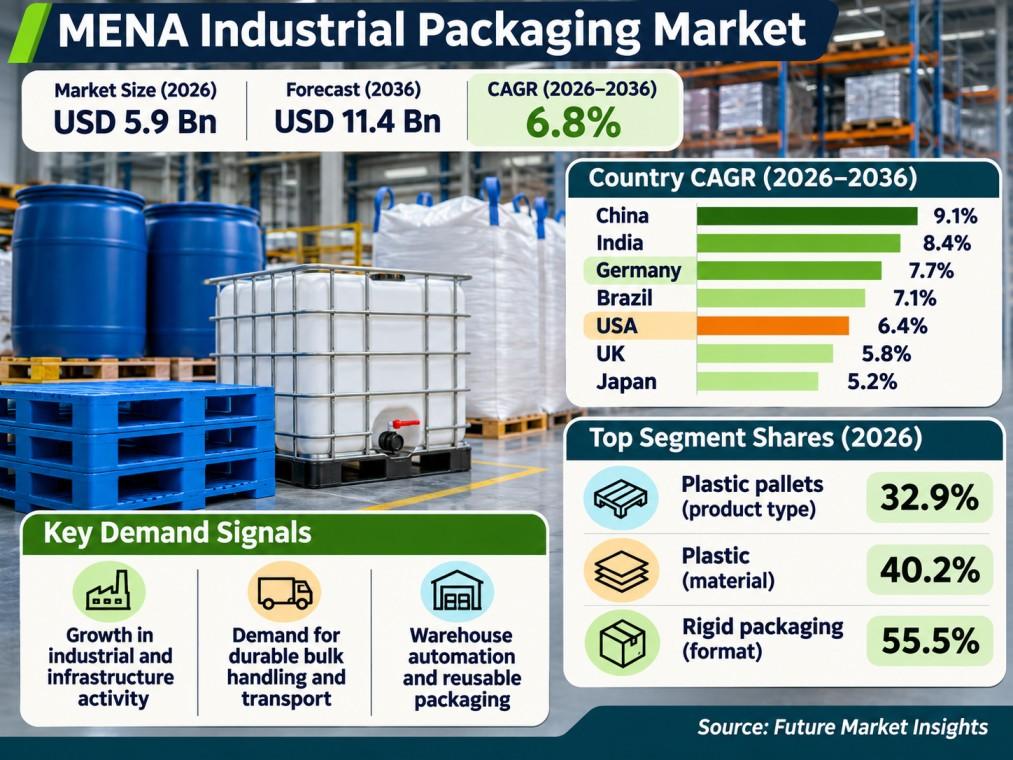
The MENA industrial packaging market is projected to grow from USD 5.9 billion in 2026 to USD 11.4 billion by 2036, registering a CAGR of 6.8%, according to Future Market Insights (FMI).
Demand is supported by industrial output, infrastructure development and higher trade volumes across the Middle East and North Africa. Buyers are seeking durable packaging for bulk handling, storage and transport. Plastic pallets and rigid packaging formats hold leading positions in the market.
The short version
- The market is forecast to reach USD 11.4 billion by 2036, up from USD 5.9 billion in 2026.
- Plastic pallets are the leading product category, with a 32.9% share in 2026.
- Rigid packaging accounts for 55.5% of the market, supported by demand for durable industrial transport and storage formats.
>> Get Detailed Market Forecasts, Competitive Benchmarking, and Pricing Trends: https://www.futuremarketinsights.com/reports/sample/rep-ma-3880
Three numbers that matter
|
Metric |
Report figure |
|
Market size (2026) |
USD 5.9 billion |
|
Forecast value (2036) |
USD 11.4 billion |
|
CAGR (2026–2036) |
6.8% |
Where growth is strongest
The report's country table lists the following growth rates. These are reproduced as published, although the country list is not geographically consistent with the MENA market scope.
- China – 9.1% CAGR: Export activity and industrial shipments are increasing demand for durable packaging, pallets and bulk transport formats.
- India – 8.4% CAGR: Manufacturing and infrastructure development are supporting demand for industrial sacks, containers and protective packaging.
- USA – 6.4% CAGR: Industrial, pharmaceutical and food distribution requirements support demand for reliable packaging formats.
- Germany – 7.7% CAGR: Industrial exports and requirements for protective packaging support demand for high-strength formats.
- UK – 5.8% CAGR: Industrial logistics and distribution networks support demand for corrugated and rigid packaging.
The report also lists Brazil at 7.1% and Japan at 5.2%. It does not provide country-level CAGRs for individual MENA countries such as Saudi Arabia or the UAE in the displayed country comparison.
Who is moving
The report identifies a mix of regional packaging manufacturers and international suppliers. Competition centres on local production capacity, durable packaging formats, material performance and supply-chain reach.
Key players identified in the market overview include:
- Mauser Packaging Solutions
- Middle East Packaging Factory
- Arabian Packaging
- Gulf Packaging Industries
The report's competitive landscape section also profiles:
- National Paper Products Company
- Hotpack Global
- Al Watania for Industries
- Napco National
- Obeikan Investment Group
The report discusses growing interest in automation-compatible packaging, reusable plastic formats, intermediate bulk containers, tracking and traceability, and material reduction.
Dated developments: The report page does not provide dated company announcements or product-launch developments. No external company news has been added.
Where to act
- Plastic pallets: With a 32.9% share, this is the leading product category. Durability, moisture resistance, reusability and compatibility with automated warehouses support adoption.
- Plastic materials: Plastic holds a 40.2% share. Its strength, lighter weight and resistance to corrosion and moisture make it useful across pallets, containers and bins.
- Rigid packaging: This format accounts for 55.5% of the market. Drums, pails, totes and crates support the movement and storage of heavy or sensitive goods.
- Bulk logistics: Intermediate bulk containers and drums are important for chemicals and liquids. Their handling efficiency and storage capacity make them relevant to industrial supply chains.
- Automation-ready designs: Consistent dimensions, barcode readability and compatibility with robotic handling can help packaging suppliers meet modern warehouse requirements.
Where to be careful
Resin, polymer and transport cost fluctuations can affect procurement budgets. Waste management and recycling infrastructure vary across MENA markets. Automation investment can also be limited by capital costs, equipment lead times and packaging compatibility.
Suppliers should assess local handling requirements, end-user specifications and disposal infrastructure before expanding a packaging format across the region.
>> Access Detailed Market Insights: https://www.futuremarketinsights.com/reports/mena-industrial-packaging-market
Analyst quote
The report page does not provide a clearly attributed direct analyst quotation. No quote has been created or attributed to an FMI analyst.
Questions for your next planning meeting
- Should we prioritise plastic pallets, drums or intermediate bulk containers for our next product investment?
- Which MENA markets offer the strongest opportunity for local production and distribution partnerships?
- Can our packaging formats meet customer requirements for durability, automation compatibility and material efficiency?
MEDIA CONTACT
Contact Person: Media Relations Team
Designation: Corporate Communications
Email: sales@futuremarketinsights.com
Phone: +1-347-918-3531
Website: https://www.futuremarketinsights.com/
ABOUT FUTURE MARKET INSIGHTS
Future Market Insights, Inc. (FMI) is an ESOMAR-certified market research and consulting firm headquartered in Delaware, USA, with offices in the United Kingdom, the United Arab Emirates, and India. FMI delivers syndicated and custom research across food and beverage, healthcare, chemicals, technology, packaging, consumer goods, and industrial sectors. Its research helps organizations assess market opportunities, understand industry developments, and make informed strategic decisions.

 English
 Arabic
 French
 Spanish
 Portuguese
 Deutsch
 Turkish
 Italiano
 Russian
 Romaian
 Portuguese (Brazil)
 Greek