


Biodiversity Credit Market Growth, Key Players, SWOT, Revenue Analysis Analysis By Fact.MR
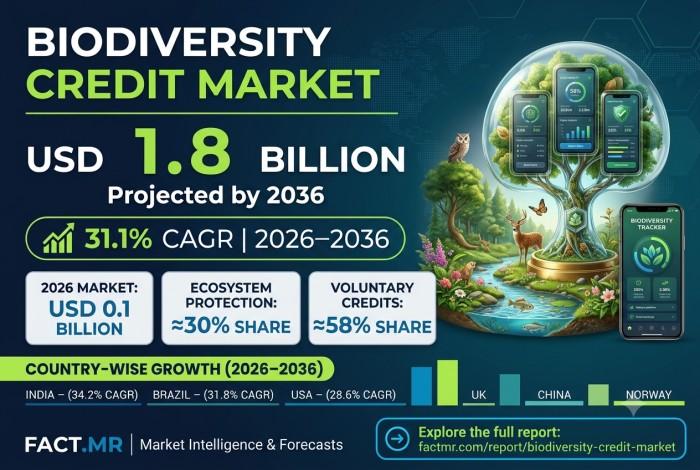
Rockville, Maryland – November 10, 2026: The global biodiversity credit market is projected to reach USD 1.8 billion by 2036, rising from an estimated USD 0.1 billion in 2026, according to Fact.MR. The market is forecast to expand at a compound annual growth rate (CAGR) of 31.1% between 2026 and 2036. Increasing interest in nature-positive finance, corporate biodiversity strategies and measurable conservation outcomes is creating new opportunities for project developers, credit providers, financial institutions and corporate buyers.
The market was valued at USD 0.09 billion in 2025. Its projected expansion reflects growing efforts to channel private and public finance toward biodiversity protection, habitat restoration and ecosystem improvement. Fact.MR estimates an absolute market opportunity of approximately USD 1.6 billion over the 2026–2036 forecast period.
Biodiversity credits are tradable units designed to reward measurable positive biodiversity outcomes. They can be generated through activities such as ecosystem protection, species and habitat restoration, landscape conservation and community-led stewardship. Unlike carbon credits, which primarily represent greenhouse gas reductions or removals, biodiversity credits focus on measurable improvements in ecological conditions.
Request for PDF Report Sample Pages: https://www.factmr.com/connectus/sample?flag=S&rep_id=15037
Key Takeaways from the Biodiversity Credit Market
- Market value: The market was valued at USD 0.09 billion in 2025.
- 2026 estimate: Fact.MR estimates market demand at approximately USD 0.1 billion in 2026.
- 2036 forecast: The market is projected to reach USD 1.8 billion by 2036.
- Growth outlook: The market is forecast to expand at a 31.1% CAGR from 2026 to 2036.
- Leading credit type: Ecosystem protection credits are expected to account for approximately 30% of the market in 2026.
- Leading market type: Voluntary biodiversity credit markets are projected to hold approximately 58% share in 2026.
- Fastest-growing country: India is forecast to register a 34.2% CAGR through 2036.
Nature Finance and Corporate Strategies Support Market Expansion
Growing recognition of biodiversity loss as a financial and economic concern is encouraging organizations to explore new funding mechanisms for conservation. Biodiversity credits are emerging as one instrument through which companies, financial institutions and public agencies can support projects with defined ecological outcomes.
The development of high-integrity market principles is an important factor shaping adoption. Industry initiatives led by organizations including the Biodiversity Credit Alliance, World Economic Forum and International Advisory Panel on Biodiversity Credits are contributing to discussions around transparency, measurement and market credibility.
Corporate participation is another important source of demand. Businesses are increasingly examining their relationships with ecosystems through supply chains, land use and nature-related strategies. Biodiversity credits may provide a financing mechanism for supporting conservation and restoration activities, provided that the underlying outcomes can be measured and verified.
Fact.MR estimates that corporates will account for approximately 33% of the market in 2026. Nature-positive corporate action is projected to represent around 29% of application demand, reflecting the role of private-sector nature strategies in early market development.
Voluntary Markets and Ecosystem Protection Lead Segment Demand
By credit type, ecosystem protection credits are expected to hold approximately 30% share in 2026. Protection-focused projects can direct funding toward biodiversity-rich landscapes and conservation areas where financial resources are limited. Their role in supporting existing ecosystems makes them an important part of emerging biodiversity-finance models.
Species and habitat restoration credits also represent a significant area of market activity. These credits are relevant where project developers can demonstrate ecological recovery through defined restoration activities. Community and Indigenous stewardship-linked credits offer another pathway, particularly where local participation and equitable benefit-sharing are central to long-term conservation outcomes.
By market type, voluntary biodiversity credit markets are projected to account for approximately 58% share in 2026. Voluntary frameworks currently provide a platform for pilot projects, methodology development and early buyer participation. Compliance-linked markets and sovereign or public-private biodiversity credit programs may also become relevant as formal market structures evolve.
India, China and Brazil Represent High-Growth Country Markets
India is projected to lead country-level growth with a CAGR of 34.2% from 2026 to 2036. The country's biodiversity-rich ecosystems and growing interest in natural-capital finance are expected to support market development.
China is forecast to record a CAGR of 32.4%, supported by ecological restoration opportunities and increasing institutional attention to nature-positive financing. Brazil is projected to expand at 31.8%, reflecting the significance of its biodiversity assets and potential for conservation-focused project development.
The United States is expected to register a CAGR of 28.6% during the forecast period. Corporate nature strategies, voluntary credit adoption and evolving nature-related disclosure practices are among the factors supporting its outlook.
Germany is projected to grow at 27.4% CAGR through 2036. Its sustainability-finance ecosystem, corporate environmental strategies and interest in integrity-focused market frameworks are expected to contribute to demand.
These growth projections indicate opportunities across both biodiversity-rich project locations and markets where corporate and financial buyers are exploring nature-related investment mechanisms.
Market Integrity Remains a Key Challenge
Despite its growth outlook, the biodiversity credit market faces important challenges. Measuring biodiversity outcomes is more complex than relying on a single standardized environmental metric. Ecosystems differ by location, species composition and ecological conditions, making consistent assessment and comparison difficult.
Market participants must establish credible methodologies, transparent governance structures and reliable verification processes. Benefit-sharing arrangements are also important, particularly when projects involve Indigenous Peoples and local communities. Buyers need confidence that credits represent measurable ecological improvements rather than broad environmental claims.
For project developers and intermediaries, competitive positioning will therefore depend on scientific measurement, stakeholder trust, transparent reporting and effective local participation. Organizations able to demonstrate credible outcomes may be better positioned to attract corporate and institutional buyers as the market develops.
Competitive Landscape and Key Market Participants
The biodiversity credit market includes project developers, market intermediaries and organizations involved in conservation-finance frameworks. Fact.MR identifies Terrasos, CreditNature, Savimbo, ValueNature, RePlanet, Ekos, South Pole and Environment Bank among the market participants.
Competitive strength is shaped by the ability to develop measurable biodiversity outcomes, maintain transparent governance and establish credible benefit-sharing mechanisms. As the market matures, participants will need to demonstrate how credits are generated, assessed and linked to verifiable conservation results.
Strategic Outlook
The projected growth of the biodiversity credit market creates opportunities for conservation project developers, corporates, financial institutions and public agencies. Early market development is likely to depend on voluntary demand, credible project pipelines and stronger measurement frameworks.
For buyers, due diligence on ecological outcomes, verification methods and community participation will remain essential. For project developers, the ability to demonstrate measurable impact and maintain transparent governance may influence access to financing and long-term commercial relationships.
Fact.MR's forecast points to a rapidly expanding market, while its long-term development will depend on whether participants can build trust in the quality and integrity of biodiversity credits.
Gain Full Access to Market Forecasts and Key Drivers:https://www.factmr.com/report/biodiversity-credit-market
Frequently Asked Questions
1. What is the projected size of the biodiversity credit market by 2036?
The global biodiversity credit market is projected to reach USD 1.8 billion by 2036, according to Fact.MR.
2. What is the expected CAGR of the biodiversity credit market?
The market is forecast to grow at a CAGR of 31.1% between 2026 and 2036.
3. Which country is expected to record the fastest growth?
India is projected to lead country-level growth at a CAGR of 34.2% through 2036.
4. Which credit type is expected to hold the largest market share?
Ecosystem protection credits are estimated to account for approximately 30% share in 2026.
5. Which market type is projected to lead?
Voluntary biodiversity credit markets are expected to hold approximately 58% share in 2026.
6. What is driving demand for biodiversity credits?
Growing interest in nature-positive finance, corporate biodiversity strategies and measurable conservation outcomes is supporting market development.
7. What is the main challenge facing the market?
The market's main challenge is establishing credible biodiversity measurement, verification, governance and benefit-sharing frameworks.
Related & Top Trending Fact.MR Research Report:
Biodiversity Credit Market- https://www.factmr.com/report/biodiversity-credit-market
Menswear Market- https://www.factmr.com/report/123/mens-wear-market
Decks Market- https://www.factmr.com/report/decks-market
Fresh Food Packaging Market- https://www.factmr.com/report/fresh-food-packaging-market
Dog Perfume Market- https://www.factmr.com/report/dog-perfume-market
About Fact.MR and Media Contact
Fact.MR is a market research and consulting organisation providing industry intelligence, market sizing, forecasting, competitive analysis and strategic insights across multiple industries. Its automotive research covers market opportunities, technology developments, regional demand and competitive positioning.
Contact: sales@factmr.com
Telephone: +1 (628) 251-1583
Website: https://www.factmr.com/

 English
 Arabic
 French
 Spanish
 Portuguese
 Deutsch
 Turkish
 Dutch
 Russian
 Romaian
 Portuguese (Brazil)
 Greek