


Global Non-Alcoholic Wine Market to Hit USD 8.43 Billion by 2036; Germany Posts 6.1% CAGR
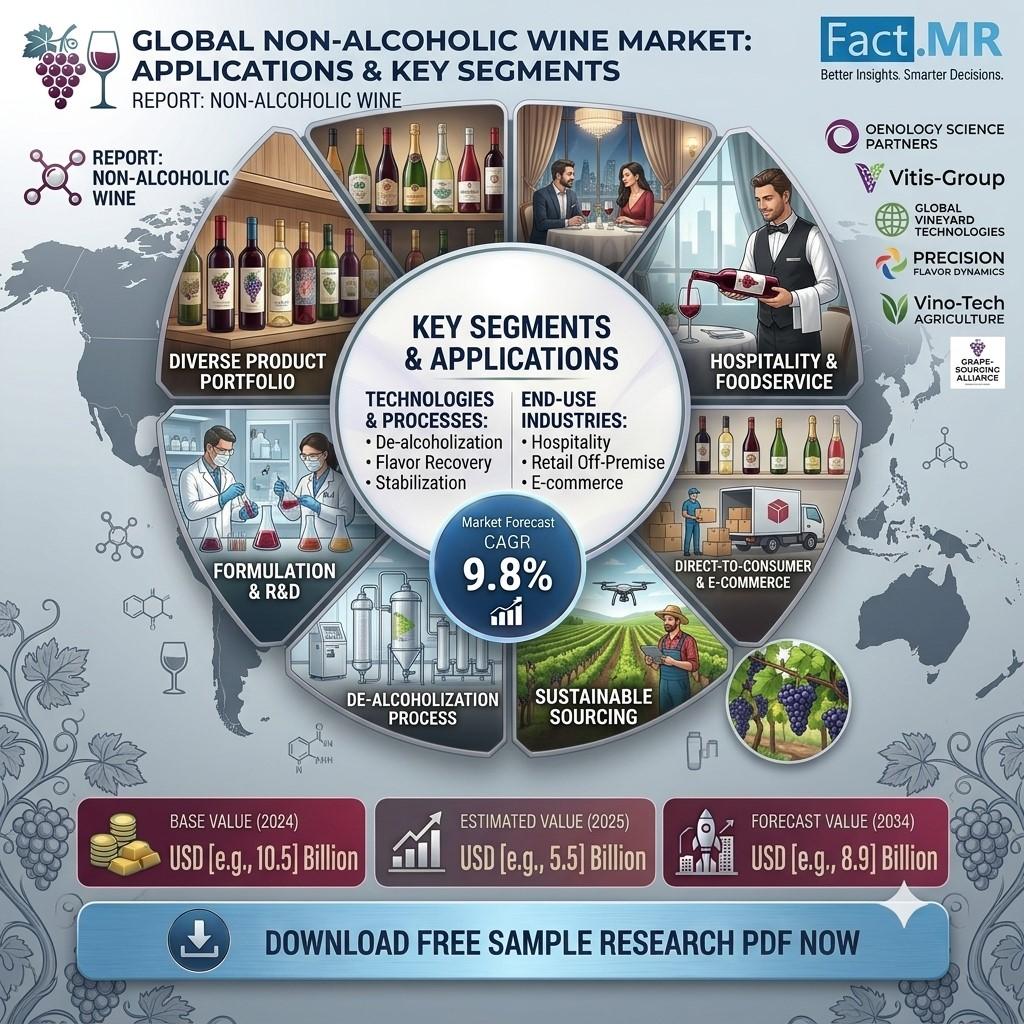
The global non-alcoholic wine market is forecast to expand from USD 3.14 billion in 2026 to USD 8.43 billion by 2036, registering a 10.4% CAGR over the forecast period. Fact.MR attributes this expansion to growing consumer interest in alcohol-free beverages, changing drinking habits, and increasing demand for premium alternatives to conventional wine. Health-conscious consumers, particularly younger urban populations, are showing greater interest in beverages that provide traditional wine flavors without the effects of alcohol.
The increasing popularity of mindful drinking is creating opportunities for manufacturers across retail, hospitality, and online distribution channels. Consumers are seeking products that offer authentic taste, recognizable ingredients, and sophisticated drinking experiences. Improvements in dealcoholization technologies, including vacuum distillation and reverse osmosis, are helping producers retain aroma and flavor while reducing alcohol content. At the same time, premiumization and clean-label preferences are encouraging manufacturers to develop differentiated products with improved sensory characteristics.
Get detailed market forecasts, competitive benchmarking, and pricing trends:
https://www.factmr.com/connectus/sample?flag=S&rep_id=4532
Sparkling Non-Alcoholic Wine Retains Leading Position
By product type, sparkling non-alcoholic wine is expected to account for approximately 59.6% of the market, supported by growing demand for alcohol-free beverages suitable for celebrations, social gatherings, and premium dining experiences. Consumers increasingly prefer sparkling alternatives that replicate the taste and presentation of conventional wines while supporting alcohol-conscious lifestyles.
Sparkling non-alcoholic wine is gaining popularity among millennials and Generation Z consumers who value product quality, flavor variety, and premium presentation. Manufacturers are responding by developing new formulations that preserve traditional wine characteristics while offering reduced-calorie and alcohol-free alternatives. The segment is also expected to register a 9.2% CAGR during the report's 2025–2035 analysis period.
Bottles remain the leading packaging format, accounting for approximately 87% of the market. Their established association with traditional wine presentation supports demand across restaurants, hospitality establishments, supermarkets, and specialty beverage retailers. Glass bottles also reinforce premium positioning and product familiarity among consumers transitioning from conventional wine.
Meanwhile, canned non-alcoholic wines are gaining attention because of their portability, portion control, and convenience. Fact.MR identifies cans as a developing packaging category, with an anticipated 8.9% CAGR during 2025–2035. Smaller packaging formats are becoming relevant for outdoor consumption, casual social occasions, and younger consumers seeking convenient beverage options.
Online stores are also emerging as an important distribution channel, with a projected 10.1% CAGR during 2025–2035. Direct-to-consumer platforms allow manufacturers to introduce new varieties, reach specialized consumer groups, and expand beyond traditional retail networks. Subscription services and digital marketing are further supporting consumer awareness.
China, India, and Germany Show Strong Growth Potential
China is projected to register a 7.1% CAGR from 2025 to 2035, representing the highest growth rate among the individual countries covered in the report. Rising disposable incomes, expanding urban populations, and increasing awareness of alcohol-free beverages are supporting market development. Younger consumers are experimenting with premium beverage alternatives, while manufacturers are introducing flavors influenced by traditional Chinese ingredients. Social commerce and livestream shopping are also helping brands reach new customers.
India is expected to advance at a 6.8% CAGR during the same period. Growing health awareness among urban millennials and Generation Z consumers is increasing demand for non-intoxicating beverages. Religious preferences, changing social habits, and the expansion of modern retail channels are contributing to market development. E-commerce platforms and influencer-led promotions are improving product visibility, although price sensitivity and limited distribution in smaller cities remain challenges. Manufacturers are exploring locally familiar fruit flavors and ingredients to improve consumer acceptance.
Germany is forecast to grow at a 6.1% CAGR through 2035. The country's established wine industry, increasing interest in alcohol moderation, and demand for premium alcohol-free beverages are supporting adoption. German manufacturers are investing in advanced dealcoholization processes and sustainable viticulture practices to preserve flavor authenticity. Low-sugar formulations, clean-label products, and regional sourcing are also influencing purchasing decisions.
The broader European market continues to benefit from growing consumer acceptance of alcohol-free beverages. The United Kingdom is expected to record a 5.6% CAGR, supported by health-conscious consumption and increasing availability in restaurants and pubs. France is projected to expand at 5.4%, reflecting changing preferences among younger consumers and growing interest in premium alcohol-free wine alternatives.
Competitive Landscape
Competition in the non-alcoholic wine market includes established wine producers, specialty alcohol-free beverage brands, and companies investing in advanced dealcoholization technologies. Key companies identified by Fact.MR include Ariel Vineyards, Fre Alcohol-Removed Wines, Pierre Chavin, Lussory Non-Alcoholic Wines, Freixenet, and Giesen Wines.
Manufacturers are focusing on flavor preservation, product differentiation, organic ingredients, and broader distribution networks to strengthen their competitive positions. Premium branding and sustainable packaging are becoming important factors in attracting consumers who expect alcohol-free alternatives to offer quality comparable to traditional wines.
Fact.MR highlights product innovation among several established brands. Ariel Vineyards has focused on premium dealcoholized wines, while Fre Alcohol-Removed Wines has pursued wider distribution across international markets. Lussory Non-Alcoholic Wines has emphasized organic and clean-label products, reflecting growing consumer interest in ingredient transparency.
Technology and Regulatory Developments Shape the Market
Advances in dealcoholization technology are influencing the quality and commercial appeal of non-alcoholic wine. Vacuum distillation, reverse osmosis, and spinning cone technologies allow producers to reduce alcohol content while preserving important flavor and aroma characteristics. These processes are becoming increasingly relevant as consumers demand products that closely resemble conventional wines.
Regulatory requirements also influence product development and international distribution. Manufacturers must consider differences in alcohol-content definitions, ingredient labeling, nutritional disclosures, and marketing requirements across countries. European markets place particular emphasis on product transparency and labeling compliance, while Asian markets present additional challenges related to import regulations and consumer education.
Sustainability is another important area of development. Producers are exploring recyclable packaging, locally sourced ingredients, and more efficient production methods to respond to changing consumer expectations. Digital retail platforms and data-driven product development are also creating opportunities for brands to understand regional preferences and introduce new formulations.
As consumers increasingly embrace alcohol-conscious lifestyles, the non-alcoholic wine market is expected to benefit from continued product innovation, premiumization, and expanding distribution. Manufacturers that successfully combine authentic wine flavors with transparent labeling and competitive pricing are positioned to address growing demand through 2036.
Top Reports:
https://adamaamresearch.blogspot.com/2026/11/thermoplastic-vulcanizate-market-to.html
https://net-pals.com/blogs/69435/Thermoplastic-Vulcanizate-Market-Eyes-USD-3-39-Billion-by-2036
https://acmingle.com/blogs/36839/Global-TPV-Market-Forecast-to-Hit-USD-3-39-Billion
About Fact.MR
Fact.MR is a market research and consulting company providing market intelligence, competitive analysis, and forecasting across global industries. Its research supports businesses with data-driven insights into emerging markets, technology trends, competitive dynamics, regional opportunities, and changing demand patterns.

 English
 Arabic
 French
 Spanish
 Deutsch
 Turkish
 Dutch
 Italiano
 Russian
 Romaian
 Portuguese (Brazil)
 Greek