


How Is Modular Construction Reshaping the Way Modern Building Projects Are Delivered?
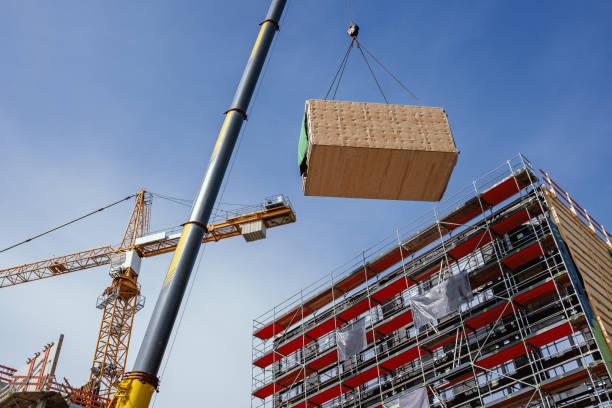
Modular construction is gaining greater attention as the building industry looks for ways to improve project coordination, accelerate delivery, and manage increasingly complex construction requirements. According to Vyansa Intelligence, the global modular construction market was valued at USD 111 Billion in 2025 and is projected to reach USD 200 Billion by 2032, registering a CAGR of 8.78% during 2026-2032. The latest market analysis highlights how factory-based production and off-site assembly are becoming increasingly relevant to modern construction strategies.
Factory-Based Production Changes the Construction Workflow
Traditional construction relies heavily on activities being completed sequentially at the project site. Modular construction changes this approach by moving a significant portion of manufacturing and assembly into controlled production environments.
Modules can be fabricated while site preparation takes place simultaneously. This parallel workflow can improve coordination between different project stages and reduce dependence on completing every construction activity at the same location and in a strictly sequential order.
For developers and contractors, this approach can provide greater control over project execution. Factory environments can also create more standardized working conditions, allowing production processes to be planned and monitored before finished modules are transported to the construction site.
The shift toward off-site production is therefore not simply about prefabricating individual components. It represents a broader change in how construction projects can be designed, manufactured, transported, assembled, and managed.
Project Delivery Is Becoming More Process-Oriented
Construction projects increasingly require coordination among architects, engineers, manufacturers, contractors, suppliers, and site teams. Modular construction places additional emphasis on early-stage planning because design decisions need to account for manufacturing, transportation, connections, installation, and site conditions.
This makes design coordination particularly important. Dimensions, interfaces, structural connections, service requirements, and installation sequences need to be considered before modules reach the site.
ISO's work on prefabricated buildings reflects this wider shift toward standardized planning, design, off-site production, integrated design, digitalization, and performance requirements for modular buildings.
As a result, modular construction can encourage project teams to resolve potential conflicts earlier rather than relying heavily on adjustments during on-site construction.
Standardization Supports Repeatable Construction
One of the defining characteristics of modular construction is the use of standardized components and repeatable processes. Standardization can simplify manufacturing and help construction teams establish consistent procedures for producing and installing modules.
However, standardization does not necessarily mean that every modular building must look identical. Modular systems can be configured for different building layouts, functional requirements, and architectural applications while still using standardized production principles.
Modular coordination has long been recognized as an important element of construction planning. ISO 2848 establishes principles for coordinating building dimensions and the positioning of components, equipment, and assemblies.
This provides an important foundation for understanding why dimensional coordination is critical when multiple components need to fit together efficiently.
Applications Extend Across Building Categories
Modular construction can be applied across a broad range of building requirements. Residential projects can use modular approaches for housing delivery, while commercial applications can incorporate factory-produced building sections into offices, hospitality properties, and other facilities.
Healthcare and educational buildings also present opportunities because projects in these categories often require carefully coordinated layouts, building services, and repeatable spaces.
Industrial applications can similarly benefit from controlled production and standardized assembly, particularly where project teams need to manage complex construction sequences or replicate similar structures across multiple locations.
The flexibility of modular construction allows the approach to be considered for both new developments and projects where additional spaces or building components need to be integrated into an existing environment.
Logistics Becomes a Central Planning Requirement
Moving completed modules from a manufacturing facility to a construction site introduces logistical considerations that are less prominent in conventional construction.
Transportation routes, module dimensions, lifting requirements, site access, storage, sequencing, and installation coordination all need to be considered during project planning. A module may be manufactured efficiently, but its value can be reduced if transportation or site installation becomes unnecessarily complicated.
This makes modular construction closely connected with supply-chain management. Manufacturers and contractors need to coordinate production schedules with site readiness so that modules arrive when they can be installed rather than creating avoidable storage or handling requirements.
Digital planning can support this coordination by connecting design information with manufacturing and installation processes. ISO's prefabricated-building work specifically includes digitalization, production management, bills of materials, and lifecycle management within its standardization scope.
Quality Control Moves Closer to the Production Environment
Another important characteristic of modular construction is the ability to conduct a greater portion of production under controlled factory conditions.
Manufacturing environments can provide more consistent access to tools, equipment, materials, and production procedures than some conventional construction sites. This can support repeatability and make quality-control processes easier to integrate into production workflows.
At the same time, factory production does not eliminate the need for rigorous inspection. Connections, interfaces, transportation handling, and on-site installation remain important because the final building depends on successful integration between manufactured modules and the completed site structure.
The construction process therefore becomes more dependent on coordination between manufacturing quality and site execution.
Sustainability Considerations Influence Construction Decisions
Environmental considerations are also becoming increasingly relevant to construction planning. Modular approaches can support more controlled material handling and production processes, while factory-based manufacturing can provide opportunities for more systematic management of materials and construction activities.
However, sustainability performance depends on the complete project rather than the construction method alone. Material selection, transportation, manufacturing processes, building operation, durability, and eventual reuse or disposal all contribute to the overall environmental profile of a building.
For developers, sustainability therefore needs to be considered alongside cost, design flexibility, logistics, performance, and long-term building requirements.
The Industry Is Moving Toward Integrated Construction Systems
The development of modular construction reflects a wider transformation in the way buildings are designed and delivered. Construction is increasingly being connected with manufacturing principles, digital coordination, standardized components, and structured production workflows.
According to this industry report, modular construction is positioned not simply as an alternative to conventional building but as a coordinated project-delivery approach. Industry analysis suggests that its effectiveness depends on how well design, manufacturing, logistics, site preparation, and installation are integrated from the beginning.
The future direction of the sector will therefore depend on the industry's ability to balance standardization with architectural flexibility while maintaining quality, efficient logistics, and reliable site execution. As construction stakeholders continue to seek more coordinated and predictable project processes, modular methods can play an increasingly important role in the evolution of modern building practices.

 English
 Arabic
 French
 Spanish
 Portuguese
 Turkish
 Dutch
 Italiano
 Russian
 Romaian
 Portuguese (Brazil)
 Greek