


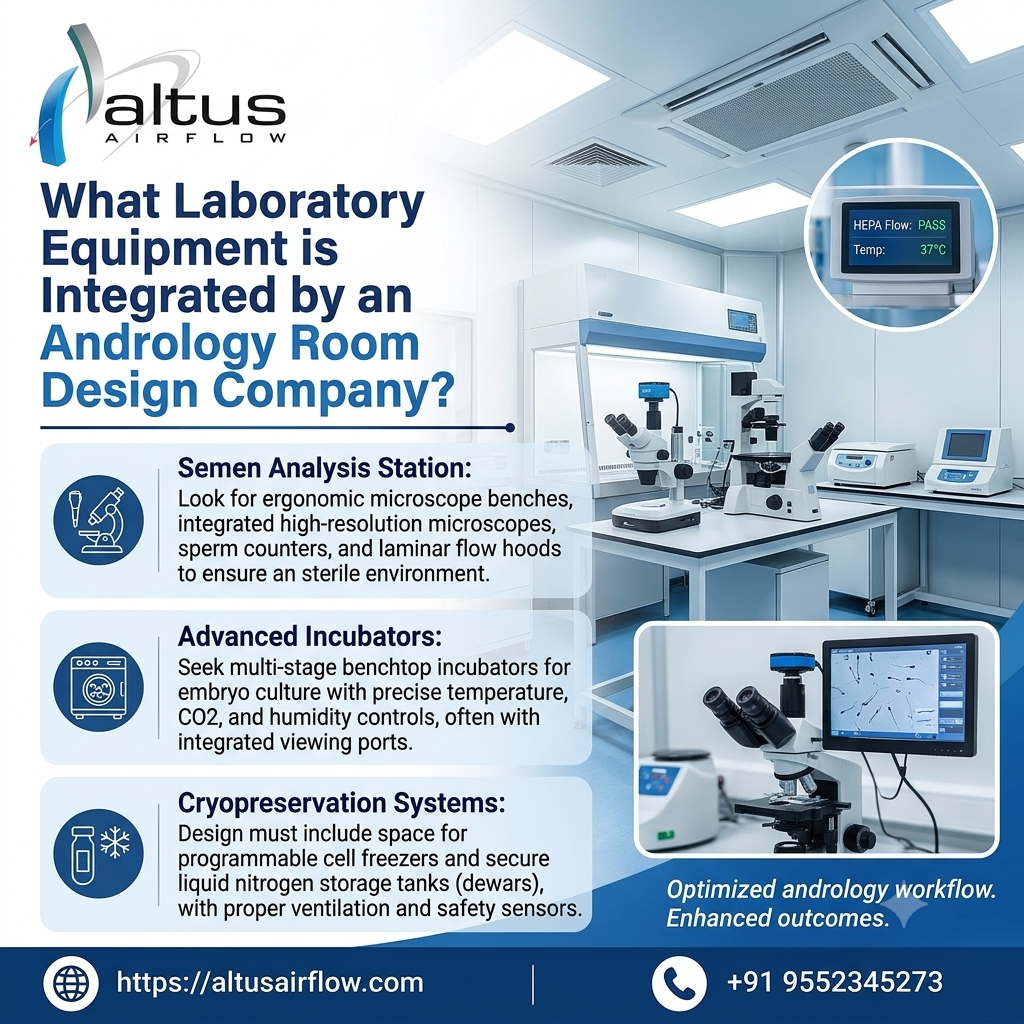
What Laboratory Equipment Is Integrated by an Andrology Room Design Company?
Introduction
Altus Airflow focuses on developing modern laboratory environments that support accurate testing, efficient workflows, and reliable reproductive healthcare services. An Andrology Room Design Company plays an important role in planning and integrating specialised laboratory equipment required for semen analysis, sperm preparation, and male fertility investigations. From microscopes and centrifuges to advanced sample handling systems, every piece of equipment must be selected according to laboratory requirements, available space, and operational needs. Proper equipment integration helps fertility clinics maintain organised workflows, minimise contamination risks, and support accurate laboratory procedures.
A well-designed andrology laboratory requires more than specialised instruments. It also needs appropriate ventilation, electrical arrangements, laboratory furniture, controlled environmental conditions, and efficient equipment positioning. Coordinating these elements during the design stage helps create a functional and dependable laboratory.
1. Microscopes for Semen Analysis
Microscopes are among the most important instruments in an andrology laboratory. They allow laboratory professionals to examine semen samples and evaluate different sperm characteristics.
Commonly integrated microscope systems include:
Bright-field microscopes: These are used for routine semen examination and observing sperm morphology, concentration, and general sample characteristics.
Phase-contrast microscopes: These microscopes improve the visibility of transparent, unstained sperm cells. They are particularly useful for assessing sperm motility and performing routine semen analysis.
Inverted microscopes: These systems can be used for specific sample observation and laboratory procedures, depending on the clinic's requirements.
Equipment placement is important for comfortable operation. Laboratory designers consider working height, lighting conditions, electrical connections, vibration control, and available bench space.
The microscope area should also provide sufficient room for sample preparation materials and related accessories. Proper positioning allows embryologists and laboratory technicians to perform examinations without unnecessary movement.
2. Laboratory Centrifuges
Centrifuges are essential for several sperm preparation and sample processing procedures. They separate components of biological samples according to their density through controlled rotational movement.
Different centrifuge types may be integrated depending on the laboratory's activities.
-
Clinical laboratory centrifuges: Used for routine sample processing.
-
Swing-out rotor centrifuges: Suitable for specific sample preparation applications.
-
Fixed-angle centrifuges: Used for selected separation procedures.
-
Specialised sperm preparation centrifuges: Selected according to laboratory protocols and processing requirements.
An appropriate centrifuge installation area should provide stable work surfaces, adequate electrical connections, and sufficient ventilation around the equipment where required.
The equipment must also be positioned to allow easy cleaning, routine maintenance, and safe operation.
During laboratory planning, designers consider the dimensions, operating requirements, and weight of centrifuges to ensure that the furniture and electrical infrastructure can support them.
3. Laminar Airflow Workstations
Maintaining a clean working environment is important when handling reproductive samples. Laminar airflow workstations provide filtered air across the working area to help minimise particulate contamination.
Depending on the laboratory's requirements, different clean-air workstation configurations may be considered.
Important features include:
-
HEPA filtration systems.
-
Controlled airflow distribution.
-
Stainless steel working surfaces.
-
Integrated lighting.
-
Accessible control panels.
-
Easy-to-clean internal surfaces.
The workstation should be positioned according to the laboratory workflow and available space.
Designers also consider the relationship between clean-air workstations, sample preparation benches, storage areas, and other equipment.
It is important to select the appropriate type of containment or clean-air equipment for the procedure. A laminar airflow workstation should not automatically be treated as a substitute for a biological safety cabinet when biological containment is required.
4. Sperm Preparation Equipment
Sperm preparation is an important part of many andrology laboratory procedures. Specialised equipment supports the processing of semen samples according to established laboratory protocols.
Commonly integrated equipment includes:
Sample preparation workstations: Provide organised surfaces for handling specimens and preparing materials.
Pipettes and micropipettes: Help laboratory professionals measure and transfer small liquid volumes accurately.
Pipette stands and accessories: Keep frequently used instruments organised and accessible.
Sample mixing equipment: Supports specific preparation procedures when required by the laboratory protocol.
Tube racks and holders: Provide stable sample positioning during processing.
Equipment arrangement should support a logical workflow from sample receipt to examination and preparation.
An organised workstation also reduces unnecessary handling and helps laboratory personnel maintain consistent procedures.
5. Laboratory Refrigerators and Freezers
Temperature-controlled storage equipment is essential for laboratories that handle reagents, diagnostic materials, and biological samples.
Depending on the laboratory's services, equipment may include:
-
Laboratory refrigerators.
-
Deep freezers.
-
Ultra-low-temperature freezers, where required.
-
Temperature-monitoring devices.
-
Digital temperature controllers.
-
Backup power arrangements.
Different materials have different storage requirements. Therefore, the temperature range should be selected according to the manufacturer's instructions, laboratory protocols, and applicable guidelines.
Equipment positioning is equally important. Refrigerators and freezers require appropriate ventilation clearances, accessible electrical connections, and enough space for door opening and maintenance.
Temperature monitoring systems can help laboratory staff identify deviations and maintain documented storage conditions.
6. Sperm Counting Chambers and Sample Analysis Accessories
Accurate semen examination requires suitable sample analysis accessories. These instruments and consumables help laboratory professionals perform standardised assessments.
Common examples include:
Counting chambers: Specialised chambers such as improved Neubauer haemocytometers are used for sperm concentration measurements through established laboratory methods.
Semen analysis slides: Designed to support sample observation under microscopes.
Microscope coverslips: Used for appropriate sample preparation and examination.
Micropipettes and tips: Support accurate sample measurement and transfer.
Sample collection containers: Help maintain appropriate sample handling and identification procedures.
The laboratory design should provide dedicated storage for these accessories. Keeping them organised helps reduce handling errors and supports efficient daily operations.
A suitable examination bench should also provide sufficient space for microscopes, sample containers, documentation, and other frequently used materials.
7. Computer-Assisted Semen Analysis Systems
Modern fertility laboratories may integrate computer-assisted semen analysis (CASA) systems to support objective sperm motility assessment.
These systems generally combine specialised microscopy, imaging hardware, and software to analyse sperm movement.
Depending on the selected system, features may include:
-
Digital imaging cameras.
-
Microscopy integration.
-
Automated sperm tracking.
-
Motility analysis software.
-
Data recording and reporting.
-
Laboratory computer connectivity.
CASA systems require appropriate workstation planning. The laboratory should provide suitable electrical points, computer connectivity, display arrangements, and sufficient space for microscopy equipment.
Software compatibility and data management requirements should also be considered before installation.
These systems support laboratory professionals by providing additional analytical information. Results still require appropriate interpretation and quality control according to established laboratory procedures.
8. Incubators for Specialised Laboratory Applications
Some andrology laboratories operate alongside IVF and embryology facilities. In such cases, specialised incubators may be required for selected reproductive laboratory procedures.
Depending on the scope of services, equipment may include:
-
CO2 incubators.
-
Temperature-controlled incubators.
-
Multi-chamber incubators.
-
Digital temperature monitoring systems.
-
Gas supply and regulation accessories.
The selection of incubators depends on the clinical application and laboratory workflow.
Designers must consider equipment dimensions, heat output, electrical load, maintenance access, and environmental requirements.
If incubators are integrated into a specialised fertility laboratory, their location should be coordinated with other equipment and the overall cleanroom design.
Appropriate planning helps ensure that essential utilities and supporting infrastructure are available before equipment commissioning.
9. Laboratory Water Baths and Heating Equipment
Water baths and controlled heating equipment may be required for specific laboratory procedures involving temperature-sensitive samples or materials.
Common equipment includes:
-
Digital water baths.
-
Dry heating blocks.
-
Temperature-controlled warming devices.
-
Laboratory thermometers.
-
Temperature monitoring accessories.
These devices should be selected according to the intended application and validated laboratory protocols.
The installation area should provide suitable electrical connections, water management arrangements where applicable, and sufficient working space.
Easy access for cleaning and temperature verification is also important.
Proper positioning helps laboratory personnel use these devices without interfering with sample preparation or microscopy activities.
10. Laboratory Furniture and Storage Systems
Laboratory furniture is not simply an aesthetic feature. It directly affects equipment positioning, staff movement, hygiene, and workflow efficiency.
An experienced Andrology Room Design Company considers the equipment layout while planning laboratory furniture and storage arrangements.
Important furniture components include:
Stainless steel workbenches: Provide durable, easy-to-clean surfaces for laboratory activities.
Modular storage cabinets: Help organise consumables, accessories, and laboratory materials.
Wall-mounted cabinets: Provide additional storage without occupying valuable floor space.
Under-bench storage units: Keep frequently used materials accessible.
Ergonomic laboratory seating: Supports comfortable working positions during prolonged examinations.
Sink and washing arrangements: Support appropriate cleaning activities and laboratory hygiene.
Furniture dimensions should be finalised after considering the size and installation requirements of the selected instruments.
This prevents overcrowding and ensures that laboratory professionals have adequate space to work efficiently.
11. Laboratory Ventilation and Environmental Monitoring Systems
Equipment integration must also consider the environmental conditions required for laboratory operations.
Ventilation systems help maintain appropriate temperature, humidity, filtration, and air distribution according to the laboratory's design specifications.
Important systems may include:
-
Air handling units.
-
HEPA filtration, where required.
-
Temperature and humidity monitoring.
-
Differential pressure monitoring.
-
Airflow control systems.
-
Ventilation control panels.
-
Environmental monitoring devices.
Different laboratory zones may have different environmental requirements. Therefore, ventilation should be designed according to the intended activities rather than applying one uniform specification to every room.
Proper coordination between equipment positioning and HVAC planning also prevents airflow obstructions and installation conflicts.
Environmental monitoring systems help laboratory staff observe whether specified operating conditions are maintained.
12. Digital Documentation and Laboratory Management Systems
Digital systems are becoming increasingly important in modern fertility laboratories. They support sample identification, documentation, reporting, and laboratory record management.
Depending on the facility's requirements, an andrology laboratory may integrate:
-
Laboratory information management systems (LIMS).
-
Computer-based reporting systems.
-
Barcode scanners.
-
Sample identification systems.
-
Digital microscopes.
-
Network-connected analytical instruments.
-
Data backup and storage solutions.
These systems help organise laboratory information and reduce dependence on manual documentation.
During planning, designers should consider network connectivity, electrical outlets, computer placement, data security, and compatibility between different devices.
The laboratory management system should also support appropriate access controls and data protection procedures.
13. How Does Equipment Integration Improve Laboratory Efficiency?
Integrating laboratory equipment during the initial design stage offers several operational advantages.
Better workflow management: Equipment is positioned according to the sequence of laboratory activities, reducing unnecessary movement.
Improved space utilisation: Proper planning ensures that instruments, furniture, and storage systems fit within the available area.
Reduced contamination risks: Suitable zoning and equipment placement support controlled sample handling and cleaning procedures.
Simplified maintenance: Accessible equipment arrangements make routine servicing and inspection easier.
Better staff productivity: Ergonomic workstations and organised equipment layouts improve day-to-day working conditions.
Future expansion: Modular infrastructure can provide flexibility for additional equipment when laboratory requirements change.
An integrated design approach ensures that the laboratory functions as a coordinated environment rather than a collection of separately installed instruments.
Conclusion
A modern andrology laboratory requires carefully selected equipment, suitable infrastructure, and an organised working environment. From microscopes, centrifuges, and sperm analysis systems to specialised storage, ventilation, and digital monitoring solutions, every component contributes to laboratory functionality. Equipment integration should be based on clinical requirements, available space, workflow planning, and applicable technical standards.
Choosing an experienced Andrology Room Design Company helps fertility clinics coordinate equipment selection, laboratory furniture, electrical systems, ventilation, and installation requirements. Altus Airflow supports the development of specialised laboratory environments through structured planning and technical integration. With a well-designed setup, Altus Airflow helps create functional and organised spaces that support modern reproductive healthcare services.
Frequently Asked Questions (FAQs)
1. What equipment does an Andrology Room Design Company integrate?
An Andrology Room Design Company integrates microscopes, centrifuges, laminar airflow workstations, sperm analysis systems, laboratory refrigerators, incubators, sample preparation equipment, and specialised laboratory furniture.
2. Why are microscopes important in an andrology laboratory?
Microscopes help laboratory professionals examine sperm concentration, motility, and morphology during semen analysis.
3. Are centrifuges necessary for andrology laboratories?
Yes, centrifuges support different sample processing and sperm preparation procedures according to laboratory protocols.
4. What is the purpose of a laminar airflow workstation?
It provides filtered airflow across the working area to help minimise particulate contamination during appropriate laboratory procedures.
5. Why are laboratory refrigerators required?
They maintain specified storage temperatures for reagents, diagnostic materials, and biological samples.
Read Our Previous Blog --------------->What storage solutions are included in Andrology Room Design?

 Arabic
 French
 Spanish
 Portuguese
 Deutsch
 Turkish
 Dutch
 Italiano
 Russian
 Romaian
 Portuguese (Brazil)
 Greek