


Non-Sedating Antihistamines Lead Growth as Safety Concerns Limit Sedating H1 Drugs
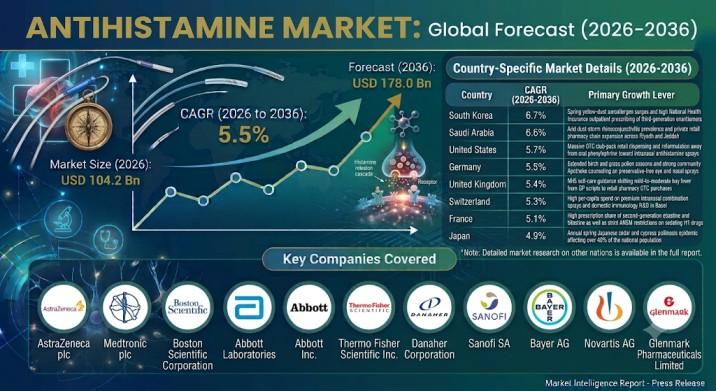
The global antihistamine market is projected to reach USD 178.0 billion by 2036, rising from USD 104.2 billion in 2026 at a compound annual growth rate (CAGR) of 5.5%, according to Future Market Insights (FMI). Market expansion is supported by the growing need to manage allergic rhinitis, seasonal allergies, and chronic urticaria, alongside continued demand for accessible over-the-counter (OTC) and prescription allergy treatments.
Antihistamines remain an important part of allergy management across respiratory and dermatological conditions. Pharmaceutical manufacturers are focusing on non-sedating formulations, convenient oral dosage forms, and topical delivery options to address patient demand for symptom relief without disrupting daily activities. Longer pollen seasons and increased awareness of allergy treatment are also supporting recurring demand through pharmacies and healthcare providers.
Request For Sample Report: https://www.futuremarketinsights.com/reports/sample/rep-gb-18295
The short version
The antihistamine market is benefiting from sustained demand for allergy management products across OTC retail, hospital pharmacies, and online distribution channels. Second-generation non-sedating agents lead the drug-generation category, while oral tablets and chewables remain the leading route of administration.
FMI identifies South Korea as the fastest-growing country market in its forecast, followed by Saudi Arabia and the United States. For manufacturers, opportunities include improving formulation convenience, expanding non-sedating product portfolios, and strengthening access through retail pharmacy networks.
Three numbers that matter
- USD 104.2 billion: Antihistamine market value projected for 2026.
- USD 178.0 billion: Forecast market value by 2036.
- 5%: Expected CAGR between 2026 and 2036.
Why is demand for antihistamines increasing?
The growing prevalence and duration of allergic symptoms are important demand drivers. Seasonal allergic rhinitis and rhinoconjunctivitis account for an estimated 49.1% of the market by indication in 2026. Longer pollen exposure periods can extend the time during which patients require symptom-management products, supporting demand for both prescription and OTC treatments.
The preference for non-sedating formulations is another important factor. Second-generation antihistamines, including cetirizine and fexofenadine, are widely used because they are designed to reduce the drowsiness associated with many first-generation products. These medicines can be particularly relevant to people who need to maintain normal work, school, and daily routines.
Retail pharmacy access also supports market expansion. OTC retail drugstores and pharmacy chains are projected to account for 58.2% of distribution-channel demand in 2026. Their accessibility allows consumers to obtain commonly used allergy medicines without always requiring a physician appointment.
Second-generation agents lead the drug-generation category
FMI estimates that second-generation non-sedating antihistamines will account for 41.6% of the drug-generation segment in 2026. Their position reflects demand for treatments that manage allergy symptoms while limiting daytime sedation.
The category includes widely used active ingredients such as cetirizine, loratadine, and fexofenadine. Third-generation agents, including levocetirizine and desloratadine, also contribute to the market through formulations designed to provide effective symptom control and improved tolerability.
By route of administration, oral solid tablets and chewables are projected to hold 45.4% of the market in 2026. Their familiar dosing formats, convenience, and availability across retail pharmacy channels support their leading position.
Other delivery formats include oral liquid syrups, ophthalmic eye drops, and intranasal sprays. These options allow manufacturers to address different patient requirements and treatment preferences.
Country outlook: South Korea leads growth projections
FMI's country forecasts indicate that South Korea will record the fastest growth among the highlighted markets, with a projected 6.7% CAGR from 2026 to 2036. Saudi Arabia follows at 6.6%, while the United States is forecast to grow at 5.7%.
Additional country projections include:
- Germany:5% CAGR, supported by demand for allergy treatment and pharmacy-based product access.
- United Kingdom:4% CAGR, with OTC availability supporting consumer access.
- Switzerland:3% CAGR.
- France:1% CAGR.
- Japan:9% CAGR, with seasonal cedar and cypress pollen exposure contributing to allergy-treatment demand.
These differences highlight the importance of national allergy patterns, healthcare access, pharmacy distribution, and product availability in shaping regional market performance.
Who is moving the antihistamine market?
The competitive landscape includes pharmaceutical manufacturers and consumer-health companies with portfolios spanning allergy medicines, respiratory treatments, and OTC products. Companies identified in FMI's market coverage include:
- Sanofi S.A.
- Bayer AG
- Novartis AG
- Glenmark Pharmaceuticals Limited
- AstraZeneca plc
Competitive positioning depends on product portfolios, brand recognition, distribution reach, formulation capabilities, and regulatory access. Manufacturers are also pursuing opportunities in topical and combination formulations, including intranasal and ophthalmic products that address specific allergy symptoms.
For market participants, the ability to serve both prescription and self-medication channels can support broader consumer reach. Pharmacy partnerships and product differentiation will remain important as generic competition and pricing pressures influence the market.
Access Full Report: https://www.futuremarketinsights.com/reports/antihistamine-market
Opportunities and challenges for manufacturers
The market's expansion creates opportunities for pharmaceutical companies developing non-sedating oral medicines, pediatric formulations, chewables, and targeted nasal or eye-care products. Formulation improvements that support ease of administration and patient adherence can help companies differentiate their offerings.
However, manufacturers must also address safety, tolerability, and appropriate-use considerations. First-generation antihistamines can cause sedation and anticholinergic effects, while long-term or unsupervised use of some products may require additional patient guidance. Regulatory requirements and competition from generic medicines can also place pressure on product margins.
Companies that combine reliable clinical evidence with accessible distribution and responsible product communication will be better positioned to compete.
Frequently asked questions
- How large is the antihistamine market in 2026?
The global antihistamine market is projected to reach USD 104.2 billion in 2026.
- What will the antihistamine market be worth by 2036?
FMI forecasts that the market will reach USD 178.0 billion by 2036.
- What is the expected CAGR for the antihistamine market?
The market is projected to grow at a CAGR of 5.5% between 2026 and 2036.
- Which drug-generation segment leads the market?
Second-generation non-sedating antihistamines are projected to account for 41.6% of the drug-generation category in 2026.
- Which country is expected to grow fastest?
South Korea leads the highlighted country forecasts, with a projected CAGR of 6.7% from 2026 to 2036.
Related Reports:
- PD-1/PD-L1 Inhibitors Market - https://www.futuremarketinsights.com/reports/pd1-pdl1-inhibitors-market
- Digital Pathology Market - https://www.futuremarketinsights.com/reports/global-digital-pathology-market
- Vaccines Market - https://www.futuremarketinsights.com/reports/vaccines-market
About Future Market Insights (FMI)
Future Market Insights (FMI) is the publisher of the Scaffold Technology Market research report. Its research provides market forecasts, company share analysis, competitive intelligence, market dynamics, challenges and strategic growth initiatives to support business planning and investment decisions.
Media and Business Enquiries
Future Market Insights
Email: sales@futuremarketinsights.com
Phone: +1 347 918 3531
Website: https://www.futuremarketinsights.com/

 English
 Arabic
 French
 Spanish
 Portuguese
 Turkish
 Dutch
 Italiano
 Russian
 Romaian
 Portuguese (Brazil)
 Greek