


Dairy Packaging Machine Market to Grow at 5.1% CAGR Through 2035 as Dairy Processing Investments Increase
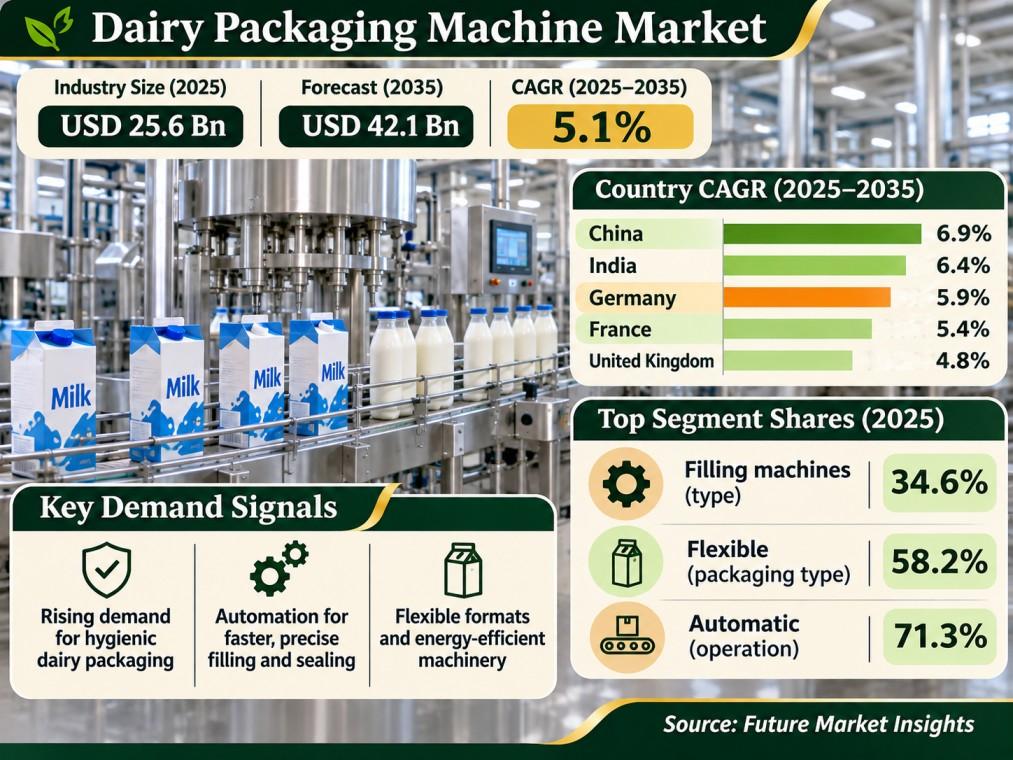
The global dairy packaging machine market is projected to expand from an estimated valuation of USD 25.6 billion in 2025 to USD 42.1 billion by 2035, registering a compound annual growth rate (CAGR) of 5.1% over the ten-year forecast period, according to a newly published 250-page industry study by Future Market Insights (FMI). Building on historical growth from USD 20.0 billion in 2020, the sector is anticipated to reach a pivotal milestone of USD 32.9 billion by 2030 as digitalized, hygienic, and sustainable packaging technologies become mainstream across global dairy processing facilities.
Market Background & Industry Context
Growth across the dairy packaging machine landscape is fundamentally shaped by rising global dairy consumption, heightened emphasis on food safety, and the critical operational need to extend the shelf life of highly perishable products. Increased urbanization, shifting consumer preferences toward retail-ready packaged dairy goods, and stricter international regulatory frameworks are compelling dairy manufacturers to upgrade legacy production lines.
Get Detailed Market Forecasts, Competitive Benchmarking, and Pricing Trends: https://www.futuremarketinsights.com/reports/sample/rep-gb-25529
Furthermore, Future Market Insights identifies five interconnected parent industries driving the market's adoption and innovation trajectory:
- Food and Beverage Packaging Machinery (32% share): Reflects daily global dairy consumption and sustained capital investment in high-volume, low-contamination machinery.
- Dairy Processing Equipment (25% share): Driven by deep integration across milk, yogurt, cheese, butter, and cream production lines to maintain product integrity.
- Flexible and Rigid Packaging (18% share): Fueled by growing demand for bottles, cartons, pouches, tubs, and cups requiring adaptable equipment.
- Automated Filling and Sealing Equipment (15% share): Supported by industry requirements for precision dosing, tamper-proof capping, and reduced product wastage.
- Sustainable and Smart Packaging (10% share): Driven by regulatory and consumer shifts toward recyclable, biodegradable, and intelligent packaging formats.
Despite strong demand, industry participants face operational headwinds, including high initial capital investments, ongoing maintenance expenses, resin price volatility, fluctuating freight rates, and rising energy costs. Regulatory complexities—such as regional restrictions on single-use plastics, extended producer obligations, and inconsistent post-consumer recovery of flexible films—further challenge converters and brand owners.
Granular Segment & Regional Analysis
The FMI study segments the global market across machine type, packaging format, operation mode, application, distribution channel, and geography to provide actionable benchmarks for equipment manufacturers and dairy processors:
- By Machine Type: Filling machines dominate the category with a 34.60% market share in 2025. Their leadership stems from their critical role in ensuring precise portion control, multi-format adaptability across liquid and viscous dairy products, and seamless integration with advanced sterilization and sealing technologies. Other key machine categories include Form-Fill-Seal (FFS) machines, palletizing machines, wrapping machines, cartoning machines, and labeling machines.
- By Packaging Type: Flexible packaging accounts for the majority share at 58.20%, favored for its lightweight profile, cost efficiency, and logistical advantages. Pouches, sachets, and flexible films compatible with high-speed automated filling and sealing systems continue to gain traction, bolstered by ongoing innovations in barrier properties and recyclable or biodegradable film substrates.
- By Operation Mode: Automatic systems capture 71.30% of the market, reflecting processor prioritization of high-speed throughput, 24/7 production reliability, and minimized human contact to prevent microbial contamination. Labor cost pressures and skilled operator shortages are accelerating the integration of robotics, machine-learning adjustments, and predictive maintenance.
- By Application & Geography: Core application verticals include milk, fresh dairy products, butter and buttermilk, and milk powder, distributed through direct and indirect channels. Regionally, North America, Asia-Pacific, and Europe stand out as the primary growth engines within a global footprint spanning Latin America, Western and Eastern Europe, the Balkan and Baltic states, Russia and Belarus, Central Asia, East Asia, South Asia and Pacific, and the Middle East and Africa.
Executive Perspective & Strategic Implications
"The steady 5.1% compound annual growth trajectory through 2035 demonstrates that dairy packaging machinery is no longer viewed merely as an end-of-line utility, but as a strategic safeguard for product shelf stability, regulatory compliance, and margin protection," noted Nandini Roy Choudhury, Report Author at Future Market Insights. "As labor constraints persist and global dairy trade expands, processors are actively prioritizing modular, energy-efficient lines equipped with quick changeover capabilities and digital monitoring to handle diverse flexible and rigid formats without sacrificing throughput."
For machinery suppliers and engineering teams, these findings underscore a clear competitive imperative: vendors offering customized, end-to-end packaging lines backed by strong after-sales service and sustainable material compatibility are best positioned to secure long-term partnerships with global dairy producers.
Future Outlook & Methodology Highlights
Looking toward 2035, technological evolution in the dairy packaging machine sector will center on robotic-assisted lines, smart packaging integration, and high-speed, low-wastage filling architectures. Capacity expansions in developing economies—aimed at satisfying both domestic consumption and export-oriented dairy demand—will provide sustained equipment replacement and greenfield installation opportunities.
Future Market Insights’ 250-page analysis evaluates historical performance from 2020 alongside a 10-year forecast from 2025 to 2035. The research framework examines market value dynamics, parent industry contributions, segmental share distributions, country-level demand drivers, regulatory constraints, and competitive benchmarking across leading global manufacturers, including Tetra Pak, Alfa Laval, Barry-Wehmiller, Carpigiani, DeLaval, Feldmeier Equipment, GEA, IMA, Krones, Paul Mueller, PFM, Scherjon Dairy Equipment, Sidel, SPX Flow, and Technogel.
Realted Report Of Packaging Industry :
Tissue Paper Converting Machine Market: https://www.futuremarketinsights.com/reports/tissue-paper-converting-machines-market
Trash Can Liner Market: https://www.futuremarketinsights.com/reports/trash-can-liners-market
Topical Applicator Market: https://www.futuremarketinsights.com/reports/topical-applicators-market
MEDIA CONTACT
Contact Person: Media Relations Team
Designation: Corporate Communications
Email: sales@futuremarketinsights.com
Phone: +1-347-918-3531
Website: https://www.futuremarketinsights.com/
ABOUT FUTURE MARKET INSIGHTS
Future Market Insights, Inc. (FMI) is an ESOMAR-certified market research and consulting firm headquartered in Delaware, USA, with offices in the United Kingdom, the United Arab Emirates, and India. FMI delivers syndicated and custom research across food and beverage, healthcare, chemicals, technology, packaging, consumer goods, and industrial sectors. Its research helps organizations assess market opportunities, understand industry developments, and make informed strategic decisions.

 English
 Arabic
 French
 Spanish
 Portuguese
 Deutsch
 Turkish
 Dutch
 Italiano
 Russian
 Romaian
 Greek