


Pongamia Food Oils Market Set to Surge to USD 152.5 Million by 2036, Registering 18.3% CAGR
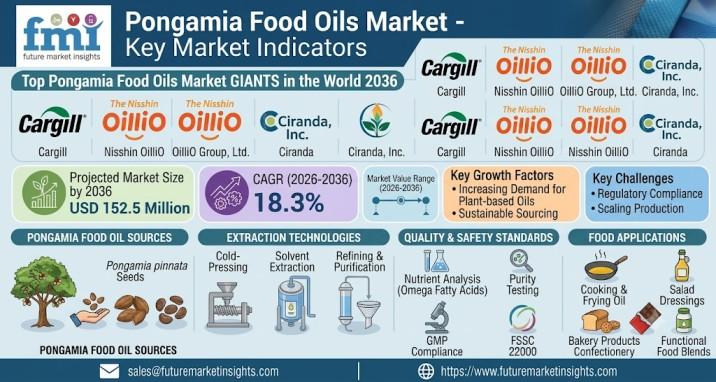
NEWARK, Del., November 12, 2026 — The global Pongamia Food Oils Market is entering a significant growth phase as food manufacturers increasingly explore sustainable, plant-derived alternatives to conventional vegetable oils, palm oil, and other tropical lipid sources. Rising demand for deforestation-free food ingredients, clean-label formulations, regenerative agriculture, and plant-based food products is creating new commercial opportunities for debittered pongamia oil across bakery, confectionery, alternative meat, dairy-free spreads, and snack applications. According to the latest market intelligence report published by Future Market Insights (FMI), the global pongamia food oils market is valued at USD 28.4 million in 2026, compared with USD 24.0 million in 2025. The market is projected to reach USD 152.5 million by 2036, expanding at a compound annual growth rate (CAGR) of 18.3% during 2026–2036. The market is expected to generate an incremental opportunity of USD 124.1 million over the forecast period.
Get the latest market insights and forecasts: Request a Sample Report: https://www.futuremarketinsights.com/reports/sample/rep-gb-36098
Market Size & Growth Forecasts
According to Future Market Insights, the pongamia food oils market is benefiting from increasing interest in regenerative oilseed production and specialty plant-based lipids. Pongamia, scientifically known as Pongamia pinnata or Millettia pinnata, is a nitrogen-fixing tree that can grow on marginal and degraded agricultural land. Its seeds contain oil that can be processed into food-grade ingredients through specialized refining and debittering technologies.
Growing interest in reducing dependence on conventional tropical oils is encouraging food manufacturers to evaluate pongamia-derived culinary oils and structured fats. Its high-oleic composition, potential frying stability, and suitability for specialty lipid formulations are supporting its evaluation across food processing applications.
FMI identifies Solvent & Adsorbent Debittering as the leading technology segment, accounting for an estimated 72.4% share in 2026. This technology removes naturally occurring bitter compounds, including karanjin and pongamol, helping improve the suitability of pongamia oil for food formulations.
The High-Oleic Culinary Oil segment is projected to account for 54.8% of the lipid fraction market in 2026, while Plant-Based Meat Fat is anticipated to represent 39.6% of end-use food applications. These developments highlight the growing commercial relevance of specialty botanical oils in the evolving plant-based food ingredients industry.
Pongamia Food Oils Market: Key Forecast Metrics
|
Market Metric |
Value |
|
Market Size (2025) |
USD 24.0 Million |
|
Market Size (2026) |
USD 28.4 Million |
|
Forecast Value (2036) |
USD 152.5 Million |
|
CAGR (2026–2036) |
18.3% |
|
Incremental Opportunity |
USD 124.1 Million |
Key Market Takeaways
- Market Valuation: The global pongamia food oils market is estimated at USD 28.4 million in 2026.
- Future Growth: The market is forecast to reach USD 152.5 million by 2036.
- Growth Rate: The industry is projected to expand at an 18.3% CAGR between 2026 and 2036.
- Leading Technology: Solvent & Adsorbent Debittering is expected to account for 72.4% of technology demand in 2026.
- Leading Lipid Fraction: High-Oleic Culinary Oil is projected to hold a 54.8% share in 2026.
- Leading Application: Plant-Based Meat Fat is anticipated to capture 39.6% of end-use food application demand.
- Leading Certification Category: GRAS & Novel-Food Grades are expected to represent 64.0% of certification demand.
- Leading Distribution Channel: Direct Formulator Supply is forecast to account for 71.8% of distribution demand.
- Fastest-Growing Country: Singapore is projected to register the highest country-level CAGR of 20.0% through 2036.
- Key Growth Drivers: Demand for sustainable edible oils, regenerative agriculture, palm-free formulations, and plant-based food ingredients.
What Is Driving the Growth of the Pongamia Food Oils Market?
The growing emphasis on sustainable ingredient sourcing is emerging as a major factor supporting the expansion of the pongamia food oils market. Food manufacturers are increasingly evaluating alternative lipid sources that can support environmental commitments while maintaining the functional properties required for commercial food production.
Pongamia trees offer an alternative agricultural model because they can grow on degraded land and contribute to nitrogen fixation. Their potential role in regenerative agroforestry is attracting interest from companies seeking to diversify vegetable oil sourcing and reduce exposure to conventional tropical oil supply chains.
Another important growth driver is the increasing demand for plant-based meat and dairy alternatives. Food formulators require specialty fats that can deliver texture, mouthfeel, melting characteristics, and cooking performance. High-oleic pongamia oil is being evaluated for structured fat applications, including meat alternatives, dairy-free spreads, and bakery shortenings.
Technological improvements in debittering and refining are also supporting commercialization. Specialized solvent and adsorbent processing helps reduce naturally occurring bitter compounds, making refined pongamia oil more suitable for food formulation trials and potential commercial applications, subject to applicable regulatory requirements.
Segmental Analysis: Which Categories Are Leading the Market?
Solvent & Adsorbent Debittering Leads Technology Demand
Solvent & Adsorbent Debittering is projected to account for 72.4% of the debittering technology segment in 2026. Its leadership reflects the importance of removing bitter phytochemicals from crude pongamia oil while maintaining the desired lipid characteristics. Commercial refiners are evaluating continuous processing systems to improve product consistency and support larger-volume food-grade production.
High-Oleic Culinary Oil Leads Lipid Fractions
High-Oleic Culinary Oil is expected to hold a 54.8% share of the lipid fraction segment in 2026. Its omega-9-rich composition makes it relevant for food applications requiring cooking stability and specialty lipid functionality. Potential applications include snack roasting, frying, plant-based spreads, and structured food fats.
Plant-Based Meat Fat Leads Food Applications
Plant-Based Meat Fat is anticipated to account for 39.6% of the end-use food application segment in 2026. The expansion of alternative protein products is encouraging ingredient manufacturers to investigate new lipid systems that can replicate the juiciness, texture, and mouthfeel of conventional meat products.
GRAS & Novel-Food Grades Support Regulatory Positioning
GRAS & Novel-Food Grades are projected to represent 64.0% of certification demand in 2026. Regulatory documentation, toxicological assessments, and ingredient specifications are important considerations for food manufacturers evaluating emerging botanical oils for commercial applications.
Direct Formulator Supply Strengthens B2B Distribution
Direct Formulator Supply is forecast to account for 71.8% of distribution demand in 2026. Direct partnerships between oil producers, specialty ingredient suppliers, and food manufacturers enable application-specific product development, formulation testing, and long-term sourcing arrangements.
Regional Outlook: Which Countries Are Driving Market Expansion?
According to FMI, regional growth opportunities are emerging across Asia-Pacific, North America, Latin America, and Europe. Demand is influenced by alternative protein innovation, specialty edible oil processing, sustainable ingredient sourcing, and food manufacturing investments.
Singapore is projected to lead the evaluated national markets with a 20.0% CAGR through 2036, followed by Japan at 19.4% and Brazil at 19.0%.
Singapore: The Singapore pongamia food oils market is projected to expand at a 20.0% CAGR through 2036. Alternative protein research, food technology innovation, and increasing interest in lower-saturated-fat ingredient formulations are supporting opportunities for specialty botanical oils.
Japan: The Japanese market is forecast to grow at a 19.4% CAGR through 2036. Specialty fat processing, bakery applications, plant-based spreads, and dairy-free formulations are creating opportunities for high-oleic culinary oils.
Brazil: Brazil is anticipated to register a 19.0% CAGR through 2036. The country's agroforestry potential, agricultural infrastructure, and established oilseed processing capabilities offer opportunities for integrating pongamia cultivation and specialty oil production.
India: The Indian market is projected to expand at an 18.5% CAGR through 2036. Native pongamia seed availability, plantation development, and investments in food-grade refining and debittering technologies are supporting the market's development. Regulatory clearances and food safety compliance remain important considerations for commercialization.
United States: The United States pongamia food oils market is expected to register a 17.7% CAGR through 2036. Emerging commercial production, specialty ingredient development, and food manufacturers' interest in sustainable oil alternatives are supporting market opportunities.
Australia: Australia is projected to record a 17.5% CAGR through 2036, supported by potential plantation development and demand for sustainable food ingredients.
Germany: Germany is forecast to expand at a 16.9% CAGR through 2036. Demand for palm-free food formulations, sustainable sourcing, and plant-based bakery and meat alternatives is creating opportunities.
United Kingdom: The UK market is anticipated to grow at a 16.4% CAGR through 2036. Clean-label product development, saturated-fat reduction initiatives, and plant-based ready-meal formulations are supporting interest in alternative specialty oils.
Competitive Landscape: Key Companies in the Pongamia Food Oils Market
The competitive landscape includes agroforestry developers, specialty oil processors, global agricultural commodity companies, and food ingredient manufacturers. Market participants are focusing on plantation development, refining technologies, product qualification, and commercial partnerships to establish their positions in the emerging food-grade pongamia oil industry.
Key companies identified by Future Market Insights include:
- Terviva, Inc. (Ponova Oil)
- Bunge Global SA
- Danone Manifesto Ventures / Formulation Partners
- Fuji Oil Holdings Inc.
- AAK AB
- Cargill, Incorporated
- The Nisshin OilliO Group, Ltd.
- Ciranda, Inc.
Terviva is associated with pongamia cultivation and Ponova oil commercialization, while global oilseed processors and specialty fat manufacturers offer capabilities relevant to refining, ingredient processing, and downstream food applications.
The competitive environment is expected to evolve as commercial orchard capacity increases, food-grade processing technologies improve, and regulatory pathways for emerging botanical ingredients become clearer.
Explore the market outlook, forecast analysis and competitive landscape in the Full Report: https://www.futuremarketinsights.com/reports/pongamia-food-oils-market
Opportunities and Challenges in the Pongamia Food Oils Market
The market offers significant opportunities for companies developing sustainable specialty oils and alternative fat systems. Food manufacturers can explore pongamia oil in palm-free bakery shortenings, plant-based meat formulations, dairy-free spreads, and specialty frying applications.
Enzymatic interesterification and oleogel structuring represent additional opportunities for converting liquid pongamia oil into functional semi-solid fats. These technologies could help manufacturers develop alternative fat ingredients with specific melting, textural, and processing characteristics.
However, the market also faces challenges. Pongamia trees generally require approximately four to five years to reach commercial pod-bearing maturity, creating limitations on short-term raw material availability. Food-grade refining requirements, residual phytochemical control, regulatory assessments, and supply chain development also influence commercialization timelines.
Companies that successfully combine plantation development, consistent raw material sourcing, advanced refining capabilities, and regulatory compliance may be better positioned to capture emerging opportunities.
Future Outlook
The global pongamia food oils market is expected to experience substantial growth through 2036 as food manufacturers explore alternative sources of sustainable edible oils. Increasing demand for plant-based food ingredients, palm-free formulations, regenerative agriculture, and specialty lipid systems is expected to create new opportunities across the global food and beverage industry.
With the market projected to increase from USD 28.4 million in 2026 to USD 152.5 million by 2036, the industry presents emerging opportunities for ingredient suppliers, agricultural producers, specialty oil refiners, and food manufacturers.
Future commercialization will depend on the development of reliable pongamia supply chains, improvements in debittering technologies, food safety validation, and regulatory acceptance across major markets.
Related Food & Beverage Industry Reports Explore additional market intelligence and industry research from Future Market Insights:
Sorbitol Market https://www.futuremarketinsights.com/reports/sorbitol-market
Sequestrants Market https://www.futuremarketinsights.com/reports/sequestrants-market
Seed Polymer Market https://www.futuremarketinsights.com/reports/seed-polymers-market
Sea Buckthorn Market https://www.futuremarketinsights.com/reports/sea-buckthorn-market
About Future Market Insights (FMI)
Future Market Insights (FMI) is a global market research and consulting organization providing actionable market intelligence, industry analysis, and strategic insights across diverse industry verticals. FMI helps businesses, investors, and decision-makers identify emerging opportunities, understand competitive landscapes, evaluate market dynamics, and develop informed growth strategies through comprehensive research and data-driven insights.
Media Contact
For Press & Corporate Inquiries
Rahul Singh
AVP – Marketing and Growth Strategy
Phone: +91 8600020075
For Sales: sales@futuremarketinsights.com
For Media: Rahul.singh@futuremarketinsights.com
Website: https://www.futuremarketinsights.com

 English
 Arabic
 French
 Portuguese
 Deutsch
 Turkish
 Dutch
 Italiano
 Russian
 Romaian
 Portuguese (Brazil)
 Greek