


Chillers Market Expansion Supported by Industrial Cooling Applications; India Records 4.9% CAGR
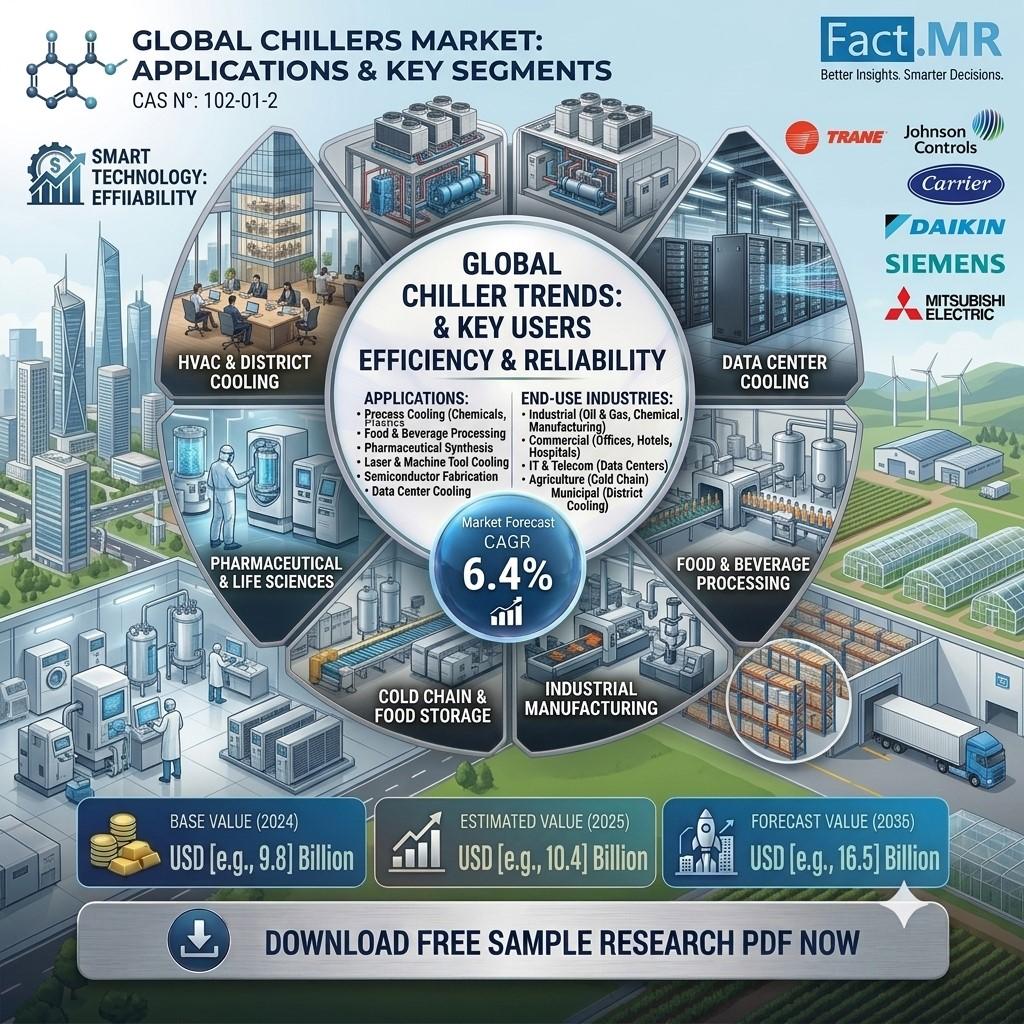
The global chillers market is forecast to expand from USD 4,610.3 million in 2025 to USD 6,256.3 million by 2035, registering a 3.1% CAGR over the forecast period. Fact.MR attributes this expansion to increasing demand for precise temperature management across data centers, hospitals, commercial buildings, and industrial facilities. Growing emphasis on energy efficiency, refrigerant compliance, and dependable cooling infrastructure is also influencing equipment selection and investment decisions.
Industrial modernization and commercial infrastructure development are creating additional requirements for centralized cooling systems. Manufacturing facilities increasingly depend on chillers to maintain stable process temperatures, while data centers require reliable cooling to protect equipment performance. Hospitals, hospitality facilities, and corporate offices are also investing in cooling systems that can manage changing thermal loads. Manufacturers are responding with variable-speed compressors, adaptive controls, and modular designs that improve operational flexibility and energy performance.
Get detailed market forecasts, competitive benchmarking, and pricing trends:
https://www.factmr.com/connectus/sample?flag=S&rep_id=554
Compressor Chillers Retain Leading Position
By product type, compressor chillers remain an important category, with the segment projected to expand at a 3.3% CAGR during the forecast period. Their application across commercial buildings, industrial facilities, and temperature-sensitive operations supports continued demand. Screw and scroll chillers are particularly relevant because they can address different cooling requirements while maintaining operational efficiency.
Scroll chillers are widely used in commercial buildings and smaller data centers, where compact equipment and efficient part-load performance are important. Screw chillers are preferred for industrial applications requiring continuous cooling under substantial thermal loads, including chemical processing, plastics manufacturing, and food production.
The 50–150 ton cooling capacity range represents the core demand category, accounting for the majority of installations across hospitals, hotels, and commercial buildings. This capacity range provides a practical balance between cooling performance and installation requirements. Larger chillers are generally deployed in heavy industrial operations and centralized utility systems, where higher cooling capacities are necessary.
Water-cooled chillers maintain a strong position because of their efficiency in demanding cooling environments. Air-cooled alternatives are gaining attention in urban developments and retrofit projects, where installation flexibility and reduced infrastructure requirements influence procurement decisions.
India, China, and Germany Show Strong Growth Potential
India is expected to register a 4.9% CAGR from 2025 to 2035, making it the fastest-growing country among those specifically quantified in the report. Expanding manufacturing capacity, commercial construction, and demand for industrial temperature control are supporting market development. India's Cooling Action Plan and increasing attention to energy-efficient infrastructure are also influencing cooling equipment procurement.
China is projected to advance at a 3.3% CAGR during the same period. Industrial modernization, construction activity, and the development of smart manufacturing facilities are supporting demand for high-efficiency cooling systems. Government initiatives associated with industrial upgrades are encouraging the adoption of advanced chillers. Modular air-cooled systems are also gaining relevance in major urban developments, while screw and scroll technologies continue to support manufacturing operations.
Germany remains an important European market for chillers, supported by industrial decarbonization initiatives and demand for efficient process cooling. Chemical manufacturers and industrial facilities are investing in screw and absorption chillers with thermal energy recovery capabilities. European energy-efficiency requirements and refrigerant regulations are also encouraging equipment modernization. The report discusses Germany's growth drivers but does not publish a specific country CAGR.
The United States is expected to record a 2.4% CAGR through 2035. Commercial HVAC retrofits, institutional cooling requirements, and refrigerant transition initiatives are shaping demand. Regulatory requirements under the American Innovation and Manufacturing Act are influencing equipment selection, while energy-efficiency standards continue to encourage the replacement of older cooling systems.
Competitive Landscape
Competition in the chillers market includes established manufacturers with extensive product portfolios, technological capabilities, and international distribution networks. Key companies profiled by Fact.MR include Carrier, Trane Technologies, Johnson Controls, Daikin Industries, Mitsubishi Electric, LG Electronics, GEA Group, Blue Star Ltd., MTA SpA, and Smart Chiller Group.
The market is highly concentrated, with leading manufacturers collectively accounting for more than 60% of market value, according to Fact.MR. Competition is increasingly influenced by refrigerant flexibility, energy efficiency, adaptive control systems, and modular equipment configurations.
Manufacturers are developing solutions that support variable-speed operation, predictive maintenance, and real-time equipment monitoring. Buyers are also considering lifecycle costs, servicing capabilities, and compliance with regional cooling regulations when selecting suppliers. Companies offering reliable after-sales support and flexible system configurations are positioned to address evolving industrial and commercial requirements.
Technology and Regulatory Developments Shape the Market
The chillers market is undergoing technological changes as manufacturers respond to stricter energy-efficiency requirements and refrigerant regulations. Variable-speed compressors, magnetic-bearing technologies, and intelligent control systems are improving part-load performance and helping facilities manage fluctuating cooling demand.
Refrigerant transition is another important development. Regulations concerning high-global-warming-potential refrigerants are encouraging manufacturers to introduce equipment compatible with lower-impact alternatives. European F-gas requirements and U.S. refrigerant policies are influencing system design, replacement schedules, and long-term procurement strategies.
In January 2025, Daikin introduced its VRX-series scroll chiller featuring an inverter compressor and multi-refrigerant controls. In August 2024, Johnson Controls announced a collaboration with the U.S. Department of Energy to pilot ultra-low-GWP centrifugal chillers under real-time operating conditions, according to the Fact.MR report.
As industrial facilities and commercial buildings place greater emphasis on cooling efficiency, operational reliability, and regulatory compliance, demand for advanced chiller systems is expected to continue through 2035. The full Fact.MR report provides detailed market forecasts, product analysis, regional opportunities, and competitive insights.
To View Top Reports
https://adamaamresearch.blogspot.com/2026/11/luxury-eyewear-market-projected-to.html
https://net-pals.com/blogs/70286/Global-Luxury-Eyewear-Market-Forecast-at-USD-56-Billion-by
https://acmingle.com/blogs/37165/Global-Luxury-Eyewear-Market-to-Hit-USD-56-Billion-by
About Fact.MR
Fact.MR is a market research and consulting company providing market intelligence, competitive analysis, and forecasting across global industries. Its research supports businesses with data-driven insights into emerging markets, technology trends, competitive dynamics, regional opportunities, and changing demand patterns.

 English
 Arabic
 French
 Portuguese
 Deutsch
 Turkish
 Dutch
 Italiano
 Russian
 Romaian
 Portuguese (Brazil)
 Greek