


Individual Consumers Account for 63.9% of Hair Color Market Demand
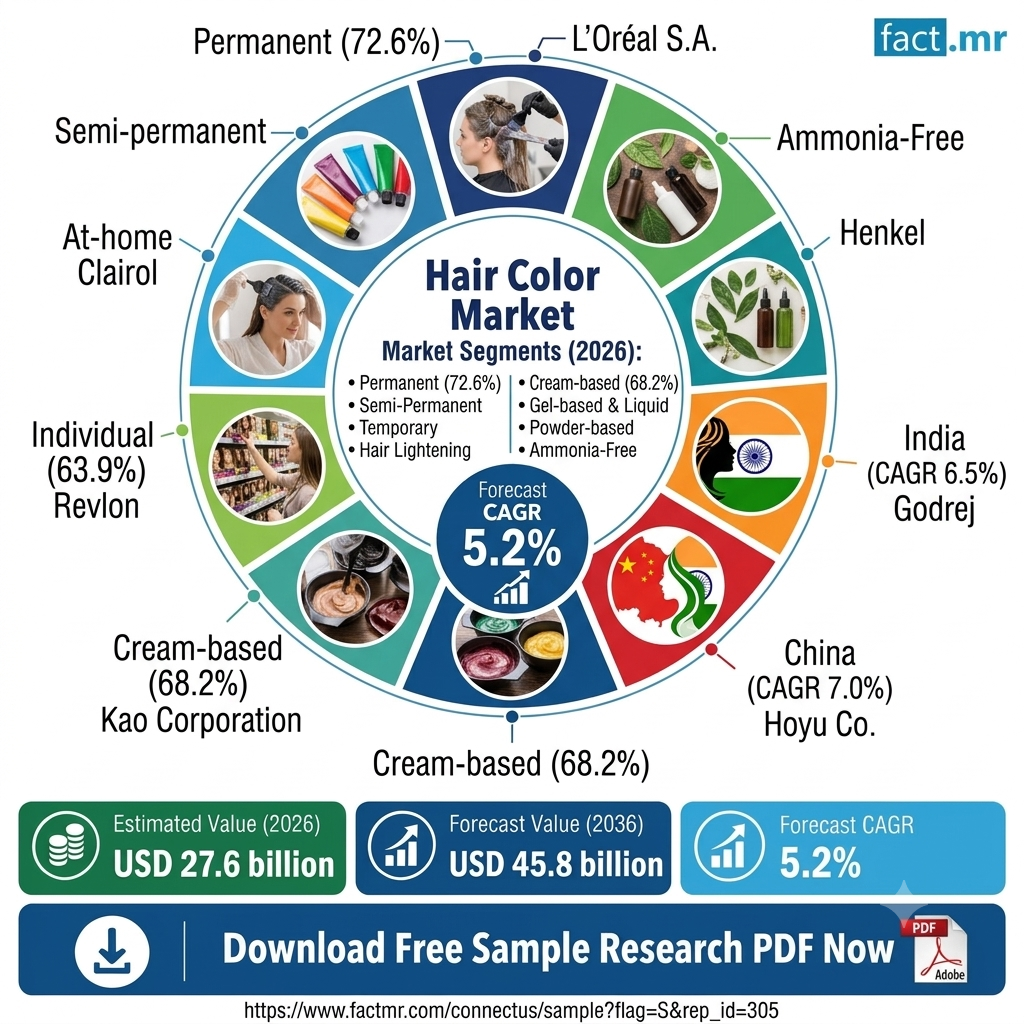
Rockville, MD, November 13, 2026 – The global hair color market is projected to increase from USD 27.6 billion in 2026 to USD 45.8 billion by 2036, registering a compound annual growth rate (CAGR) of 5.2%, according to a new analysis by Fact.MR. Valued at approximately USD 26.2 billion in 2025, the market is expected to create an absolute dollar opportunity of USD 18.2 billion over the forecast period. Rising demand for at-home hair coloring, professional salon services, grey coverage, and ammonia-free formulations is supporting this expansion.
Permanent hair color will account for 72.6% of the product segment in 2026, while individual consumers will represent 63.9% of total end-use demand. These figures highlight the importance of long-lasting color performance and consumer-led purchasing in shaping product development. Manufacturers are increasingly focusing on scalp comfort, reliable grey coverage, and formulations that address changing preferences for cleaner ingredient profiles.
Request a FREE Sample Report: https://www.factmr.com/connectus/sample?flag=S&rep_id=305
Permanent Hair Color Maintains Its Leading Market Position
Permanent hair color remains the dominant product category. Its projected 72.6% share in 2026 reflects established application performance, broad compatibility, and demand for lasting results across consumer and professional applications. Established supply relationships and long qualification histories also support the segment's position.
Semi-permanent and temporary hair color products serve consumers seeking shorter-lasting results and greater flexibility in changing their appearance. Hair lightening products address additional requirements across fashion styling and professional salon applications.
Cream-based formulations are expected to hold 68.2% of the formulation segment in 2026. Their established processing characteristics and application performance support continued adoption. Gel-based, liquid, and powder formulations serve more specialized requirements, including targeted styling and professional color preparation.
At-home hair coloring represents an important demand channel. Individual consumers account for 63.9% of end-use demand, reflecting the substantial role of household purchases in the market. Retail color kits, online beauty platforms, and direct brand websites provide additional routes for reaching these buyers.
Ammonia-Free Formulations and Product Innovation Shape Competition
Product formulation is becoming an important competitive consideration. Manufacturers are developing ammonia-free hair color products, low-odor color creams, oil-infused systems, and formulations designed to improve the coloring experience without compromising performance.
Recent launches illustrate this direction. In January 2025, Clairol introduced ColorStrong, its first bonding hair color line. The product combines permanent hair color with AHA bonding care and a zero-ammonia positioning, targeting at-home users seeking coloring and hair-strengthening benefits. [LINK: Clairol ColorStrong bonding hair color launch announcement]
In February 2025, Henkel announced that Schwarzkopf Keratin Root Permanent Color and Keratin Root Temporary Color & Thickening Spray had received 2025 Product of the Year USA recognition. The development highlights continued product innovation in root coloring and coverage applications.
Sustainability is another area influencing product development. Manufacturers are exploring reduced-emission formulations, recycled content, and bio-based ingredients while seeking to maintain established color performance. Verified environmental credentials could help differentiate products in premium market categories.
China and India Lead Country-Level Market Growth
Asia Pacific is expected to record the fastest regional expansion during the forecast period. China leads the country-level outlook with a projected CAGR of 7.0% between 2026 and 2036, supported by industrial expansion and growing domestic manufacturing capabilities.
India follows with a projected CAGR of 6.5%. Manufacturing expansion supported by Production Linked Incentive (PLI) initiatives, alongside increasing domestic consumption, creates opportunities for hair color manufacturers and suppliers.
Germany is projected to grow at a CAGR of 6.0%, with procurement requirements influenced by European regulatory compliance and DIN standards. The United States is expected to register a CAGR of 4.9%, supported by established industry demand and growing preferences for products with documented environmental credentials. The United Kingdom is projected to expand at 4.4% over the same period.
North America continues to benefit from established consumer and professional demand. Europe maintains steady market activity, with product specifications and regulatory compliance influencing manufacturer positioning.
Competition Centers on Formulation Capabilities and Product Differentiation
The competitive landscape includes multinational beauty companies and specialized manufacturers. L'Oréal S.A., Henkel AG & Co. KGaA, Kao Corporation, Avon Products, The Estée Lauder Companies, Godrej Consumer Products, Revlon Consumer Products LLC, Hoyu Co., and Combe Incorporated are among the companies operating in the market.
Leading participants compete through product portfolios, distribution networks, and research and development investments. Smaller and mid-tier competitors focus on specialized formulations and regional market opportunities.
Price premiums remain a constraint, particularly in cost-sensitive consumer categories where buyers may not consider additional product features sufficient justification for higher prices. Supply concentration among qualified producers can also restrict availability during demand surges.
[SECOND QUOTE: Insert an approved statement from a second named Fact.MR spokesperson, with their verified designation.]
Shambhu Nath Jha, Principal Consultant at Fact.MR, commented, "The hair color market reflects structural demand growth driven by end-use industry expansion and evolving regulatory requirements. The combination of performance demands and sustainability mandates is reshaping competitive dynamics, favoring manufacturers that combine product quality with environmental credentials."
Fact.MR's Hair Color Market Forecast
Fact.MR's assessment covers the global hair color market across product types, applications, end uses, technologies, formulations, distribution channels, and geographic regions. The research combines secondary research, primary interviews, and forecast modelling.
The methodology draws on more than 90 secondary sources, benchmarks over 45 company portfolios, and evaluates demand across more than 30 countries. Primary validation includes over 25 interviews with producers, end users, and industry specialists.
The findings provide market participants with an assessment of growth opportunities, competitive positioning, and country-level demand through 2036.
Fact.MR is a market research and consulting firm that provides industry intelligence, market forecasts, and strategic analysis to businesses across global markets. Its research combines primary interviews, secondary sources, and proprietary forecasting methodologies.

 English
 Arabic
 French
 Spanish
 Portuguese
 Deutsch
 Turkish
 Dutch
 Russian
 Romaian
 Portuguese (Brazil)
 Greek