


Infrastructure Spending Supports Global Bridge Inspection Market Growth
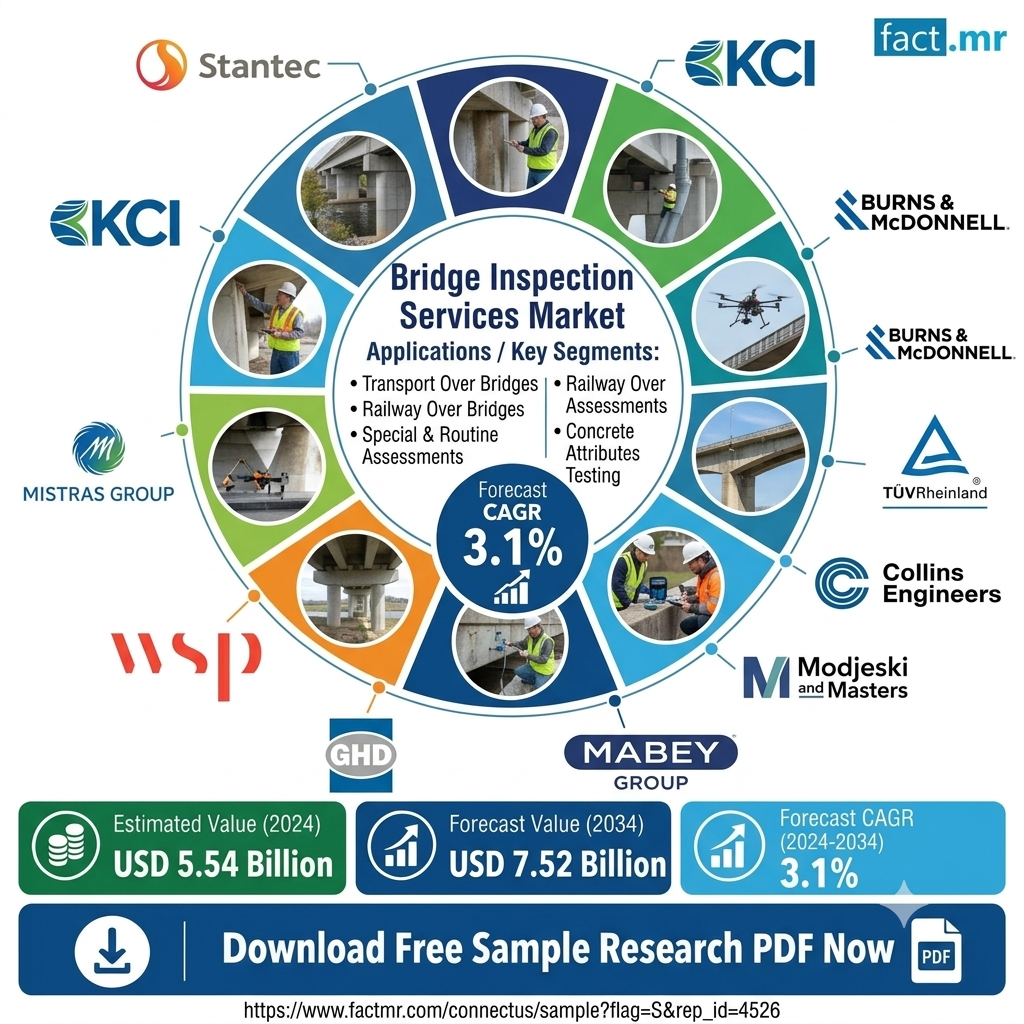
Rockville, MD, November 14, 2026 – The global bridge inspection services market is projected to increase from US$ 5.54 billion in 2024 to US$ 7.52 billion by 2034, expanding at a compound annual growth rate (CAGR) of 3.1% during the forecast period, according to Fact.MR. Rising concerns about aging transportation infrastructure, growing awareness of structurally deficient bridges, and stricter inspection requirements are supporting demand for professional bridge assessment and maintenance services. Transportation agencies are also increasingly outsourcing inspection activities to specialized service providers with the technical expertise and equipment required to evaluate complex structures.
The need for regular bridge assessments is becoming more pressing. According to the United States Department of Transportation (DoT), more than 56,000 bridges, representing approximately 9.1% of all bridges in the United States, were classified as structurally deficient in 2023. This figure highlights the scale of infrastructure maintenance requirements and the importance of identifying structural deterioration before it affects bridge safety and serviceability.
Request a FREE Sample Report: https://www.factmr.com/connectus/sample?flag=S&rep_id=4526
Outsourcing and Infrastructure Safety Support Bridge Inspection Services Market Growth
Transportation agencies are increasingly relying on external specialists to conduct inspection and maintenance activities. The growing complexity of non-destructive testing, combined with strict government requirements, has increased the need for qualified inspectors and specialized assessment technologies. Organizations that previously handled inspections internally are turning to contractors and engineering companies with dedicated technical teams.
Bridge inspections cover several structural components, including superstructures, substructures, abutments, piers, and bearings. Engineers examine these elements for visible damage, material deterioration, and other conditions that could affect structural performance. Routine assessments also help authorities identify maintenance requirements and estimate the progression of deterioration.
Climate-related infrastructure risks are creating additional demand. Extreme weather events, natural disasters, and erosion can accelerate damage to existing bridges. Digital monitoring systems and smart sensors are gaining attention as tools for tracking structural conditions and supporting maintenance decisions. However, inspection costs, time requirements, and shortages of qualified technicians remain challenges for service providers.
Drone Technology Expands Bridge Inspection Capabilities
Unmanned aerial vehicles (UAVs) equipped with imaging and sensing technologies are changing how inspection teams access difficult-to-reach bridge components. [LINK: Drone bridge inspection services] provide an alternative to certain manual inspection procedures by reducing inspection time and improving worker safety.
These systems allow inspectors to capture images and collect structural information from locations that may otherwise require specialized access equipment. Road and railway bridges are among the primary structures assessed through drone-based inspection methods. Their use is particularly relevant where conventional inspection involves difficult working conditions or restricted access.
The market also includes several inspection categories, ranging from superficial and routine assessments to principal, special, and damage inspections. Testing methods cover concrete characteristics, steel properties, and specialized non-destructive procedures.
United States and China Remain Important Country-Level Markets
The United States bridge inspection services market is projected to grow at a CAGR of 3% from 2024 to 2034, increasing from US$ 989.1 million in 2024 to US$ 1.33 billion by 2034. Investment in oil and gas transportation infrastructure is creating additional requirements for pipeline bridge inspections. Aging oil and gas infrastructure across North America requires regular assessments to identify corrosion and other forms of metal deterioration.
China's market is forecast to increase from US$ 703.4 million in 2024 to US$ 946.2 million by 2034, registering a CAGR of 3%. The country's extensive bridge network and growing infrastructure requirements are supporting demand for inspection and repair services. Regular assessments are particularly relevant as older structures become more vulnerable to environmental exposure and material degradation.
Canada is projected to register a CAGR of 3.2% during the forecast period. South Korea is expected to record a faster CAGR of 3.3% between 2024 and 2034, accounting for 26.8% of the East Asian market by the end of the assessment period.
Transportation Over Bridges Account for a Major Market Segment
By bridge category, transportation over bridges are projected to increase from US$ 2.42 billion in 2024 to US$ 3.3 billion by 2034, expanding at a CAGR of 3.1%. These structures support substantial vehicle and pedestrian movement and are exposed to continuous loading and environmental conditions. Regular inspections help engineers assess their ability to maintain safe operating conditions.
The railway over bridge segment is forecast to expand at a CAGR of 3.2% through 2034. Railway structures require careful assessment because of repeated loading and the operational requirements associated with rail transportation networks.
By testing category, inspections for concrete attributes in structures represent another major segment. This category is projected to rise from US$ 2.37 billion in 2024 to US$ 3.23 billion by 2034, registering a CAGR of 3.1%. Engineers use rebound hammer tests, carbonation depth assessments, ultrasonic pulse velocity tests, and compressive strength tests to evaluate concrete characteristics.
Competitive Developments in the Bridge Inspection Services Industry
Companies operating in the bridge inspection services market are expanding their engineering and infrastructure capabilities through project appointments and acquisitions.
In March 2024, Jacobs was appointed as a design consultant for the Tasmanian New Bridgewater Bridge Project. The assignment involves providing design services for the new bridge, adding to Jacobs' infrastructure engineering activities.
In January 2022, CEC announced the acquisition of White Engineering in Oklahoma. The combination was expected to strengthen capabilities across civil engineering, construction engineering and inspection, materials testing, surveying and mapping, and power delivery.
Key companies profiled in the Fact.MR report include Mistras Group, KCI Technologies, Stantec, TUV Rheinland, Mabey Group, ATS Engineering, Burns & McDonnell, Collins Engineers, WSP Global, GHD Pty Ltd., and Modjeski and Masters Inc.
A Fact.MR spokesperson said, "The number of structurally deficient bridges in the United States shows why regular inspections matter. Service providers with specialized testing capabilities will have an important role in helping infrastructure owners identify deterioration and plan maintenance activities."
A market analyst at Fact.MR added, "Drone-based inspections are opening up more practical ways to assess difficult-to-access bridge components. Still, qualified technicians and the cost of inspection remain important considerations for companies and transportation authorities."
About Fact.MR
Fact.MR is a market research and consulting firm providing comprehensive market intelligence, industry analysis, and strategic insights to businesses across diverse sectors. The company delivers data-driven research covering market size, competitive landscapes, emerging trends, and

 English
 Arabic
 French
 Spanish
 Portuguese
 Deutsch
 Turkish
 Dutch
 Italiano
 Russian
 Romaian
 Greek