


Early Warning Signs of Oral Cancer: Symptoms You Should Never Ignore
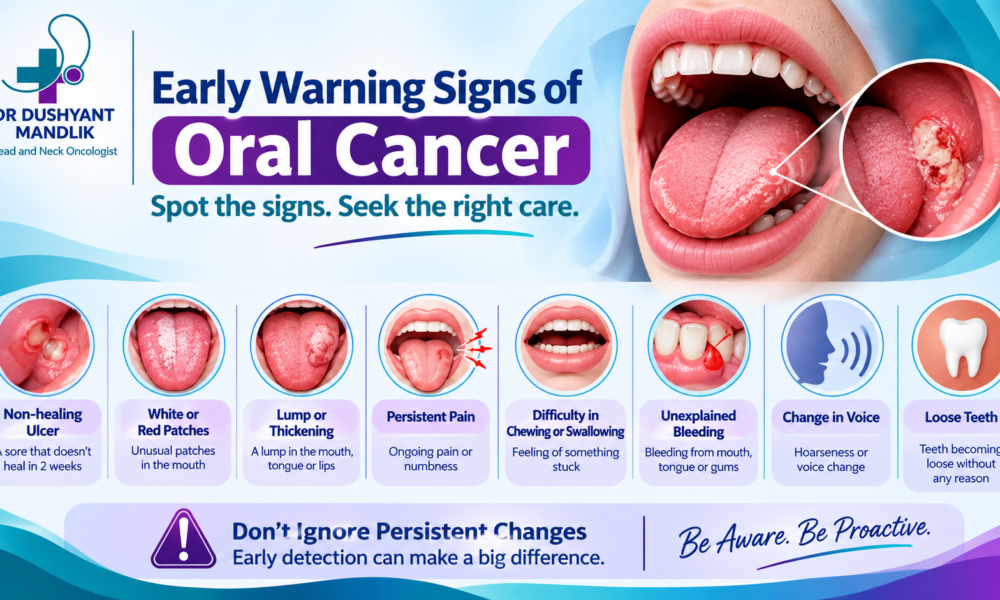
Oral cancer is one of the important health concerns in India. It can affect different parts of the mouth, including the tongue, inner cheeks, gums, lips, floor of the mouth and roof of the mouth. One of the major challenges in managing oral cancer is that its early symptoms are often overlooked or mistaken for common dental problems, mouth ulcers or minor infections.
Many people continue to ignore a persistent mouth ulcer, an unusual patch inside the cheek or difficulty opening the mouth, assuming that the problem will resolve on its own. Unfortunately, delaying medical evaluation can allow the disease to progress.
The encouraging fact is that early detection can make a significant difference in the management of oral cancer. Recognising unusual changes in the mouth and seeking timely medical attention are important steps towards diagnosis and treatment.
What Is Oral Cancer?
Oral cancer refers to cancer that develops in the tissues of the oral cavity. It most commonly develops in the lining of the mouth, with the tongue and inner cheek being frequently affected sites.
The disease can develop in different locations, including:
-
Tongue
-
Inner lining of the cheeks
-
Gums
-
Floor of the mouth
-
Roof of the mouth (palate)
10 Early Warning Signs of Oral Cancer
Recognising changes in the mouth is important. The following signs should not be ignored, particularly when they persist, increase in size or do not respond to routine treatment.
1. A Mouth Ulcer That Does Not Heal
A persistent mouth ulcer is one of the important warning signs of oral cancer.
Ordinary mouth ulcers generally heal within a short period. However, an ulcer that remains for more than two weeks, gradually increases in size or repeatedly develops in the same location should be examined.
A suspicious ulcer may have:
-
Raised or hardened edges
-
An irregular surface
2. White Patches Inside the Mouth
White patches on the tongue, gums or inner cheek may indicate a condition called leukoplakia.
Some white patches are harmless or related to other oral conditions. However, certain types of leukoplakia are considered potentially precancerous and may carry a risk of developing into oral cancer.
3. Red or Mixed Red-and-White Patches
Red patches inside the mouth, known as erythroplakia, deserve particular attention.
Some red lesions have a higher likelihood of showing precancerous or cancerous changes than ordinary white patches. Mixed red-and-white patches can also require further investigation.
These changes may appear on the tongue, floor of the mouth, gums or inner cheeks.
4. A Lump or Thickening in the Mouth
An unusual growth, swelling or thickened area inside the mouth can be another warning sign.
Patients may notice a small lump on the tongue, cheek, gums or palate. Sometimes, the affected area feels harder than the surrounding tissue.
5. Difficulty Opening the Mouth
Progressive restriction in mouth opening is an important symptom, particularly in individuals who chew tobacco or betel nut.
Some patients initially notice difficulty eating large food portions or opening their mouth comfortably.
This may be associated with oral submucous fibrosis, a potentially malignant condition commonly linked to areca nut and related chewing products. In some cases, difficulty opening the mouth may also occur with advanced oral cancer.
6. Persistent Pain or Burning Sensation
Unexplained pain, tenderness or burning inside the mouth can sometimes indicate an underlying oral condition.
Patients may experience discomfort while eating, speaking or moving their tongue. Some may also notice increased sensitivity to spicy foods.
7. Unexplained Bleeding or Numbness
Bleeding from the tongue, gums or inner cheek without an obvious injury should be investigated.
Similarly, persistent numbness or reduced sensation in the tongue, lips or other areas of the mouth may indicate involvement of underlying nerves.
8. Difficulty Chewing, Swallowing or Moving the Tongue
As an oral lesion grows, it may interfere with normal mouth movements.
Patients may experience:
-
Difficulty chewing food
-
Pain while swallowing
-
Restricted tongue movement
9. Loose Teeth or Dentures That No Longer Fit Properly
An unexplained loosening of teeth, particularly when there is no obvious gum disease, may sometimes be associated with an underlying lesion involving the jaw or surrounding tissues.
Some patients also notice that their dentures no longer fit comfortably.
10. A Lump in the Neck
A persistent lump in the neck can sometimes indicate that oral cancer has spread to nearby lymph nodes.
It may be painless and gradually increase in size. Some patients notice the neck swelling before recognising any abnormality inside their mouth.
Who Is at Higher Risk of Developing Oral Cancer?
Certain lifestyle habits and exposures increase the risk of oral cancer.
Important risk factors include:
-
Tobacco use: Smoking cigarettes, bidis and using smokeless tobacco products such as gutkha and khaini.
-
Areca nut and betel quid: Chewing supari, areca nut and related preparations can increase the risk of oral cancer.
-
Alcohol consumption: Regular and heavy alcohol consumption increases risk, particularly when combined with tobacco use.
How Is Oral Cancer Diagnosed?
Diagnosis begins with a detailed clinical examination.
Depending on the symptoms and findings, the evaluation may include:
1. Clinical examination: The doctor examines the tongue, gums, inner cheeks, floor of the mouth, palate and lips. The neck is also examined for enlarged lymph nodes.
2. Biopsy: If a suspicious lesion is identified, a small tissue sample may be taken and examined under a microscope. A biopsy is generally essential to confirm whether the lesion is cancerous.
Final Thoughts: Early Recognition Can Make a Difference
Oral cancer often begins with changes that may appear small or insignificant. A persistent ulcer, unusual white or red patch, unexplained lump or progressive difficulty opening the mouth may be the first indication that something is wrong.
The most important message is simple: do not ignore persistent changes inside your mouth.
Not every ulcer or patch indicates cancer, but every suspicious and persistent lesion deserves proper evaluation. Avoid delaying consultation or relying only on temporary relief from medication.
Original Source: https://www.headandneckcancerclinics.in/early-warning-signs-of-oral-cancer/

 English
 Arabic
 French
 Spanish
 Portuguese
 Turkish
 Dutch
 Italiano
 Russian
 Romaian
 Portuguese (Brazil)
 Greek