


What Is A Fixed Voltage AC/DC Power Adapter? AC vs DC Explained
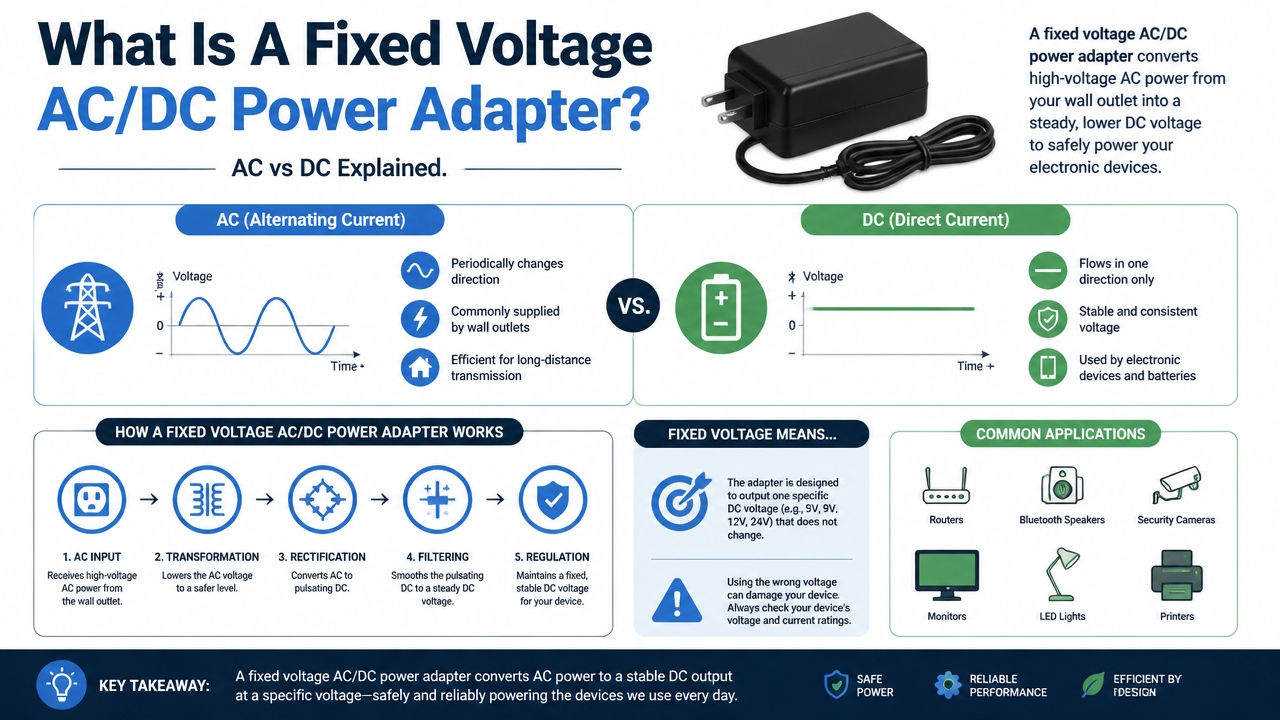
A fixed voltage AC/DC power adapter is an external power supply that converts the alternating current (AC) from a standard wall outlet into a steady, fixed direct current (DC) voltage required by an electronic device. These adapters are common in Australian homes and workplaces, powering everything from internet routers to security cameras and LED strip lighting.
Understanding how these adapters work and the fundamental difference between AC and DC, helps users select the correct unit for their equipment and avoid costly mistakes.
What Is AC and DC Power?
Electricity comes in two main forms: alternating current (AC) and direct current (DC).
Alternating Current (AC)
AC is the electricity supplied through standard wall outlets in Australia. In AC, the flow of electrons periodically reverses direction. In Australia, the mains supply is 230V AC at 50Hz, meaning the current changes direction 50 times per second. AC is used for power distribution because it can be transformed to high voltages for efficient transmission over long distances, then stepped down to safer, usable levels near the point of use.
Direct Current (DC)
DC is electricity that flows in one constant direction. Batteries produce DC and so do solar panels. Most electronic components, microchips, transistors, LEDs and sensors, require DC to function correctly. Unlike AC, DC provides a steady voltage level, which is essential for sensitive electronics that need consistent power to operate reliably.
What Does a Fixed Voltage AC/DC Adapter Do?
A fixed voltage AC/DC adapter performs two main jobs:
-
Converts AC to DC. It takes the 230 V AC from the wall outlet and converts it to a lower DC voltage.
-
Regulates the output. It maintains a steady output voltage regardless of minor fluctuations in the input mains supply or changes in the load.
The term “fixed voltage” means the adapter outputs a constant voltage, for example 12V DC and does not automatically adjust that voltage based on the connected device. The device being powered must be designed to run on that specific voltage.
Typical fixed voltage adapters include:
-
12V DC adapters for LED downlights and LED strip lighting
-
5V DC adapters for USB-powered devices
-
9V DC adapters for routers, modems and some CCTV cameras
-
24V DC adapters for industrial sensors and some security systems
How Is AC Converted to DC?
The conversion from AC to DC inside a switchmode power supply follows several steps:
-
Rectification. The incoming AC is passed through diodes, which allow current to flow in only one direction. This produces a rough, pulsing DC signal.
-
Filtering. Capacitors smooth the pulsing DC into a more continuous voltage.
-
Switching and transformation. In a switchmode supply, the DC is switched on and off at high frequency and passed through a small transformer. This regulates the voltage efficiently and provides electrical isolation.
-
Output regulation. A feedback circuit monitors the output voltage and adjusts the switching to keep the voltage stable, even if the load changes.
Switchmode adapters are preferred over older linear power supplies because they are smaller, lighter and significantly more efficient, generating far less heat.
Why Do Most Electronics Require DC?
Most modern electronics rely on DC because their internal components are designed to operate at fixed, low voltages. A computer processor, for example, runs at around 1.2V DC. LEDs require approximately 2–3V DC depending on their colour. Cameras, routers and sensors all contain integrated circuits that require clean, stable DC power.
Supplying an AC voltage directly to these components would damage them, as the reversing current would cause malfunction and overheating. The AC/DC adapter bridges the gap between the AC mains supply and the DC requirements of the device.
Everyday Examples of Fixed Voltage Adapters
Routers and Modems
Most home internet routers use a fixed 12V or 9V DC adapter. These devices run continuously, so an efficient switchmode adapter minimises energy waste and heat buildup over extended operating periods.
CCTV Cameras
Security cameras commonly require 12V DC. Some systems distribute power from a central location using a multi-output power supply. Selecting the correct voltage and current rating is essential to avoid camera failure or damage.
LED Lighting
LED strip lights and downlights are typically powered by a 12V or 24V DC adapter. The adapter must be rated for the total wattage of the LED load. Running an LED system with an undersized adapter can cause flickering, overheating or premature failure.
Chargers Versus Power Supplies: Common Misconception
A widespread misunderstanding is that phone chargers, laptop chargers and power adapters are all the same device. They are not.
-
A power supply delivers a fixed voltage and only supplies current up to its rated maximum. It does not negotiate with the connected device.
-
A charger contains additional circuitry that manages the charging process. It regulates current and voltage during charging and often stops charging when the battery is full.
For example, a laptop charger is not simply a 19V power supply, it includes charging logic that controls how the battery receives power. Using a generic fixed voltage adapter to charge a device that expects a dedicated charger can result in overcharging, battery damage or safety hazards.
Devices that do not contain batteries, such as routers, LED lighting and most CCTV cameras, only need a power supply, not a charger.
Input and Output Ratings
When selecting a fixed voltage AC/DC adapter, two critical ratings must be checked:
-
Output voltage (V DC). This must match the device’s requirement exactly. The adapter’s voltage is printed on the label, for example “Output: 12V DC”.
-
Output current (A or mA). This must be equal to or greater than the device’s requirement. A device that draws 1A can safely be powered by an adapter rated at 1.5A or 2A, but not by one rated at 500mA.
Connecting an adapter with the wrong voltage or an overly high current capability, can cause serious damage. In Australia, power supplies sold for mains connection must meet relevant electrical safety standards. Users should only purchase adapters from reputable suppliers and should never modify or repair a damaged adapter.
Can I Connect Any DC Power Adapter To Any Device If Voltage And Current Match?
No, matching voltage and current alone is not enough; you must also check the polarity, connector type/size, and current rating rules.
What Must Match
-
Voltage (V): Must match the device requirement exactly. If the device needs 12V, use a 12V adapter. Higher voltage can fry the device; lower voltage may fail to power it.
-
Current (Amperage / A): The adapter’s current rating must be equal to or higher than what the device requires. Devices only draw as much current as they need, so a higher-amp adapter is safe. However, if the adapter's current rating is lower than the device needs, it can overheat or fail.
-
Current Type (AC or DC): You must match DC to DC (or AC to AC). Do not plug an AC adapter into a DC device (or vice versa).
Other Critical Factors to Check
-
Polarity: You must check whether the plug is center-positive or center-negative. Reversing the polarity can short-circuit or destroy the device immediately. Look for the symbol showing a little diagram with a plus (+) and minus (-) pointing to the centre pin or outer barrel.
-
Connector Plug Size and Shape: The physical barrel plug or jack must fit snugly and make proper electrical contact. Even if the voltage and amps match, a loose or incorrectly sized tip won't work safely. See the article Selecting the Right Plug Size for Your DC Power Supply for more information.
Conclusion
A fixed voltage AC/DC power adapter is a simple but essential component that converts Australia’s 230V AC mains supply into the low-voltage DC that most electronics require. The difference between AC and DC is fundamental: AC changes direction and is used for distribution, while DC flows one way and is required by electronic circuits.
Fixed voltage adapters convert and regulate power for devices such as routers, CCTV cameras and LED lighting. They should not be confused with chargers, which contain additional circuitry for battery management. When selecting a power supply, matching the voltage exactly and ensuring the current rating is adequate are the two most important steps.
A broad selection of DC power supplies, including 5V, 9V, 12V, 24V and 48V units, is available from Campad Electronics to suit a wide range of devices.
FAQs
What is the difference between AC and DC power?
AC (alternating current) reverses direction periodically and is what comes from Australian wall outlets (230V, 50Hz). DC (direct current) flows in one constant direction and is required by electronic components like microchips, LEDs and sensors.
What does "fixed voltage" mean on an AC/DC adapter?
It means the adapter outputs a constant DC voltage ie, 12V, regardless of input fluctuations or load changes. It does not adjust voltage based on the connected device.
Can I use a fixed voltage adapter to charge a device with a battery?
No, unless the adapter is specifically a charger. Chargers contain extra circuitry to regulate current and stop when the battery is full. A fixed voltage power supply can overcharge and damage a battery or create a safety hazard.
What happens if I use an adapter with the wrong voltage?
Using an adapter with a higher voltage than required can damage or destroy the device. Using a lower voltage may cause the device not to function or to malfunction. Voltage must match exactly. See the article How to Choose the Right Power Supply for Your Device for more information.
Can I use an adapter with a higher current rating than my device needs?
Yes. The device only draws the current it needs, so an adapter rated higher than required is safe. However, the adapter’s current rating must never be lower than the device’s requirement, as this can cause overheating and failure.
What devices typically use fixed voltage AC/DC adapters?
Common examples include routers (9V or 12V), CCTV cameras (12V), LED strip lighting (12V or 24V), USB-powered devices (5V) and industrial sensors or security systems (24V).
Are switchmode adapters better than older linear power supplies?
Yes. Switchmode adapters are smaller, lighter and significantly more efficient, generating less heat. They are the standard choice for most modern fixed voltage power supplies. For more information see the following article: What Exactly Is a Switch Mode Power Supply?
What does the output current rating (A or mA) mean on an adapter?
It indicates the maximum current the adapter can safely supply. It must be equal to or greater than the current drawn by the device. For example, a device drawing 1A can be powered by a 1.5A or 2A adapter but not by a 500mA one.
Do I need a special adapter for use in Australia?
Yes. Any mains-connected power supply sold in Australia must meet relevant electrical safety standards. Always purchase from reputable suppliers such as Campad Electronics and avoid modifying or repairing damaged adapters.
Can I power LED strip lights with any 12V adapter?
No. The adapter must be rated for the total wattage of the LED load. An undersized adapter can cause flickering, overheating or premature failure. Check the wattage of the LEDs and select an adapter with a suitable current rating.

 English
 Arabic
 French
 Spanish
 Portuguese
 Deutsch
 Dutch
 Italiano
 Russian
 Romaian
 Portuguese (Brazil)
 Greek