


Signal Intelligence Antennas : Matching Bandwidth and Pattern to the Intercept Task
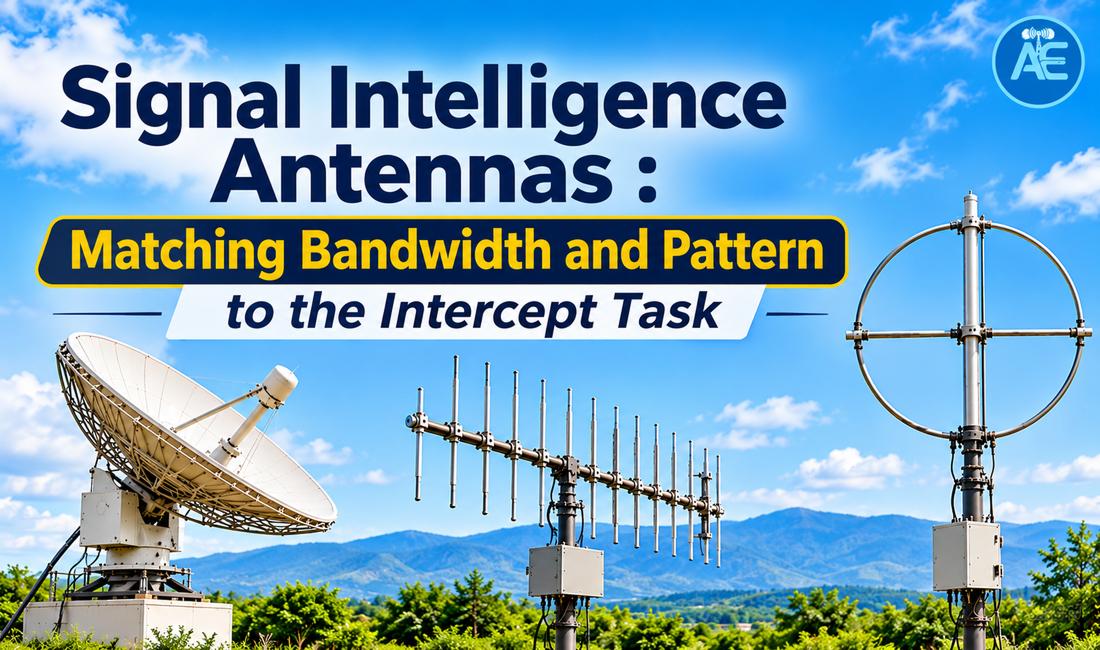
The choice of the right site depends on its purpose and the signals it needs to detect. A wideband antenna can span multiple frequencies a directional antenna can focus reception toward a particular area. Buyers should also test for gain polarization and cable loss. These factors determine the suitability for the monitoring task and site installation conditions.
Stations rarely play one band. They look at big areas and then focus down to single signals. That is why buyers shortlisting a signal intelligence antenna manufacturer in India need a clear selection process before asking for a quote. This post makes one.
What a SIGINT Site Needs From Its Antennas
An antenna converts radio waves into a tiny electric signal that can be examined by a receiver. A SIGINT antenna has to do that over the frequencies the site cares about. You need to watch signal bands. Then match the frequency coverage gain pattern, polarization, receiver compatibility and installation conditions to the list. Without it you’re guessing when you compare suppliers.
Omni Search vs Directional Analysis
The omnidirectional antenna receives in all directions in the horizontal plane. It's good to search if you don't know where a signal comes from. A directional antenna is aimed in one direction. That way it adds gain but rejects some unwanted signals coming from other directions . So it is good for analyzing a known source. Go with the price. It may miss signals elsewhere. Neither is always better and some sites use both.
Log Periodic and Discone Functions
Log-periodic antennas are directional and have wide band coverage so they are often used for wideband directional reception. Discone antennas are omni-directional and tend to have an even broader band at lower gain which is good for search. Actual coverage, gain and pattern will vary by model read the datasheet. Compare log periodic options in our Military Log Periodic Dipole Antenna category.
Broad Frequency Coverage And Why VSWR Still Counts On Receive
A broadband receiving antenna works over many frequencies without returning. The voltage standing wave ratio (VSWR) indicates how well the antenna is matched to its cable and receiver at each frequency. A bad match consumes energy. A bad match discards weak signal. But VSWR alone does not prove receiving performance. Also look at gain, pattern, polarization, cable loss and receiver characteristics.
Polarization Diversity
Signals are received in vertical horizontal or circular polarization. An antenna tuned to the wrong polarization will lose signal. Antennas with different polarizations can be used to catch more signals, but will not eliminate signal loss or interference. Match the polarization to the application.
Cable Loss & Preamplifiers
Long cables attenuate the received signal. One published example, from Urgent Communications, showed a tower-top preamplifier system cutting system noise from about 13 dB to about 4 dB. A preamplifier is not a panacea for every site. It can add overload and intermodulation when there is a lot of noise or strong signals nearby. Check noise figure, linearity and position in the whole receiver chain.
Location, Height and Interference Control
A good antenna can be ruined by poor siting. Keep it away from other structures that reflect or block signals. Beware of co-located transmitters that can overload receivers. Run cables away from noise sources, ground the install properly and plan for wind, rain and salt exposure.
Elevation and position of the antenna can also influence reception. Radio signals are blocked or reflected by buildings, trees and nearby metal surfaces, which makes them harder to pick up. Check the area and identify possible sources of interference prior to installation. Minimize signal loss by using appropriate cables and connectors and protect connections from moisture. Regular inspections can spot loose fittings, damaged cables and corrosion. These checks ensure that the system works reliably and help the monitoring team to keep the signal reception consistent over time.
How Antenna Experts Aid Signal Intelligence Programs
We have combined SIGINT, COMINT and ELINT antennas together to give buyers a chance to see what is available. Whatever supplier you look at, ask for datasheets and check frequency range, gain, pattern, polarization, connector, power handling where it applies, mounting and environmental ratings. Ask us for the numeric specs. We have a few of them on our category pages. You can find related requirements in our Electronic Warfare Antenna and Military Surveillance Antenna categories.
Why should you choose Antenna Experts?
Antenna Experts is a dedicated antenna manufacturer and supplier company in India. If you are comparing manufacturers of signal intelligence antennas in India, we keep our categories side by side, so you can compare options for your application. We suggest talking over technical details and checking datasheets before purchasing. Visit our Signal Intelligence Antenna category.
Our antenna categories also include electronic warfare, military surveillance and log periodic applications. Check the frequency range, gain, radiation pattern, polarization and mounting requirements before selecting the model. Our team can help you determine what product information you need to review. So it is easier to compare available options and discuss your site needs before deciding to purchase.
FAQ (Frequently Asked Questions)
1. What is a signal intelligence aerial?
It receives radio signals for monitoring and analysis, It is selected for its frequency coverage, pattern and polarization to match the signals a site has to monitor. It is part of a chain that includes receivers and cables.
2. Types of antennas used in SIGINT include:
Common types are discone and other omnidirectional antennas for search and log-periodic and other directional antennas for analysis. The best choice will depend on the band and the monitoring task.
3. What is the best omni or directional antenna for listening?
Neither is better in all situations. Omnidirectional antennas are good for searching in all directions. Directionality is achieved by fitting a known bearing to analyze and add gain. Select by task and site.
4. How broad a range of frequencies will a SIGINT antenna pick up?
Depending on the model. Some wideband antennas cover a very wide range, others a narrower band. Refer to the datasheet for exact range and check gain and VSWR across range.
About the Author
Kajal Singh is the marketing manager of Antenna Experts. Her work, aimed at technical buyers, covers antenna solutions, RF communications and their uses in defence and aviation.
See the category pages or contact Antenna Experts to discuss your needs.

 English
 Arabic
 French
 Spanish
 Portuguese
 Turkish
 Dutch
 Italiano
 Russian
 Romaian
 Portuguese (Brazil)
 Greek