


Oil Discharge Monitoring Equipment Industry Forecast to Reach USD 405.6 Million by 2035; China CAGR 5.5%, Germany 5.3%, USA 4.9%
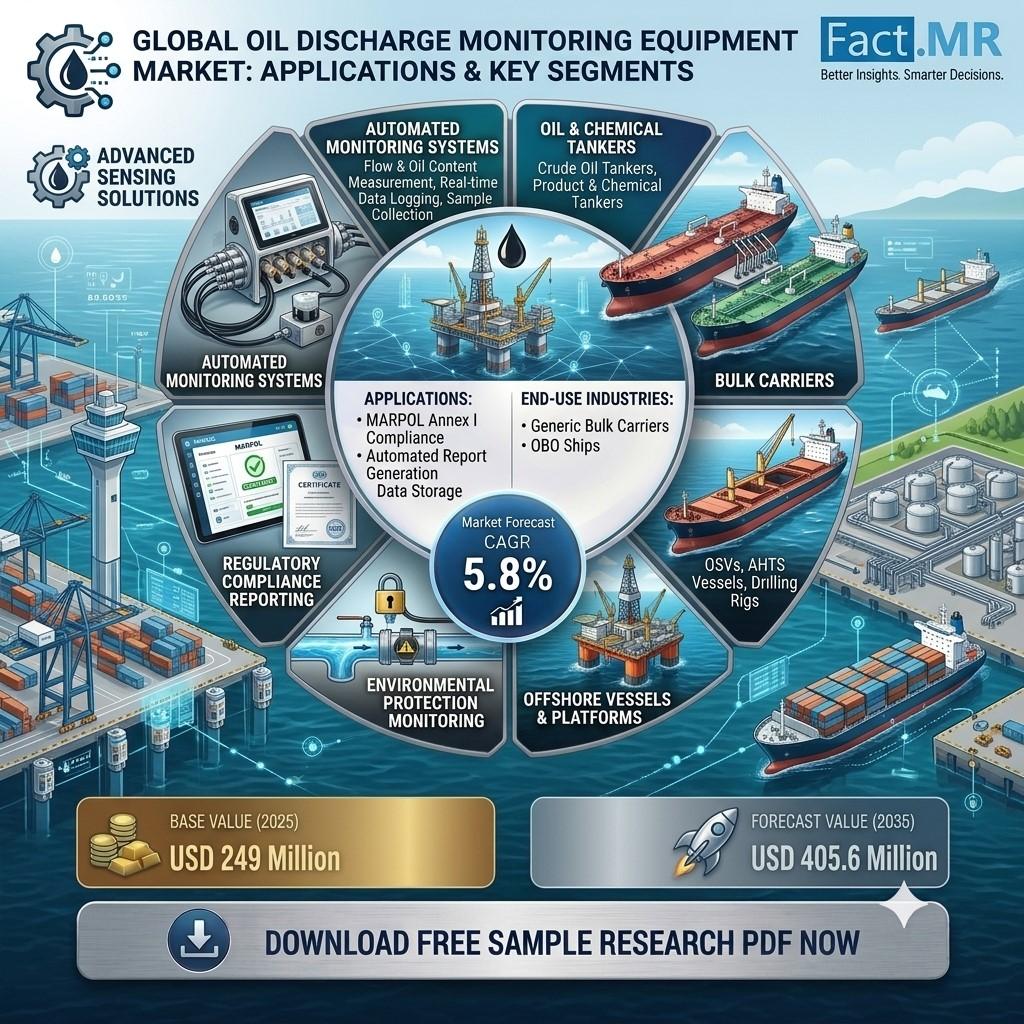
The global oil discharge monitoring equipment market is projected to expand from USD 249 million in 2025 to USD 405.6 million by 2035, registering a CAGR of 5.0% during the forecast period. According to Fact.MR, increasing enforcement of international maritime environmental regulations, growing transportation of crude oil and chemicals, and rising demand for accurate discharge monitoring systems are supporting market expansion. Ship operators are increasingly adopting automated monitoring technologies to maintain regulatory compliance, improve operational efficiency, and reduce the risk of marine pollution.
The expansion of international maritime trade is creating greater demand for reliable oil discharge monitoring equipment across commercial shipping fleets. Tankers, bulk carriers, offshore vessels, and chemical transport ships require monitoring systems capable of measuring discharge conditions and maintaining accurate operational records. Stricter port inspections and environmental compliance requirements are encouraging vessel operators to upgrade existing monitoring systems. Meanwhile, technological advancements in automated calibration, digital data logging, and remote diagnostics are improving monitoring accuracy and reducing dependence on manual intervention.
Get detailed market forecasts, competitive benchmarking, and pricing trends:
https://www.factmr.com/connectus/sample?flag=S&rep_id=3684
Oil & Chemical Tankers Retain Dominant Market Position
By vessel type, oil and chemical tankers are expected to account for 26% of the global oil discharge monitoring equipment market in 2025. Their leading position is supported by strict maritime pollution regulations and the need for continuous discharge monitoring during transportation operations. These vessels frequently transport petroleum products and chemicals, making accurate discharge measurement essential for preventing environmental contamination and maintaining compliance with international maritime standards.
Growing transportation volumes and increased regulatory scrutiny are encouraging tanker operators to invest in advanced monitoring equipment. Modern systems provide automated recording, sensor calibration, and digital audit trails, helping operators demonstrate compliance during port inspections. Integration with onboard vessel management platforms is also improving monitoring efficiency and operational visibility.
Bulk carriers represent another important segment, projected to grow at a 5.8% CAGR during the forecast period. Container ships are expected to register a slightly higher CAGR of 5.9%, supported by expanding maritime trade and growing adoption of environmental monitoring technologies. As shipping companies modernize their fleets, demand for reliable monitoring equipment is increasing across multiple vessel categories.
Automatic oil discharge monitoring systems are also gaining importance because they reduce manual monitoring requirements and improve operational consistency. These systems use advanced sensors, integrated data logging, and automated controls to continuously track discharge conditions. Their ability to support regulatory reporting and minimize human error is encouraging adoption across commercial shipping operations.
China, Germany, and the USA Show Strong Growth Potential
China is projected to record the highest growth among the countries highlighted in the report, with oil discharge monitoring equipment demand increasing at a 5.5% CAGR from 2025 to 2035. Expanding maritime trade, increasing vessel modernization, and stronger environmental enforcement are supporting market development. The China Maritime Safety Administration's emphasis on marine pollution prevention is encouraging ship operators to adopt digitally integrated monitoring systems. Major ports, including Shanghai, Shenzhen, and Tianjin, are witnessing increasing demand for automated discharge logging and remote diagnostic technologies.
Germany is expected to advance at a 5.3% CAGR during the same period. Its established maritime engineering industry, strict environmental standards, and compliance with European Union ship pollution regulations are supporting demand for advanced monitoring equipment. Ports such as Hamburg, Bremerhaven, and Wilhelmshaven are placing greater emphasis on accurate discharge reporting and reliable environmental monitoring. German maritime technology companies are also developing monitoring solutions featuring automatic calibration, intelligent diagnostics, and tamper-resistant reporting capabilities.
The United States is forecast to register a 4.9% CAGR through 2035. Enforcement of maritime pollution regulations by the U.S. Coast Guard and Environmental Protection Agency is encouraging vessel operators to strengthen discharge monitoring practices. Offshore exploration activities, coastal shipping operations, and fleet modernization initiatives are contributing to equipment demand. Maritime technology development in Texas, Louisiana, and California is also supporting innovation in automated monitoring, remote diagnostics, and digital compliance reporting.
The broader regional market is benefiting from increasing environmental awareness and maritime regulatory enforcement. Asia Pacific remains an important growth region because of expanding seaborne trade and vessel construction activity. European markets are emphasizing precision monitoring and regulatory compliance, while the Middle East is experiencing demand from its extensive oil tanker operations.
Competitive Landscape
Competition in the oil discharge monitoring equipment market includes established marine technology manufacturers, environmental monitoring specialists, and regional equipment suppliers. Key companies profiled by Fact.MR include MAN Energy Solutions, Sea and Sun Technology GmbH, SPM Instrument AB, Fuente International Co., JOWA, and Rivertrace. Other prominent participants identified in the report include Bestobell, Donjun, and Master Systems.
Manufacturers are focusing on improving sensor precision, automated calibration, digital discharge recording, and real-time monitoring capabilities. Product reliability, regulatory compatibility, maintenance requirements, and integration with existing vessel systems are becoming important purchasing considerations.
Competition is also increasing in the retrofit equipment segment as shipping companies upgrade older vessels to meet evolving maritime standards. Suppliers offering modular monitoring systems, calibration services, and technical support are positioned to address demand from fleet operators seeking cost-effective compliance solutions. Partnerships with shipbuilders and original equipment manufacturers are also supporting equipment integration during new vessel construction.
Technology and Regulatory Developments Shape the Market
The oil discharge monitoring equipment market is undergoing technological development as maritime operators adopt digital monitoring and automated compliance systems. Modern equipment increasingly incorporates real-time sensors, automatic calibration, integrated data logging, and remote diagnostic functions. These technologies improve monitoring accuracy while helping operators maintain reliable discharge records for regulatory inspections.
International maritime pollution requirements remain a major influence on equipment adoption. Increasing inspections by port authorities and stricter enforcement of environmental regulations are encouraging shipping companies to invest in monitoring systems capable of supporting transparent reporting and operational accountability.
In April 2025, Miros expanded its monitoring portfolio with the introduction of its Oil Spill Detection Monitoring application through Miros Cloud. The development reflects growing interest in cloud-enabled marine environmental monitoring and remote operational visibility.
However, high installation costs, technical integration challenges, and the need for specialized maintenance personnel remain barriers, particularly for operators managing older vessels. Differences in inspection procedures across international ports can also complicate equipment selection and compliance management.
As global maritime trade continues to expand and environmental regulations become more demanding, oil discharge monitoring equipment is expected to remain an important component of commercial vessel operations. Continued investment in automation, digital monitoring, and regulatory compliance technologies will support market development through 2035.
To View Top Reports
https://adamaamresearch.blogspot.com/2026/11/contrast-media-consumables-market.html
https://net-pals.com/blogs/72399/Expanding-Applications-of-Contrast-Enhanced-Imaging-Strengthen-Contrast-Media-Consumables
https://acmingle.com/blogs/37902/Increasing-Focus-on-Early-Disease-Detection-Boosts-Contrast-Media-Consumables
About Fact.MR
Fact.MR is a market research and consulting company providing market intelligence, competitive analysis, and forecasting across global industries. Its research supports businesses with data-driven insights into emerging markets, technology trends, competitive dynamics, regional opportunities, and changing demand patterns.

 English
 Arabic
 French
 Spanish
 Portuguese
 Deutsch
 Turkish
 Italiano
 Russian
 Romaian
 Portuguese (Brazil)
 Greek