


Acetone Derivatives Industry Forecast to Reach USD 19.9 Billion by 2032; China CAGR 6.2%, United States 5.1%
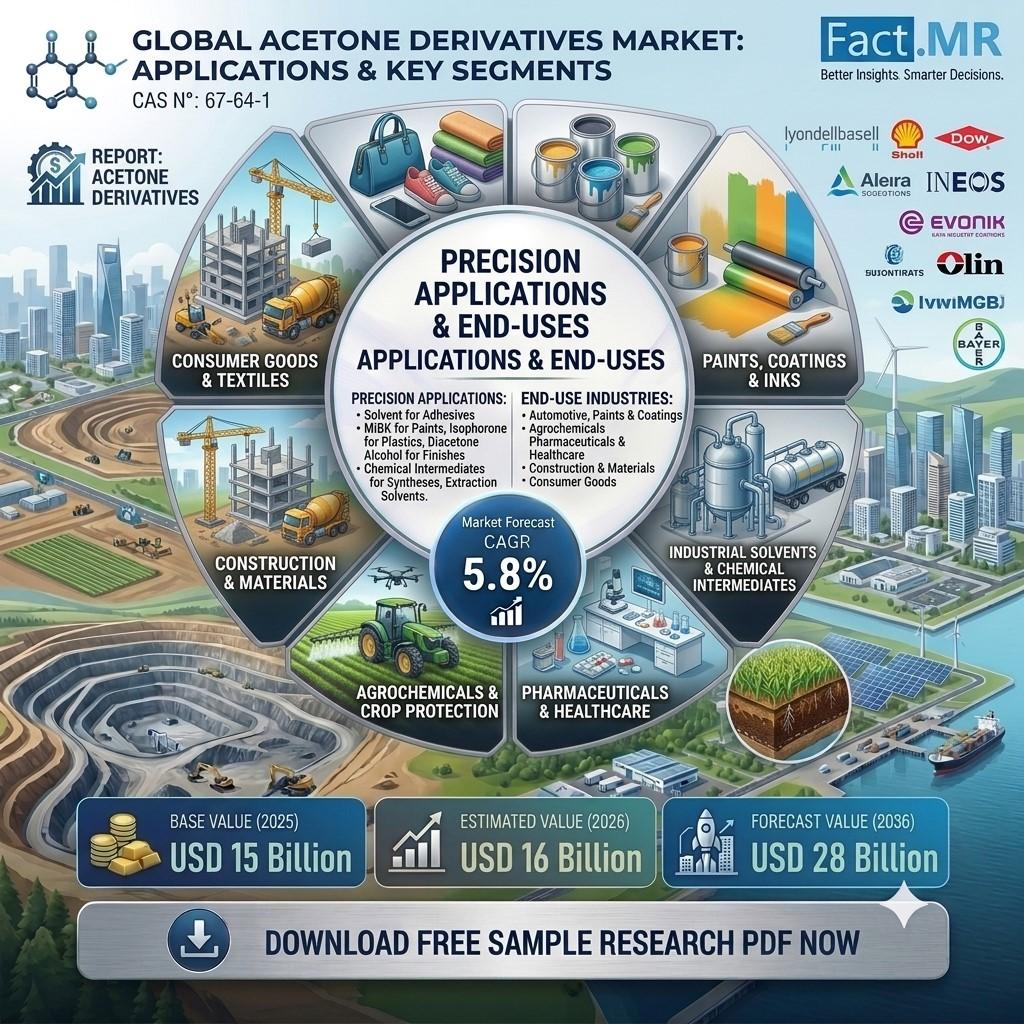
Demand for acetone derivatives is forecast to increase from USD 11.2 billion in 2022 to USD 19.9 billion by 2032, registering a 5.8% CAGR over the forecast period. Fact.MR attributes this expansion to increasing consumption of chemical solvents and intermediates across paints and coatings, construction, cosmetics, pharmaceuticals, and industrial manufacturing. The market is also benefiting from the growing use of acetone-based compounds in resin production and specialty chemical formulations.
Industrial development and expanding construction activities are creating additional requirements for acetone derivatives. These chemicals are widely used to dissolve resins, improve coating performance, and regulate viscosity in paints and varnishes. Manufacturers are also using acetone derivatives in adhesives and chemical intermediates that support production across several downstream industries. Growing demand for surface coatings in automotive manufacturing is contributing to market development, particularly as vehicle manufacturers seek materials that provide environmental protection and durable finishes.
Get detailed market forecasts, competitive benchmarking, and pricing trends:
https://www.factmr.com/connectus/sample?flag=S&rep_id=1439
Solvents Retain Dominant Position in Acetone Derivatives Market
By application, solvents represent the leading segment, accounting for approximately 51.2% of the acetone derivatives market. Their dominant position is supported by extensive utilization in paints, coatings, adhesives, and chemical processing. Acetone derivatives such as methyl isobutyl ketone (MIBK), diacetone alcohol (DAA), and isophorone are valued for their solvent properties and compatibility with industrial formulations.
The solvent segment is expected to expand at a 4.5% CAGR through 2032, reaching approximately 51.7% market share by the end of the forecast period. Demand is supported by industrial applications requiring effective resin dissolution and controlled viscosity. Paint manufacturers use these compounds to improve application properties and achieve the required coating characteristics.
Paints and coatings represent another major area of consumption, accounting for approximately 33% of market revenue. Increasing housing construction and infrastructure investment are supporting the use of protective and decorative coatings. Automotive manufacturers also require specialized coating formulations that provide resistance to environmental exposure while maintaining surface appearance.
Beyond conventional coatings, acetone derivatives are used in chemical formulations associated with pharmaceuticals and personal care products. Their versatility as solvents and intermediates allows manufacturers to address different processing requirements, supporting demand across industrial and consumer applications.
China and the United States Support Global Market Expansion
China is projected to register a 6.2% CAGR through 2032, supported by increasing consumption of acetone derivatives in paints, coatings, and resin manufacturing. Expanding infrastructure development and construction activity are strengthening demand for industrial coating materials. Acetone derivatives are used in formulations that provide surface protection and decorative finishes across construction and automotive applications.
East Asia accounts for approximately 31.7% of the global acetone derivatives market, with China holding the leading regional position. The country's manufacturing activities and requirements for resin-based coating formulations are important contributors to consumption. Continued investment in industrial infrastructure is expected to support demand for chemical solvents and intermediates.
The United States is forecast to expand at a 5.1% CAGR from 2022 to 2032. Increasing consumption of cosmetics and personal care products is a significant demand driver. Acetone derivatives are used in hair care and skin care formulations, while higher consumer spending on cosmetic products is supporting the market. The United States accounts for approximately 87% of North American acetone derivatives demand.
Germany and other European markets are included in Fact.MR's regional analysis. European demand is associated with industrial applications involving chemicals, coatings, and specialty materials. However, the publicly available report does not specify a separate CAGR for Germany, preventing a verified numerical comparison with China and the United States.
The Middle East and Africa region is projected to grow at approximately 7.5% CAGR during the forecast period. The regional outlook indicates additional opportunities for manufacturers seeking to expand beyond established markets.
Competitive Landscape
Competition in the acetone derivatives market includes established chemical manufacturers with diversified production capabilities and international distribution networks. Key companies profiled by Fact.MR include Kumho P&B Chemical, Mitsubishi Chemicals, Celanese, INEOS Phenol, LG Chem, Covestro, Lotte Chemical, SABIC, Arkema, Mitsui Chemicals, Solvay, and LyondellBasell.
The five leading companies collectively account for approximately 38.7% of the market. Manufacturers are focusing on product customization, sustainable production methods, and strategic partnerships to strengthen their competitive positions.
In March 2021, Lotte Chemical announced plans to adopt Honeywell UOP Q-max, EVONIK MSHP, and Phenol 3G technologies for phenol and acetone derivative production. In June 2022, INEOS Phenol introduced a product line associated with renewable resources, reflecting growing interest in alternatives to conventional fossil-based chemical feedstocks.
Renewable Energy Applications and Environmental Regulations Shape the Market
The renewable energy sector is creating additional opportunities for acetone derivative manufacturers. These chemicals serve as intermediates in the production of polycarbonate and epoxy resins used in wind turbine rotor blades. Polymethyl methacrylate (PMMA) also offers applications in the solar industry because of its shatter-resistant characteristics.
Mining represents another potential growth area. Methyl isobutyl carbinol (MIBC), produced from methyl isobutyl ketone, is used as a frothing agent in mineral flotation processes. Its role in separating valuable minerals creates opportunities for acetone derivative suppliers serving mineral processing operations.
Environmental regulations remain a significant consideration for manufacturers. Increasing scrutiny of chemical production and growing interest in sustainable alternatives could influence production methods, investment decisions, and material selection.
As demand from construction, automotive coatings, cosmetics, and industrial chemicals continues to develop, manufacturers are expected to prioritize production efficiency and application-specific formulations. Fact.MR's research provides further insights into market forecasts, regional demand, product segmentation, and competitive developments through 2032.
Top Reports:
https://adamaamresearch.blogspot.com/2026/11/global-automotive-vibration-absorber.html
https://net-pals.com/blogs/72425/Automotive-Vibration-Absorber-Market-Targets-USD-39-Billion-by-2035
https://acmingle.com/blogs/37907/Automotive-Vibration-Absorber-Market-Expansion-Supported-by-Automotive-Innovation-Targeting
About Fact.MR
Fact.MR is a market research and consulting company providing market intelligence, competitive analysis, and forecasting across global industries. Its research supports businesses with data-driven insights into emerging markets, technology trends, competitive dynamics, regional opportunities, and changing demand patterns.

 English
 Arabic
 French
 Spanish
 Portuguese
 Deutsch
 Turkish
 Dutch
 Russian
 Romaian
 Portuguese (Brazil)
 Greek